Pastoral Epistles Titus
Rev Chris Knepp

Pastoral Epistles Titus
Links
<< Home >> << Pastoral Epistles Menu >>
Pastoral Epistles Titus - the Text
The pastoral epistles
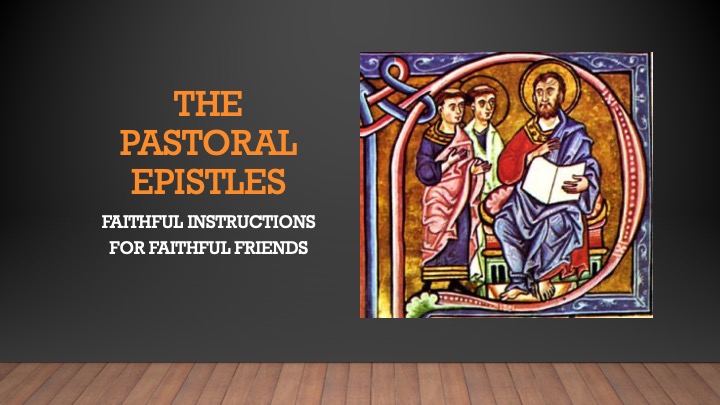
Faithful Instructions for Faithful Friends
The Pastoral Epistles
The collective witness of the New Testament to Paul includes a variety of images: Paul the prosecutor, Paul the convert, Paul the evangelist, Paul the pastor, Paul the defender of the gospel, Paul the letter-writer, and Paul the theologian. What we have in 1-2 Timothy and Titus is best described as Paul the mentor. Even though this trio of letters has, since the eighteenth century, gone under the collective title ‘The Pastoral Epistles’, which is appropriate in its way, they might more fittingly be named ‘The Mentoring Epistles’, or as Luke Timothy Johnson calls them, ‘Letters to Paul’s Delegates.’ N.T. Wright and Michael F. Bird, The New Testament In Its World
The pastoral epistles
Where do they fit in Paul’s career?
• Likely after A.D. 62
• Almost impossible to fit the into the narrative of Acts
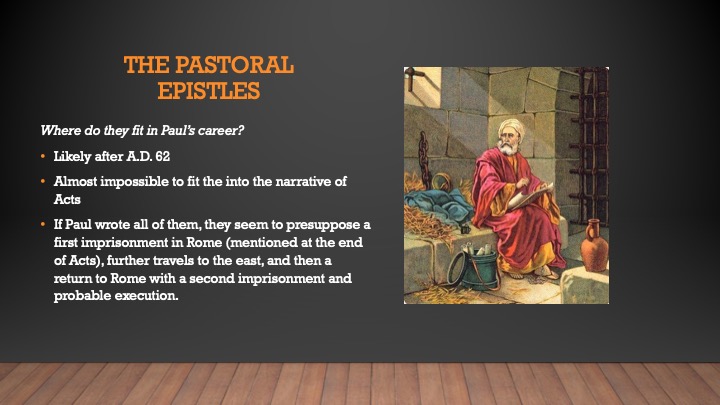
• If Paul wrote all of them, they seem to presuppose a first imprisonment in Rome (mentioned at the end of Acts), further travels to the east, and then a return to Rome with a second imprisonment and probable execution.
The pastoral epistles: author
1 Timothy 1:1 – “Paul, an apostle of Christ Jesus by command of God our Savior and Christ Jesus our hope.”
2 Timothy 1:1 – “Paul, an apostle of Christ Jesus by the will of God according to the promise of the life that is in Christ Jesus.”
Titus 1:1 – “Paul, a servant of God and an apostle of Jesus Christ, for the sake of the faith of God’s elect and their knowledge of the truth, which accords with godliness, in hope of eternal life, which God, who never lies, promised before the ages began and at the proper time manifested in his word through the preaching with which I have been entrusted by the command of God our Savior.”
The pastoral epistles: author?
Recipient
1 Timothy 1:1 – “Paul, an apostle of Christ Jesus by command of God our Savior and Christ Jesus our hope.”
2 Timothy 1:1 – “Paul, an apostle of Christ Jesus by the will of God according to the promise of the life that is in Christ Jesus.”
Titus 1:1 – “Paul, a servant of God and an apostle of Jesus Christ, for the sake of the faith of God’s elect and their knowledge of the truth, which accords with godliness, in hope of eternal life, which God, who never lies, promised before the ages began and at the proper time manifested in his word through the preaching with which I have been entrusted by the command of God our Savior.”
The pastoral epistles: author?
• That Paul was the author of the pastorals was universally affirmed until the 19th century. Many today consider them pseudepigraphical, differing from Paul’s other letters in style, vocabulary, theology, and church order.
• But early church excluded from the canon any works they thought to be pseudonymous. Though this practice was common in ancient world, it was less common in personal letters and was rejected by early church.
titus: recipient
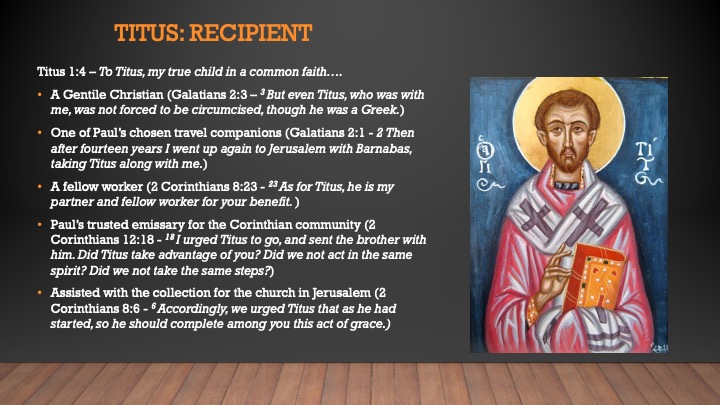
Titus 1:4 – To Titus, my true child in a common faith….
• A Gentile Christian (Galatians 2:3 – 3 But even Titus, who was with me, was not forced to be circumcised, though he was a Greek.)
• One of Paul’s chosen travel companions (Galatians 2:1 - 2 Then after fourteen years I went up again to Jerusalem with Barnabas, taking Titus along with me.)
• A fellow worker (2 Corinthians 8:23 - 23 As for Titus, he is my partner and fellow worker for your benefit. )
• Paul’s trusted emissary for the Corinthian community (2 Corinthians 12:18 - 18 I urged Titus to go, and sent the brother with him. Did Titus take advantage of you? Did we not act in the same spirit? Did we not take the same steps?)
• Assisted with the collection for the church in Jerusalem (2 Corinthians 8:6 - 6 Accordingly, we urged Titus that as he had started, so he should complete among you this act of grace.)
TITUS: date
“The traditional understanding has been that Titus, like 1 Timothy, was written in the time between Paul’s first imprisonment (Acts 28) and a second imprisonment that led to his death…. In this case, Titus would have been written in the mid-60s, around the same time as 1 Timothy.” ESV Study Bible
Titus: Purpose and Occasion
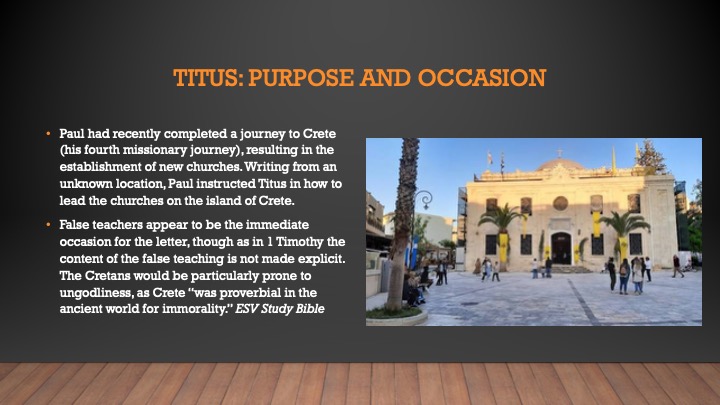
• Paul had recently completed a journey to Crete (his fourth missionary journey), resulting in the establishment of new churches. Writing from an unknown location, Paul instructed Titus in how to lead the churches on the island of Crete.
• False teachers appear to be the immediate occasion for the letter, though as in 1 Timothy the content of the false teaching is not made explicit. The Cretans would be particularly prone to ungodliness, as Crete “was proverbial in the ancient world for immorality.” ESV Study Bible
titus: structure
I. The need for proper leadership (1:5-9)
II. False teachers (1:10-16)
III. Christian living in contrast to the false teachers (2:1-3:8)
IV. False teachers (again) (3:9-11)
V. Closing exhortation (3:12-15)
Titus 1:5-9: The need for
proper leadership
5 This is why I left you in Crete, so that you might put what remained into order, and appoint elders in every town as I directed you— 6 if anyone is above reproach, the husband of one wife, and his children are believers and not open to the charge of debauchery or insubordination. 7 For an overseer, as God's steward, must be above reproach. He must not be arrogant or quick-tempered or a drunkard or violent or greedy for gain, 8 but hospitable, a lover of good, self-controlled, upright, holy, and disciplined. 9 He must hold firm to the trustworthy word as taught, so that he may be able to give instruction in sound doctrine and also to rebuke those who contradict it.
Titus 1:10-16: false teachers
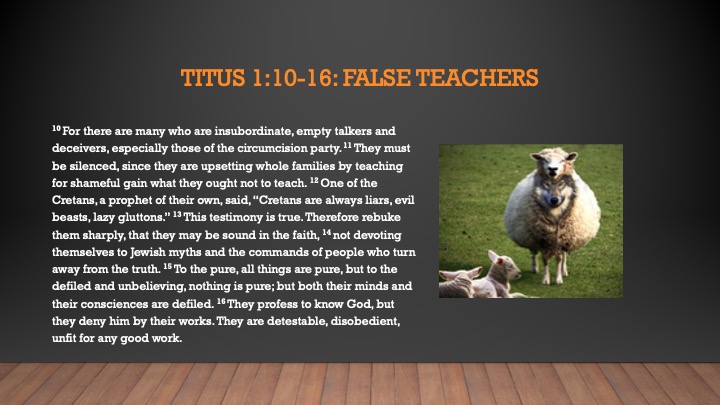
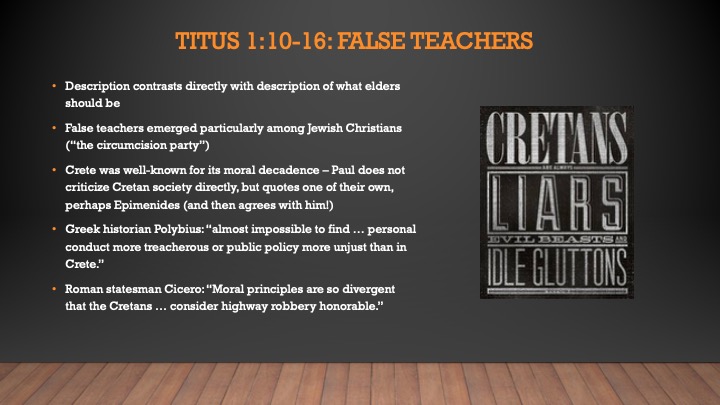
10 For there are many who are insubordinate, empty talkers and deceivers, especially those of the circumcision party. 11 They must be silenced, since they are upsetting whole families by teaching for shameful gain what they ought not to teach. 12 One of the Cretans, a prophet of their own, said, “Cretans are always liars, evil beasts, lazy gluttons.” 13 This testimony is true. Therefore rebuke them sharply, that they may be sound in the faith, 14 not devoting themselves to Jewish myths and the commands of people who turn away from the truth. 15 To the pure, all things are pure, but to the defiled and unbelieving, nothing is pure; but both their minds and their consciences are defiled. 16 They profess to know God, but they deny him by their works. They are detestable, disobedient, unfit for any good work.
Titus 1:10-16: false teachers
• Description contrasts directly with description of what elders should be
• False teachers emerged particularly among Jewish Christians (“the circumcision party”)
• Crete was well-known for its moral decadence – Paul does not criticize Cretan society directly, but quotes one of their own, perhaps Epimenides (and then agrees with him!)
• Greek historian Polybius: “almost impossible to find … personal conduct more treacherous or public policy more unjust than in Crete.”
• Roman statesman Cicero: “Moral principles are so divergent that the Cretans … consider highway robbery honorable.”
Titus 2:1-3:8: Christian living in contrast to the false teachers – proper living by age and gender groups
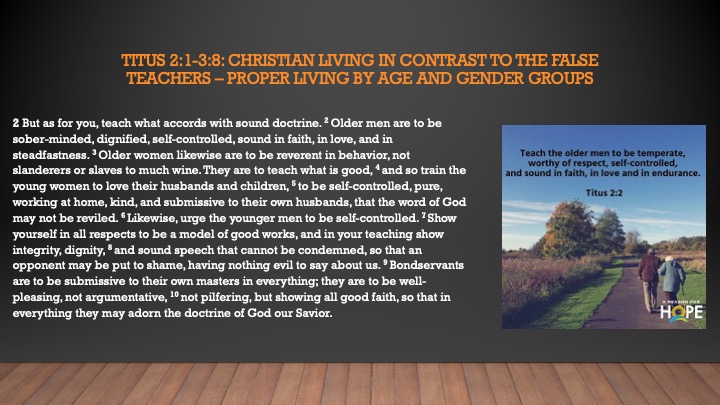
2 But as for you, teach what accords with sound doctrine. 2 Older men are to be sober-minded, dignified, self-controlled, sound in faith, in love, and in steadfastness. 3 Older women likewise are to be reverent in behavior, not slanderers or slaves to much wine. They are to teach what is good, 4 and so train the young women to love their husbands and children, 5 to be self-controlled, pure, working at home, kind, and submissive to their own husbands, that the word of God may not be reviled. 6 Likewise, urge the younger men to be self-controlled. 7 Show yourself in all respects to be a model of good works, and in your teaching show integrity, dignity, 8 and sound speech that cannot be condemned, so that an opponent may be put to shame, having nothing evil to say about us. 9 Bondservants are to be submissive to their own masters in everything; they are to be well-pleasing, not argumentative, 10 not pilfering, but showing all good faith, so that in everything they may adorn the doctrine of God our Savior.
Titus 2:1-3:8: Christian living in contrast to the false teachers – gospel basis and command
11 For the grace of God has appeared, bringing salvation for all people, 12 training us to renounce ungodliness and worldly passions, and to live self-controlled, upright, and godly lives in the present age, 13 waiting for our blessed hope, the appearing of the glory of our great God and Savior Jesus Christ, 14 who gave himself for us to redeem us from all lawlessness and to purify for himself a people for his own possession who are zealous for good works.
15 Declare these things; exhort and rebuke with all authority. Let no one disregard you.
Titus 2:1-3:8: Christian living in contrast to the false teachers – gospel basis and command
11 For the grace of God has appeared, bringing salvation for all people, 12 training us to renounce ungodliness and worldly passions, and to live self-controlled, upright, and godly lives in the present age, 13 waiting for our blessed hope, the appearing of the glory of our great God and Savior Jesus Christ, 14 who gave himself for us to redeem us from all lawlessness and to purify for himself a people for his own possession who are zealous for good works.
15 Declare these things; exhort and rebuke with all authority. Let no one disregard you.
Titus 2:1-3:8: Christian living in contrast to the false teachers – proper
living, particularly with respect to outsiders;
gospel basis and summary command
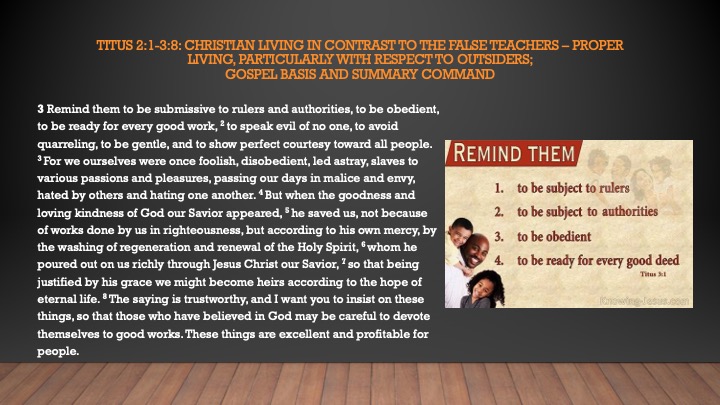
3 Remind them to be submissive to rulers and authorities, to be obedient, to be ready for every good work, 2 to speak evil of no one, to avoid quarreling, to be gentle, and to show perfect courtesy toward all people. 3 For we ourselves were once foolish, disobedient, led astray, slaves to various passions and pleasures, passing our days in malice and envy, hated by others and hating one another. 4 But when the goodness and loving kindness of God our Savior appeared, 5 he saved us, not because of works done by us in righteousness, but according to his own mercy, by the washing of regeneration and renewal of the Holy Spirit, 6 whom he poured out on us richly through Jesus Christ our Savior, 7 so that being justified by his grace we might become heirs according to the hope of eternal life. 8 The saying is trustworthy, and I want you to insist on these things, so that those who have believed in God may be careful to devote themselves to good works. These things are excellent and profitable for people.
Titus 3:9-11: false teachers (again)
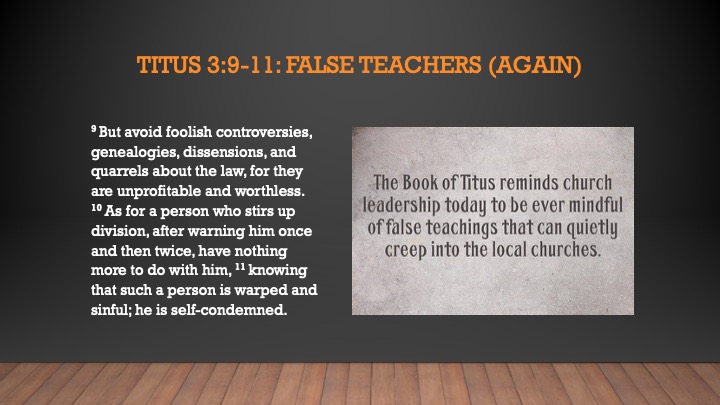
• 9 But avoid foolish controversies, genealogies, dissensions, and quarrels about the law, for they are unprofitable and worthless. 10 As for a phaveerson who stirs up division, after warning him once and then twice, nothing more to do with him, 11 knowing that such a person is warped and sinful; he is self-condemned.
Titus 3:12-15: closing exhortation
12 When I send Artemas or Tychicus to you, do your best to come to me at Nicopolis, for I have decided to spend the winter there. 13 Do your best to speed Zenas the lawyer and Apollos on their way; see that they lack nothing. 14 And let our people learn to devote themselves to good works, so as to help cases of urgent need, and not be unfruitful.
15 All who are with me send greetings to you. Greet those who love us in the faith.
Grace be with you all.