Amos - Israel's Judgement
Chris Knepp
Amos - Israel's Judgement
Links
<< Home >> << Minor Prophets - Major Issues Menu >>
Amos - Israel's Judgement - the Text
Amos – the Text
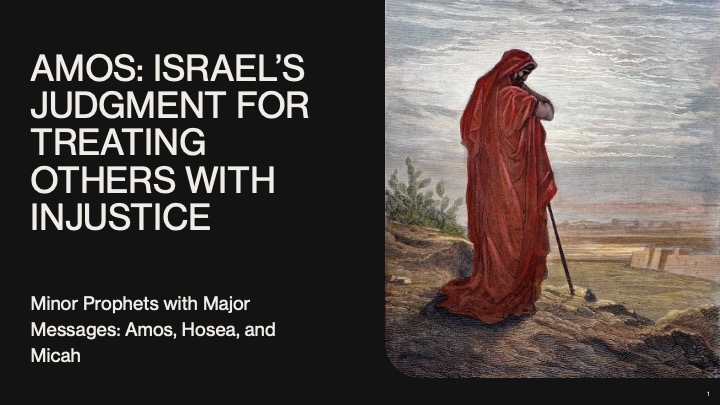
AMOS: Israel’s Judgment for treating others with injustice
Minor Prophets with Major Messages: Amos, Hosea, and Micah
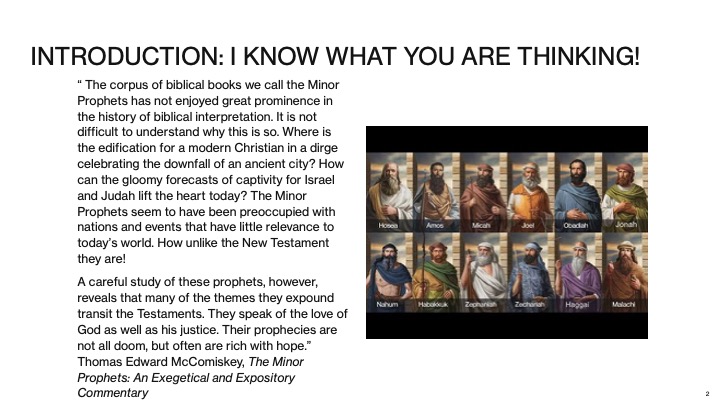
Introduction: I know what you are thinking!
“ The corpus of biblical books we call the Minor Prophets has not enjoyed great prominence in the history of biblical interpretation. It is not difficult to understand why this is so. Where is the edification for a modern Christian in a dirge celebrating the downfall of an ancient city? How can the gloomy forecasts of captivity for Israel and Judah lift the heart today? The Minor Prophets seem to have been preoccupied with nations and events that have little relevance to today’s world. How unlike the New Testament they are!
A careful study of these prophets, however, reveals that many of the themes they expound transit the Testaments. They speak of the love of God as well as his justice. Their prophecies are not all doom, but often are rich with hope.” Thomas Edward McComiskey, The Minor Prophets: An Exegetical and Expository Commentary
Forth-telling and Foretelling
“Many Christians think of the prophets primarily in terms of foretelling the future. They read them looking for predictions about the coming of Jesus, the new covenant age and the end of the world. However, less than 5% of OT prophecy describes the new covenant age, less than 2% is ‘messianic’ (even broadly speaking), and less than 1% concerns the end of the world. Most OT prophecy can be described as ‘forth-telling’, declaring to the hearers God’s perspective on them and their situation, usually in terms of exposing their sinful state.” Ernest Lucas, “Prophets,” IVP Introduction to the Bible
The Role of the Prophet
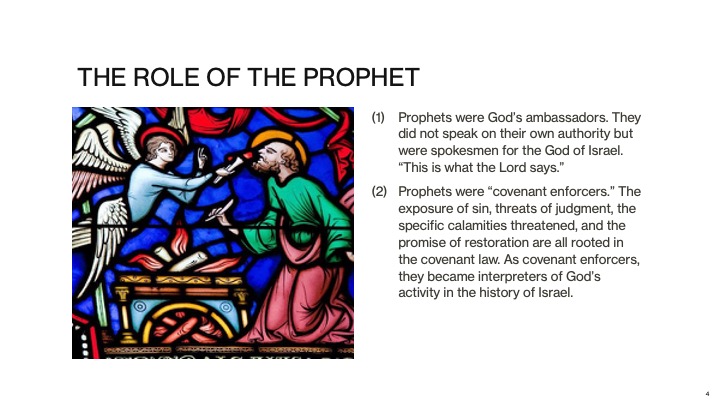
(1) Prophets were God’s ambassadors. They did not speak on their own authority but were spokesmen for the God of Israel. “This is what the Lord says.”
(2) Prophets were “covenant enforcers.” The exposure of sin, threats of judgment, the specific calamities threatened, and the promise of restoration are all rooted in the covenant law. As covenant enforcers, they became interpreters of God’s activity in the history of Israel.
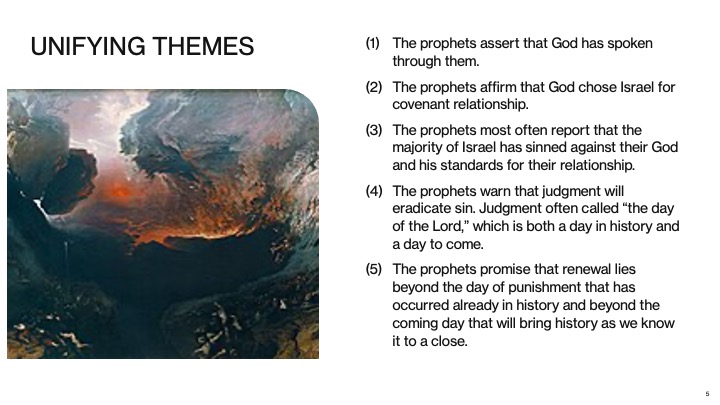
Unifying Themes
(1) The prophets assert that God has spoken through them.
(2) The prophets affirm that God chose Israel for covenant relationship.
(3) The prophets most often report that the majority of Israel has sinned against their God and his standards for their relationship.
(4) The prophets warn that judgment will eradicate sin. Judgment often called “the day of the Lord,” which is both a day in history and a day to come.
(5) The prophets promise that renewal lies beyond the day of punishment that has occurred already in history and beyond the coming day that will bring history as we know it to a close.
Historical context
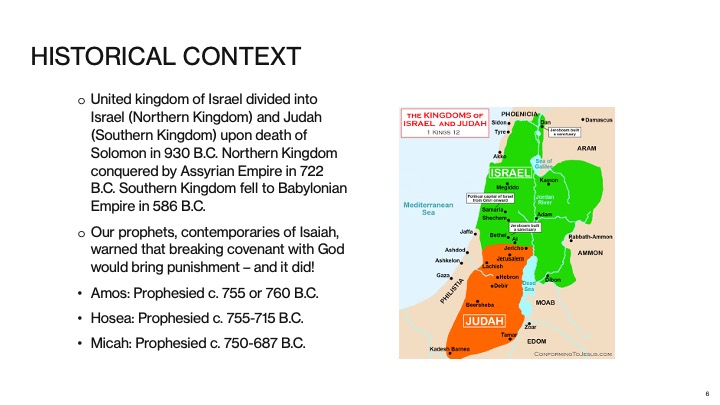
- United kingdom of Israel divided into Israel (Northern Kingdom) and Judah (Southern Kingdom) upon death of Solomon in 930 B.C. Northern Kingdom conquered by Assyrian Empire in 722 B.C. Southern Kingdom fell to Babylonian Empire in 586 B.C.
- Our prophets, contemporaries of Isaiah, warned that breaking covenant with God would bring punishment – and it did!
• Amos: Prophesied c. 755 or 760 B.C.
• Hosea: Prophesied c. 755-715 B.C.
• Micah: Prophesied c. 750-687 B.C.
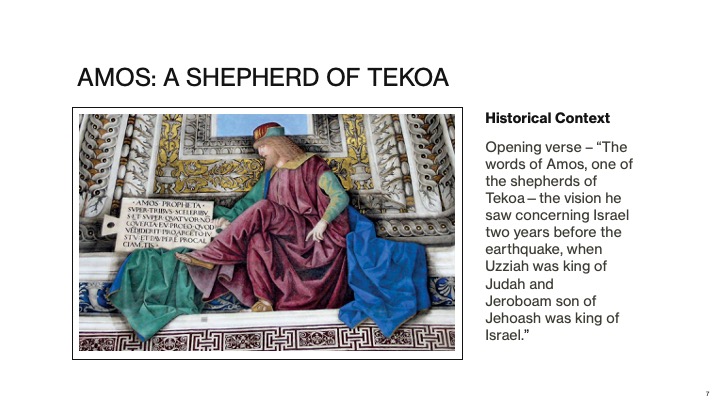
Amos: A Shepherd of Tekoa
Historical Context
Opening verse – “The words of Amos, one of the shepherds of Tekoa—the vision he saw concerning Israel two years before the earthquake, when Uzziah was king of Judah and Jeroboam son of Jehoash was king of Israel.”
Amos: A Shepherd of Tekoa
Historical Context
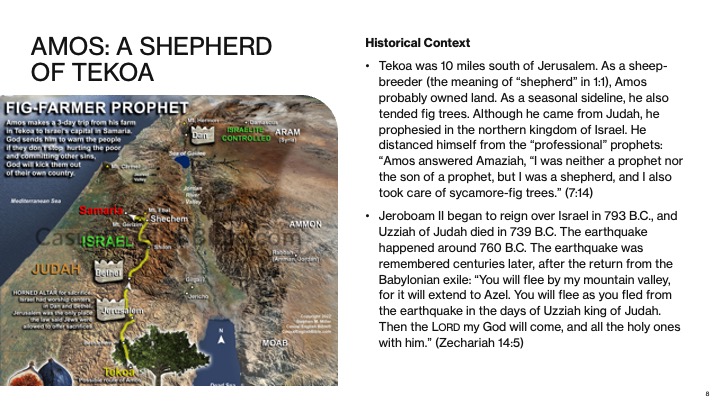
• Tekoa was 10 miles south of Jerusalem. As a sheep-breeder (the meaning of “shepherd” in 1:1), Amos probably owned land. As a seasonal sideline, he also tended fig trees. Although he came from Judah, he prophesied in the northern kingdom of Israel. He distanced himself from the “professional” prophets: “Amos answered Amaziah, “I was neither a prophet nor the son of a prophet, but I was a shepherd, and I also took care of sycamore-fig trees.” (7:14)
• Jeroboam II began to reign over Israel in 793 B.C., and Uzziah of Judah died in 739 B.C. The earthquake happened around 760 B.C. The earthquake was remembered centuries later, after the return from the Babylonian exile: “You will flee by my mountain valley, for it will extend to Azel. You will flee as you fled from the earthquake in the days of Uzziah king of Judah. Then the Lord my God will come, and all the holy ones with him.” (Zechariah 14:5)
Amos: A Shepherd of Tekoa
Historical Context
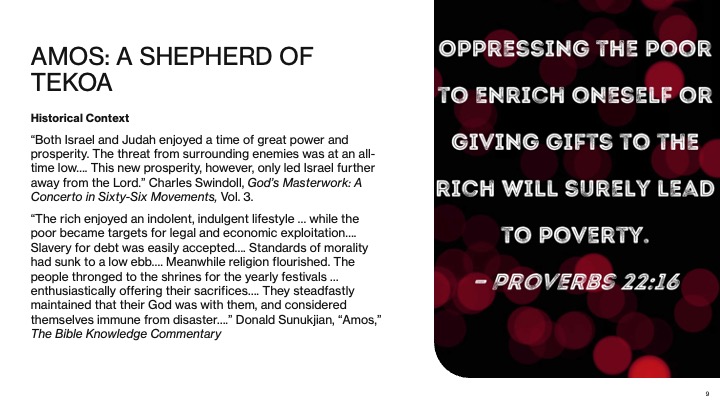
“Both Israel and Judah enjoyed a time of great power and prosperity. The threat from surrounding enemies was at an all-time low…. This new prosperity, however, only led Israel further away from the Lord.” Charles Swindoll, God’s Masterwork: A Concerto in Sixty-Six Movements, Vol. 3.
“The rich enjoyed an indolent, indulgent lifestyle … while the poor became targets for legal and economic exploitation…. Slavery for debt was easily accepted…. Standards of morality had sunk to a low ebb…. Meanwhile religion flourished. The people thronged to the shrines for the yearly festivals … enthusiastically offering their sacrifices…. They steadfastly maintained that their God was with them, and considered themselves immune from disaster….” Donald Sunukjian, “Amos,” The Bible Knowledge Commentary
Amos: A Shepherd of Tekoa
Structure:
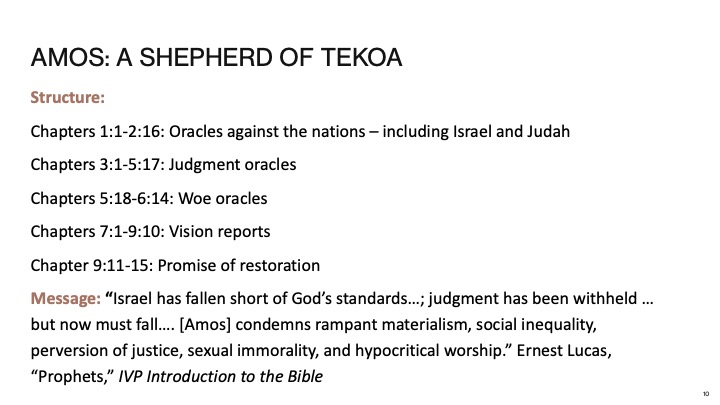
Chapters 1:1-2:16: Oracles against the nations – including Israel and Judah
Chapters 3:1-5:17: Judgment oracles
Chapters 5:18-6:14: Woe oracles
Chapters 7:1-9:10: Vision reports
Chapter 9:11-15: Promise of restoration
Message: “Israel has fallen short of God’s standards…; judgment has been withheld … but now must fall…. [Amos] condemns rampant materialism, social inequality, perversion of justice, sexual immorality, and hypocritical worship.” Ernest Lucas, “Prophets,” IVP Introduction to the Bible
Amos 1:1-2:16 (Oracles Against the Nations – including Israel and Judah)
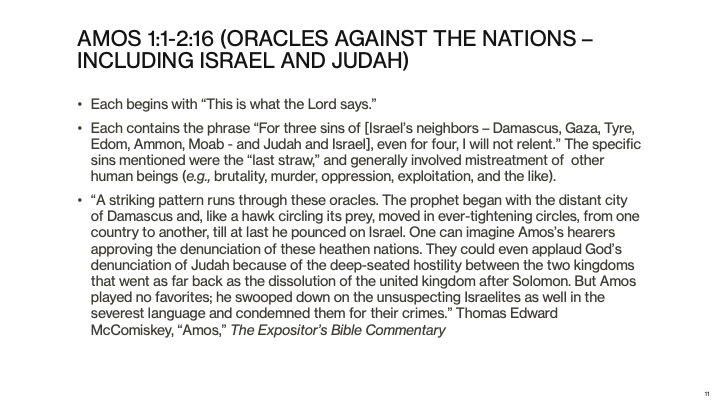
• Each begins with “This is what the Lord says.”
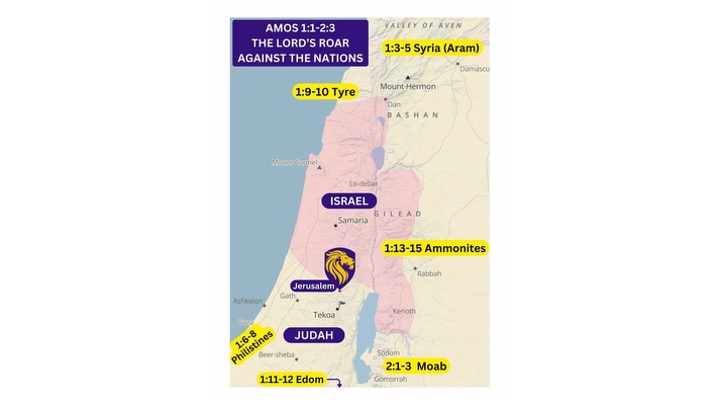
• Each contains the phrase “For three sins of [Israel’s neighbors – Damascus, Gaza, Tyre, Edom, Ammon, Moab - and Judah and Israel], even for four, I will not relent.” The specific sins mentioned were the “last straw,” and generally involved mistreatment of other human beings (e.g., brutality, murder, oppression, exploitation, and the like).
• “A striking pattern runs through these oracles. The prophet began with the distant city of Damascus and, like a hawk circling its prey, moved in ever-tightening circles, from one country to another, till at last he pounced on Israel. One can imagine Amos’s hearers approving the denunciation of these heathen nations. They could even applaud God’s denunciation of Judah because of the deep-seated hostility between the two kingdoms that went as far back as the dissolution of the united kingdom after Solomon. But Amos played no favorites; he swooped down on the unsuspecting Israelites as well in the severest language and condemned them for their crimes.” Thomas Edward McComiskey, “Amos,” The Expositor’s Bible Commentary
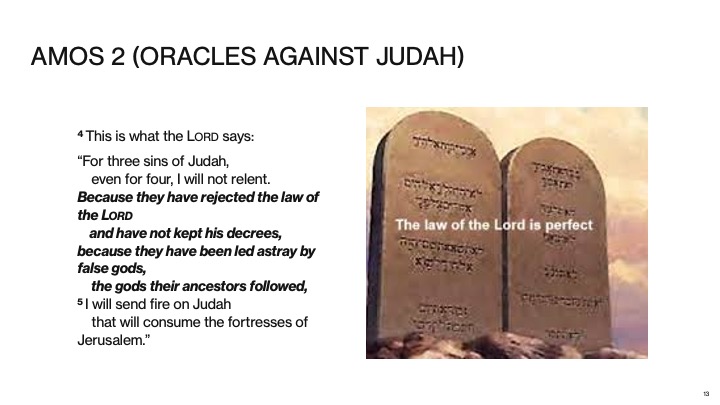
Amos 2 (Oracles Against Judah)
4 This is what the Lord says:
“For three sins of Judah,
even for four, I will not relent.
Because they have rejected the law of the Lord
and have not kept his decrees,
because they have been led astray by false gods,
the gods their ancestors followed,
5 I will send fire on Judah
that will consume the fortresses of Jerusalem.”
Crimes
6 This is what the Lord says:
“For three sins of Israel,
even for four, I will not relent.
They sell the innocent for silver,
and the needy for a pair of sandals.
7 They trample on the heads of the poor
as on the dust of the ground
and deny justice to the oppressed.
Father and son use the same girl
and so profane my holy name.
8 They lie down beside every altar
on garments taken in pledge.
In the house of their god
they drink wine taken as fines….
Judgement
13 “Now then, I will crush you
as a cart crushes when loaded with grain.
14 The swift will not escape,
the strong will not muster their strength,
and the warrior will not save his life.
15 The archer will not stand his ground,
the fleet-footed soldier will not get away,
and the horseman will not save his life.
16 Even the bravest warriors
will flee naked on that day,”
declares the Lord.
Amos 3:1-5:17 (Judgment oracles)
3 Hear this word, people of Israel, the word the Lord has spoken against you - against the whole family I brought up out of Egypt:
2 “You only have I chosen
of all the families of the earth;
therefore I will punish you
for all your sins.”
• “Heathen nations have no special exemption from God’s judgments, and Israel has no special position. The sermon that begins in chapter 3 picks up at that point, showing that not only has Israel no special position on the basis of which she can sin with impunity, but she actually has a higher obligation for holiness because of God’s dealings with her and will therefore be judged more severely for her rebellion against God’s law….” James Montgomery Boice, The Minor Prophets
Amos 3:1-5:17 (Judgment oracles)
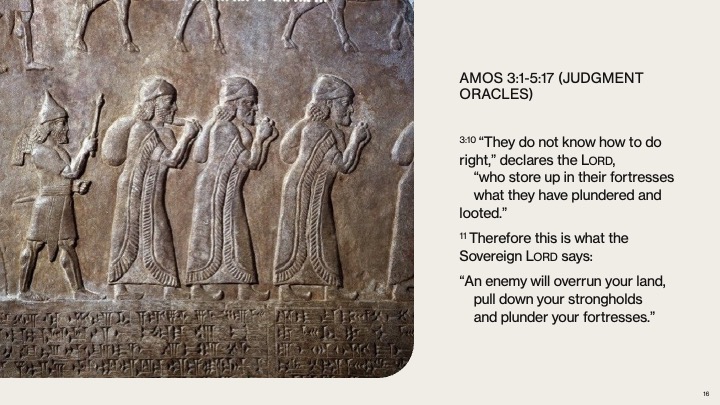
3:10 “They do not know how to do right,”
declares the Lord,
“who store up in their fortresses
what they have plundered and looted.”
11 Therefore this is what the Sovereign Lord says:
“An enemy will overrun your land,
pull down your strongholds
and plunder your fortresses.”
Amos 3:1-5:17 (Judgment oracles)
4 Hear this word, you cows of Bashan on
Mount Samaria,
you women who oppress the poor and crush the needy
and say to your husbands, “Bring us some drinks!”
2 The Sovereign Lord has sworn by his
holiness:
“The time will surely come
when you will be taken away with hooks,
the last of you with fishhooks.
5 14 Seek good, not evil,
that you may live.
Then the Lord God Almighty will be with you,
just as you say he is.
15 Hate evil, love good;
maintain justice in the courts.
Perhaps the Lord God Almighty will have mercy
on the remnant of Joseph.
Amos 5:18-6:14 (Woe oracles)
5:21 “I hate, I despise your
religious festivals;
your assemblies are a stench to me.
22 Even though you bring me burnt offerings and
grain offerings,
I will not accept them.
Though you bring choice fellowship offerings,
I will have no regard for them.
23 Away with the noise of your songs!
I will not listen to the music of your harps.
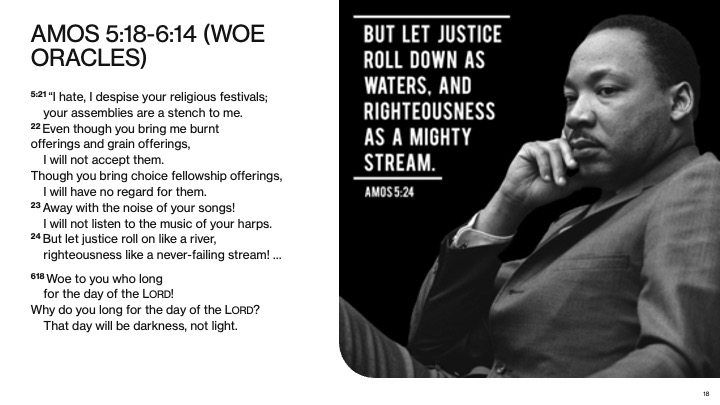
24 But let justice roll on like a river,
righteousness like a never-failing stream! …
618 Woe to you who long
for the day of the Lord!
Why do you long for the day of the Lord?
That day will be darkness, not light.
Amos 7:1-9:10 (Vision reports)
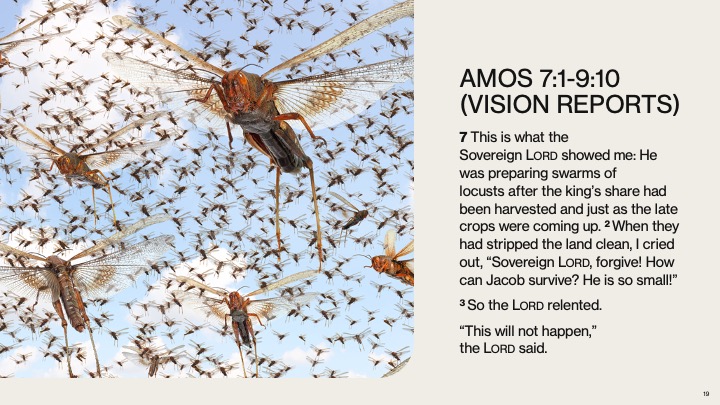
7 This is what the Sovereign Lord showed me: He was preparing swarms of locusts after the king’s share had been harvested and just as the late crops were coming up. 2 When they had stripped the land clean, I cried out, “Sovereign Lord, forgive! How can Jacob survive? He is so small!”
3 So the Lord relented.
“This will not happen,” the Lord said.
Amos 7:1-9:10 (Vision reports)
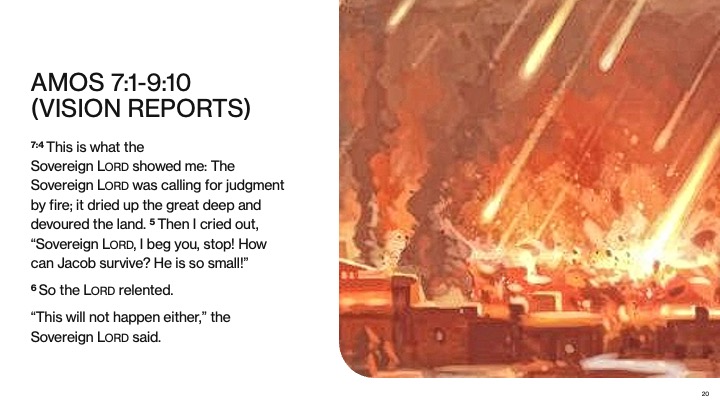
7:4 This is what the Sovereign Lord showed me: The Sovereign Lord was calling for judgment by fire; it dried up the great deep and devoured the land. 5 Then I cried out, “Sovereign Lord, I beg you, stop! How can Jacob survive? He is so small!”
6 So the Lord relented.
“This will not happen either,” the Sovereign Lord said.
Amos 7:1-9:10 (Vision reports)
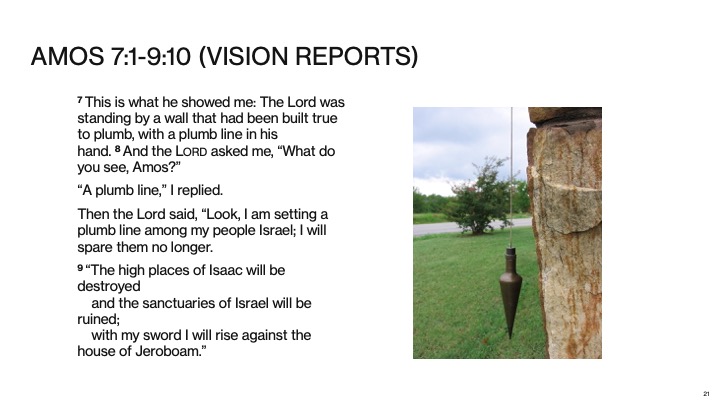
7 This is what he showed me: The Lord was standing by a wall that had been built true to plumb, with a plumb line in his hand. 8 And the Lord asked me, “What do you see, Amos?”
“A plumb line,” I replied.
Then the Lord said, “Look, I am setting a plumb line among my people Israel; I will spare them no longer.
9 “The high places of Isaac will
be destroyed
and the sanctuaries of Israel will be ruined;
with my sword I will rise against the house of
Jeroboam.”
Amos 7:1-9:10 (Vision reports)
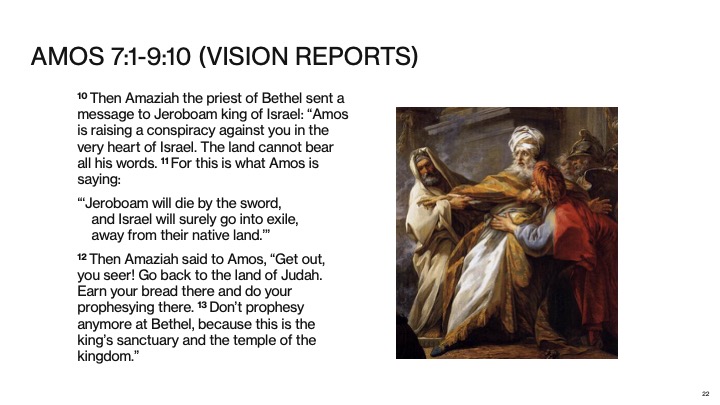
10 Then Amaziah the priest of Bethel sent a message to Jeroboam king of Israel: “Amos is raising a conspiracy against you in the very heart of Israel. The land cannot bear all his words. 11 For this is what Amos is saying:
“‘Jeroboam will die by the sword,
and Israel will surely go into exile,
away from their native land.’”
12 Then Amaziah said to Amos, “Get out, you seer! Go back to the land of Judah. Earn your bread there and do your prophesying there. 13 Don’t prophesy anymore at Bethel, because this is the king’s sanctuary and the temple of the kingdom.”
Amos 7:1-9:10 (Vision reports)
14 Amos answered Amaziah, “I was neither a prophet nor the son of a prophet, but I was a shepherd, and I also took care of sycamore-fig trees. 15 But the Lord took me from tending the flock and said to me, ‘Go, prophesy to my people Israel.’ 16 Now then, hear the word of the Lord. You say,
“‘Do not prophesy against Israel,
and stop preaching against the descendants of Isaac.’
17 “Therefore this is what the Lord says:
“‘Your wife will become a prostitute in the city,
and your sons and daughters will fall by the sword.
Your land will be measured and divided up,
and you yourself will die in a pagan country.
And Israel will surely go into exile,
away from their native land.’”
Amos 9:11-15 (Promise of restoration)
11 “In that day
“I will restore David’s fallen shelter—
I will repair its broken walls
and restore its ruins—
and will rebuild it as it used to be,
12 so that they may possess the remnant of Edom
and all the nations that bear my name,”
declares the Lord, who will do these things.
13 “The days are coming,” declares the Lord,
“when the reaper will be overtaken by the plowman
and the planter by the one treading grapes.
New wine will drip from the mountains
and flow from all the hills,
14 and I will bring my
people Israel back from exile.
“They will rebuild the ruined cities and live in them.
They will plant vineyards and drink their wine;
they will make gardens and eat their fruit.
15 I will plant Israel in their own land,
never again to be uprooted
from the land I have given them,”
says the Lord your God.
Acts 15: Amos in the NT (The Jerusalem Council)
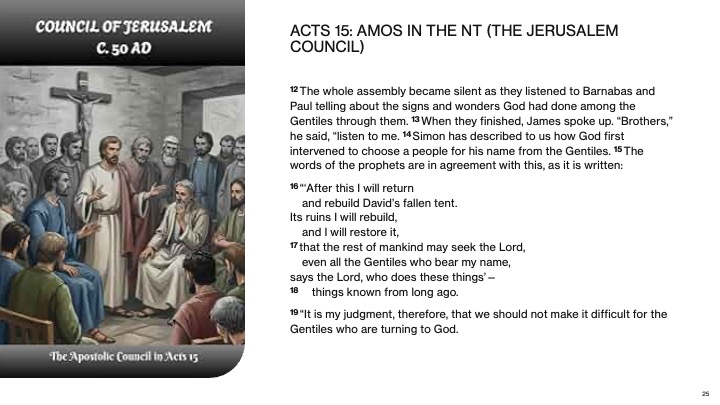
12 The whole assembly became silent as they listened to Barnabas and Paul telling about the signs and wonders God had done among the Gentiles through them. 13 When they finished, James spoke up. “Brothers,” he said, “listen to me. 14 Simon has described to us how God first intervened to choose a people for his name from the Gentiles. 15 The words of the prophets are in agreement with this, as it is written:
16 “‘After this I will return
and rebuild David’s fallen tent.
Its ruins I will rebuild,
and I will restore it,
17 that the rest of mankind may seek the Lord,
even all the Gentiles who bear my name,
says the Lord, who does these things’—
18 things known from long ago.
19 “It is my judgment, therefore, that we should not make it difficult for the Gentiles who are turning to God.