Genesis - in the Beginning
Mike Ervin

Genesis - in the Beginning
Links
<< Home >> << Great Bible Stories >>
The Creation In The Beginning Text
Does the Bible Have Great Stories?
YES! Most major religions are built not so much on a list of rulebooks but on upon their own collections of stories.
Storytelling is foundational and essential to religious teaching, serving as the primary vehicle through which faiths have historically been preserved, communicated, and internalized across generations.
The Biblical Model: In the Judeo-Christian tradition, God is revealed through historical narratives. The Hebrew Bible explicitly commands parents to pass down faith by telling the story of the Exodus to their children.
Jesus’s Parables: Jesus famously relied on parables - relatable, short stories about farming, families, and everyday life - to convey complex theological truths about the Kingdom of God.
Other Creation Stories
Genesis did not develop in an intellectual vacuum. The biblical creation stories emerged within a much older world in which Mesopotamian, Egyptian, Canaanite, and later Greek cultures already had elaborate explanations of the gods, the cosmos, humanity, and the origin of order.
The biblical creation traditions took shape over a very long period, with traditions that eventually became part of Genesis reaching back into the ancient Near East and being edited and transmitted over centuries. By the first millennium BCE, the Israelites were living among cultures with creation stories that were already extremely old.
And to better understand the Genesis creation story we need to first review the “competitive” creation accounts. Because there were many in those days.
By the first millennium BCE, the Israelites were living among cultures with creation stories that were already extremely old.
Mesopotamian Stories
Mesopotamia: creation began with multiple gods emerging from primordial waters.
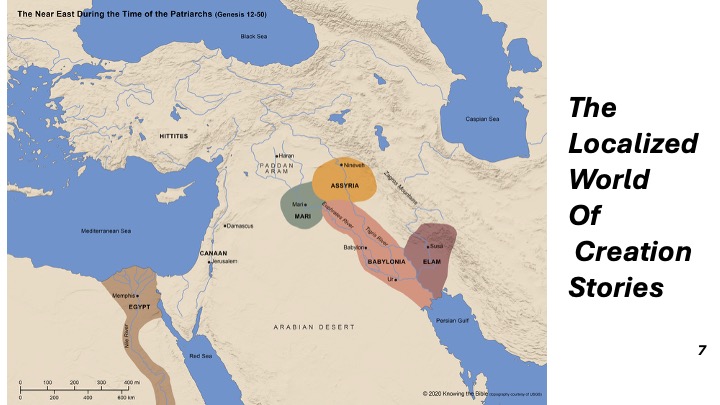
The great Mesopotamian civilizations included the Sumerians, Akkadians, Babylonians, and Assyrians. They developed sophisticated religious systems in which numerous gods governed different aspects of existence.
More on Mesopotamian Traditions
Mesopotamian gods were understood as powerful supernatural beings who nevertheless possessed many characteristics associated with human beings.
They could become angry, jealous, frightened, hungry, sexually active, or ambitious. They formed families and rivalries. They fought wars and made alliances.
A Babylonian Tradition
One important Mesopotamian creation tradition is found in the Enuma Elish, a Babylonian creation epic.
First, there are primordial waters. From these primordial beings come successive generations of gods.
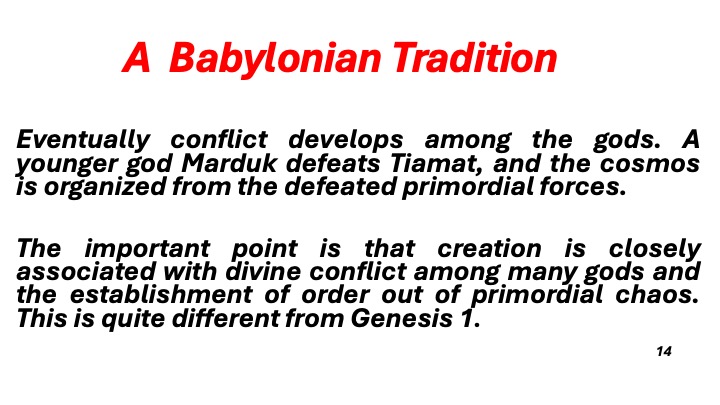
Eventually conflict develops among the gods. A younger god Marduk defeats Tiamat, and the cosmos is organized from the defeated primordial forces.
The important point is that creation is closely associated with divine conflict among many gods and the establishment of order out of primordial chaos. This is quite different from Genesis 1.
More on Mesopotamian Traditions
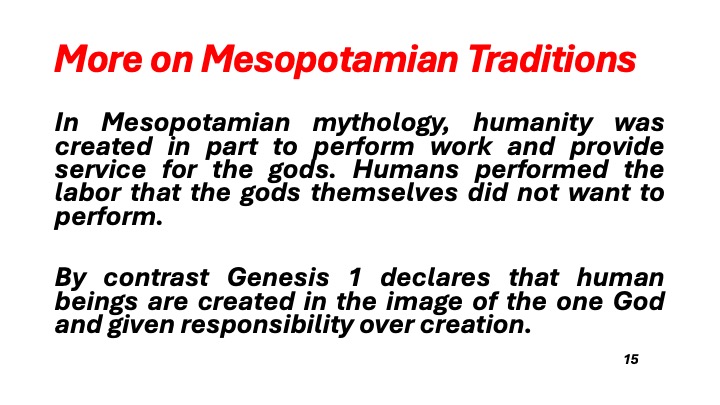
In Mesopotamian mythology, humanity was created in part to perform work and provide service for the gods. Humans performed the labor that the gods themselves did not want to perform.
By contrast Genesis 1 declares that human beings are created in the image of the one God and given responsibility over creation.
Great Stories From the Bible Today’s Story - Creation: In The Beginning
(Genesis Chapter 1)
An Initial Overview
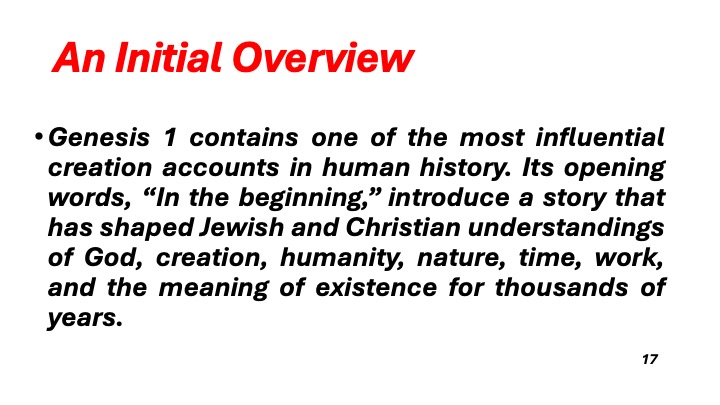
• Genesis 1 contains one of the most influential creation accounts in human history. Its opening words, “In the beginning,” introduce a story that has shaped Jewish and Christian understandings of God, creation, humanity, nature, time, work, and the meaning of existence for thousands of years.
This story is not simply an account of how the physical universe came into being. It is a carefully structured theological declaration that the universe is ordered rather than chaotic, that creation belongs to one God, that the created world is fundamentally good, and that human beings possess a distinctive place and responsibility within it.
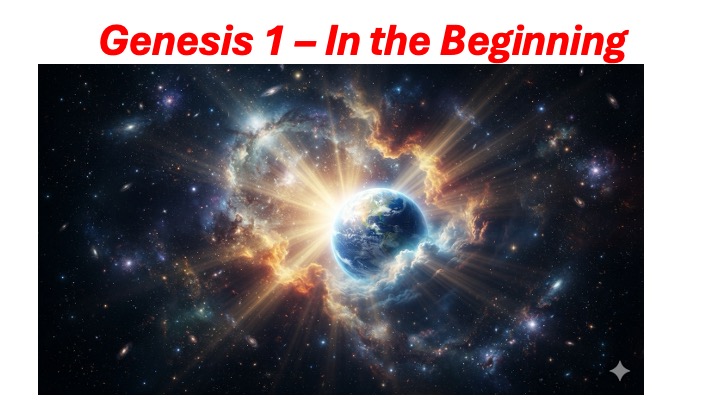
Genesis opens with a sentence that is extraordinarily simple: “In the beginning God created the heavens and the earth.”
The statement immediately places God before everything else. There is no explanation of where God came from, no account of a divine birth, and no struggle among competing gods. The story begins with God already present.
Day 1:The Creation of Light
“And God said “Let there be light” And there was light. The creation of light is the first major act of divine ordering.
One of the striking features of the passage is that the sun and moon have not yet been created. They appear later. Consequently, the light of Genesis 1 is not initially dependent upon the heavenly bodies.
Theologically, this emphasizes that light itself ultimately derives from God rather than from a divine sun god or another cosmic power. In the ancient world, heavenly bodies were often objects of religious devotion. Genesis strips them of divinity by presenting them as creations of the one God.
This opening is also important because Genesis does not initially portray creation as the transformation of something already functioning as an ordered world.
Instead, the emphasis is upon God bringing order, distinction, structure, and life into a first primordial state.
The first divine action is remarkably understated:
“Let there be light.” And there is light.
God then separates the light from the darkness. Light is called “day,” and darkness is called “night.” The first day comes to an end.
The Fundamental Pattern
Already the fundamental pattern of Genesis 1 has appeared.
God speaks, and something happens.
God evaluates what has been made. “It is good.”
Creation becomes increasingly ordered.
The First Day (continued)
The separation of light and darkness also introduces a recurring biblical theme. Creation involves distinctions. God separates day from night, waters above from waters below, sea from dry land, and later establishes different living creatures according to their kinds.
The world is becoming intelligible.
The Second Day: The Sky and the Waters
On the second day God creates an expanse, traditionally called the “firmament” separating waters above (the sky) from water below.
The Third Day: Dry Land and Vegetation
On the third day God gathers the waters so that dry land appears.
The waters are gathered into “seas”, while the dry land is called “earth.”
The Third Day: Dry Land and Vegetation
Again, God names what has been created.
Naming is significant throughout the Bible. To name something is to distinguish it and establish its place within an ordered world. Creation is becoming a recognizable environment.
And Vegetation?
Then God commands the earth to produce vegetation:
“Let the earth put forth vegetation.”
Plants, grasses, herbs, and trees appear, producing seed and fruit according to their kinds. 29
The biblical author is presenting the earth as fertile because God has ordered it to be fertile.
Life does not emerge from a meaningless cosmic accident within the theological framework of the story. The earth is capable of producing life because God has given it that capacity.
The Fourth Day
The fourth day introduces the great lights of the heavens.
God creates: the greater light to govern the day; the lesser light to govern the night; and the stars.
The language is deliberately striking. Genesis does not give them the divine names that many ancient cultures associated with these heavenly bodies. Instead, they are simply “lights” placed in the heavens.
These lights serve practical purposes. They mark day and night, establish seasons, and provide signs for times and calendars.
The sun and moon are therefore demythologized. They are not gods, as in other mid-eastern cultures. They are useful creations.
This is an important theological distinction between Genesis and many ancient Near Eastern creation traditions. The biblical account presents a universe in which everything other than God is part of God’s creation.
And the stars too are deprived of independent divine status. They are simply included among the things God has made.
The Fifth Day: Fish and Birds
On the fifth day creation moves from the physical environment to living creatures.
The waters are commanded to teem with living things, and birds are created to fly across the heavens. God creates the great sea creatures and the various kinds of living creatures that inhabit the waters and air.
For the first time in Genesis 1, God explicitly blesses his creatures:
“Be fruitful and multiply.”
Life is not merely created. It is blessed by God.
• This is an important transition. Creation is becoming abundant. The biblical vision is not of a sterile universe but of a world overflowing with life.
The sea creatures are especially significant because ancient cultures sometimes associated the sea with terrifying divine powers or primordial monsters.
Genesis places even the great creatures of the sea under God’s authority. Whatever powers they may symbolize in other traditions, here they are simply creatures.
And once again:
“God saw that it was good.”
Sixth Day: Animals and Humanity
The sixth day represents the climax of the creation sequence.
God first creates the land animals. Livestock, creatures that move along the ground, and wild animals are created “according to their kinds.”
• Then the narrative pauses. Something different is about to happen.
• God says: “Let us make mankind in our image, in our likeness.” This is the theological climax of Genesis 1.
Human beings are created in the image of God.
Male and Female
Genesis 1 makes another significant statement about humanity:
“Male and female he created them.”
Both are included within the divine image.
The text therefore does not assign the image of God exclusively to one sex. Humanity as male and female together bears the divine image.
This becomes an important foundation for later Jewish and Christian theological reflections on human dignity.
The Great Themes Introduced by Genesis 1
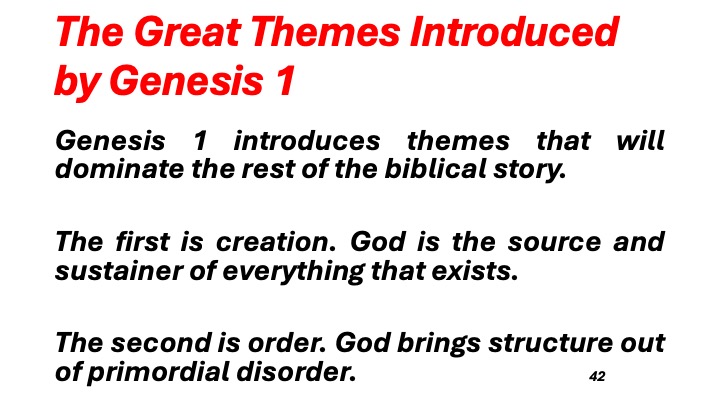
Genesis 1 introduces themes that will dominate the rest of the biblical story.
The first is creation. God is the source and sustainer of everything that exists.
The second is order. God brings structure out of primordial disorder.
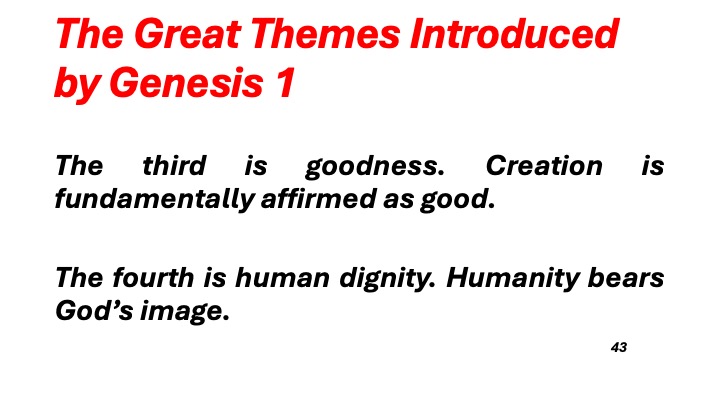
The third is goodness. Creation is fundamentally affirmed as good.
The fourth is human dignity. Humanity bears God’s image.
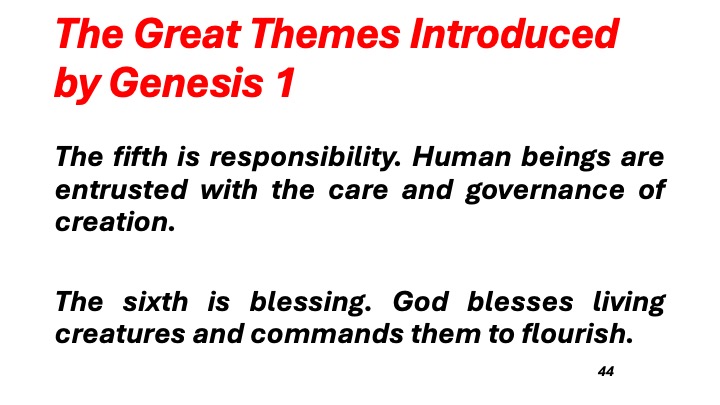
The fifth is responsibility. Human beings are entrusted with the care and governance of creation.
The sixth is blessing. God blesses living creatures and commands them to flourish.
A Seven-Day Structure
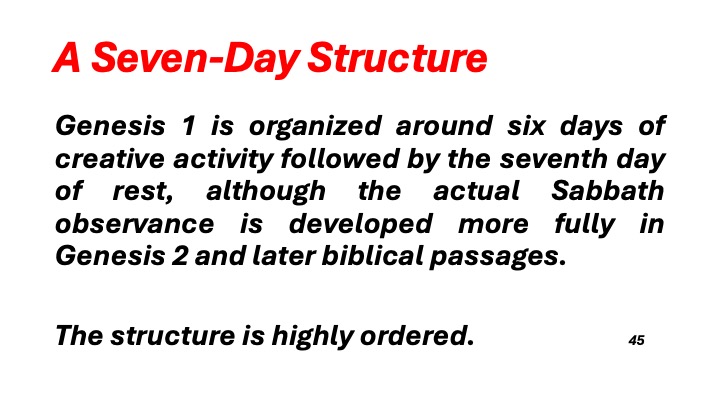
Genesis 1 is organized around six days of creative activity followed by the seventh day of rest, although the actual Sabbath observance is developed more fully in Genesis 2 and later biblical passages.
The structure is highly ordered.
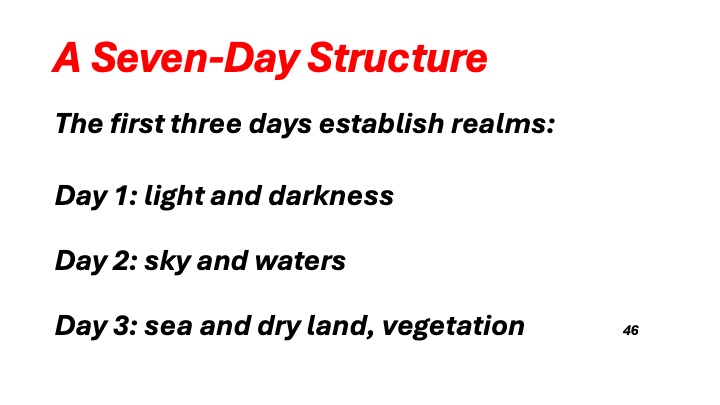
The first three days establish realms:
Day 1: light and darkness
Day 2: sky and waters
Day 3: sea and dry land, vegetation
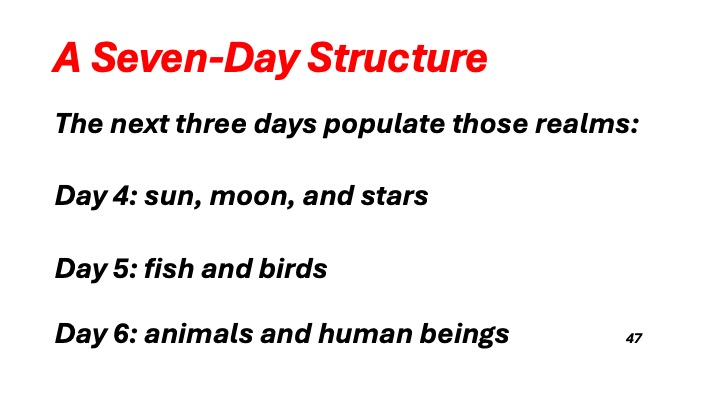
The next three days populate those realms:
Day 4: sun, moon, and stars
Day 5: fish and birds
Day 6: animals and human beings
The Enduring Significance of “In the Beginning”
For Western civilization, the chapter has profoundly influenced ideas about human dignity, nature, time, work, Sabbath, morality, and the relationship between humanity and the natural world.
The importance of Genesis 1 extends far beyond its opening chapter.
For Judaism, it establishes the fundamental confession that there is one Creator and that the world belongs to God.
For Christianity, it becomes the beginning point for a theology that eventually connects creation with incarnation, redemption, resurrection, and the renewal of creation.
Before humanity defines itself through nationality, politics, occupation, wealth, or ideology, Genesis defines humanity as part of a larger creation and as bearing the image of its Creator.
And for the individual reader, the story offers a remarkably expansive vision.
Before humanity asks what it should do, Genesis asks us to recognize the fantastic world we have been given to do it in.