Japanese Christianity 2
Chris Knepp & Andy Dearman

Japanese Christianity 2
Links
<< Home >> << Japanese Christianity Menu >>
Japanese Christianity 2 - the Text
Thank you, Koko!
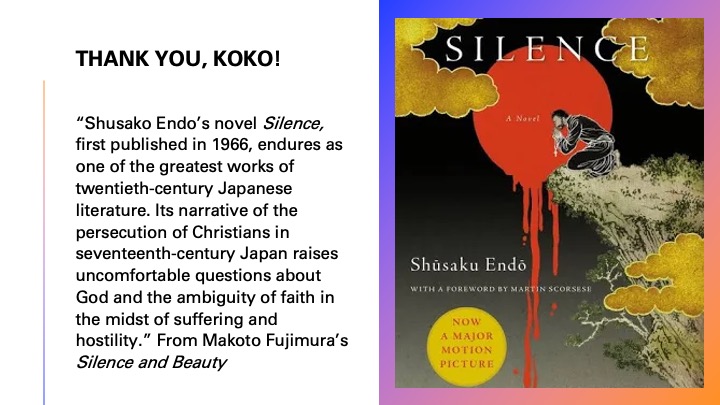
“Shusako Endo’s novel Silence, first published in 1966, endures as one of the greatest works of twentieth-century Japanese literature. Its narrative of the persecution of Christians in seventeenth-century Japan raises uncomfortable questions about God and the ambiguity of faith in the midst of suffering and hostility.” From Makoto Fujimura’s Silence and Beauty
Expulsion
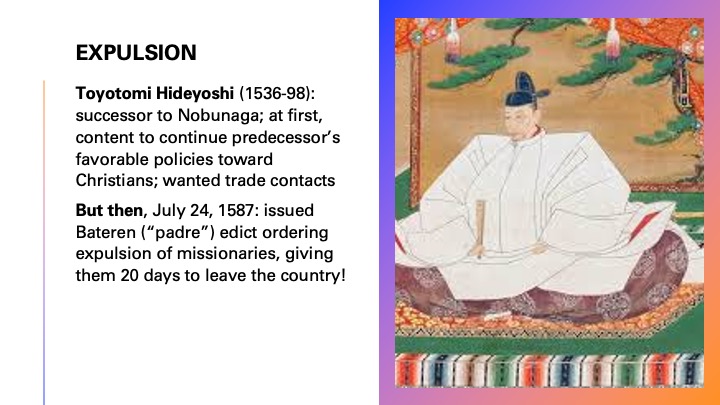
Toyotomi Hideyoshi (1536-98): successor to Nobunaga; at first, content to continue predecessor’s favorable policies toward Christians; wanted trade contacts
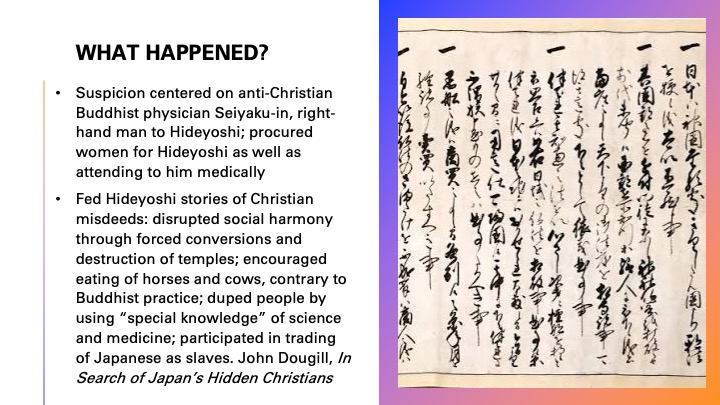
But then, July 24, 1587: issued Bateren (“padre”) edict ordering expulsion of missionaries, giving them 20 days to leave the country!
What happened?
• Suspicion centered on anti-Christian Buddhist physician Seiyaku-in, right-hand man to Hideyoshi; procured women for Hideyoshi as well as attending to him medically
• Fed Hideyoshi stories of Christian misdeeds: disrupted social harmony through forced conversions and destruction of temples; encouraged eating of horses and cows, contrary to Buddhist practice; duped people by using “special knowledge” of science and medicine; participated in trading of Japanese as slaves. John Dougill, In Search of Japan’s Hidden Christians
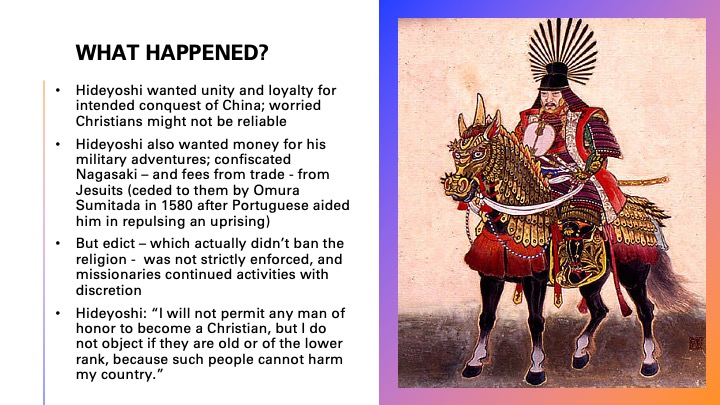
• Hideyoshi wanted unity and loyalty for intended conquest of China; worried Christians might not be reliable
• Hideyoshi also wanted money for his military adventures; confiscated Nagasaki – and fees from trade - from Jesuits (ceded to them by Omura Sumitada in 1580 after Portuguese aided him in repulsing an uprising)
• But edict – which actually didn’t ban the religion - was not strictly enforced, and missionaries continued activities with discretion
• Hideyoshi: “I will not permit any man of honor to become a Christian, but I do not object if they are old or of the lower rank, because such people cannot harm my country.”
• Hideyoshi wanted unity and loyalty for intended conquest of China; worried Christians might not be reliable
• Hideyoshi also wanted money for his military adventures; confiscated Nagasaki – and fees from trade - from Jesuits (ceded to them by Omura Sumitada in 1580 after Portuguese aided him in repulsing an uprising)
• But edict – which actually didn’t ban the religion - was not strictly enforced, and missionaries continued activities with discretion
• Hideyoshi: “I will not permit any man of honor to become a Christian, but I do not object if they are old or of the lower rank, because such people cannot harm my country.”
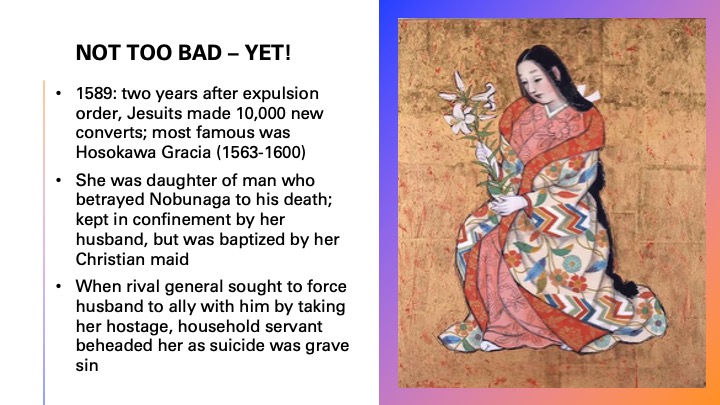
Not Too Bad - Yet • 1589: two years after expulsion order, Jesuits made 10,000 new converts; most famous was Hosokawa Gracia (1563-1600)
• She was daughter of man who betrayed Nobunaga to his death; kept in confinement by her husband, but was baptized by her Christian maid
• When rival general sought to force husband to ally with him by taking her hostage, household servant beheaded her as suicide was grave sin
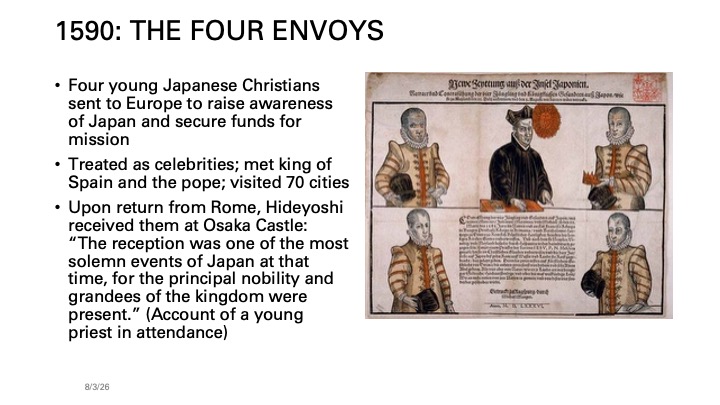
• 1590: THE FOUR ENVOYS
• Four young Japanese Christians sent to Europe to raise awareness of Japan and secure funds for mission
• Treated as celebrities; met king of Spain and the pope; visited 70 cities
• Upon return from Rome, Hideyoshi received them at Osaka Castle: “The reception was one of the most solemn events of Japan at that time, for the principal nobility and grandees of the kingdom were present.” (Account of a young priest in attendance)
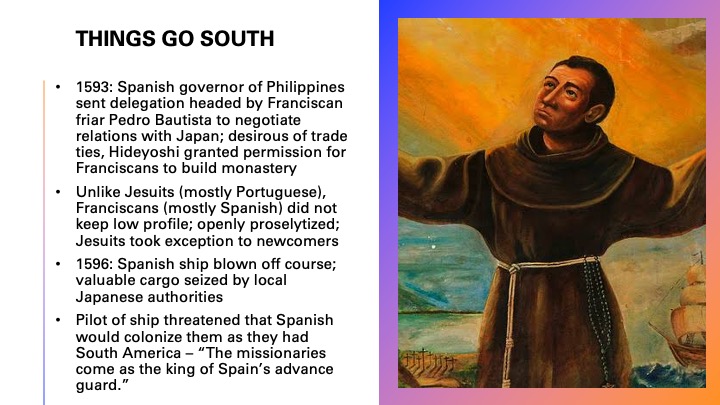
• Things Go South
• 1593: Spanish governor of Philippines sent delegation headed by Franciscan friar Pedro Bautista to negotiate relations with Japan; desirous of trade ties, Hideyoshi granted permission for Franciscans to build monastery
• Unlike Jesuits (mostly Portuguese), Franciscans (mostly Spanish) did not keep low profile; openly proselytized; Jesuits took exception to newcomers
• 1596: Spanish ship blown off course; valuable cargo seized by local Japanese authorities
• Pilot of ship threatened that Spanish would colonize them as they had South America – “The missionaries come as the king of Spain’s advance guard.”
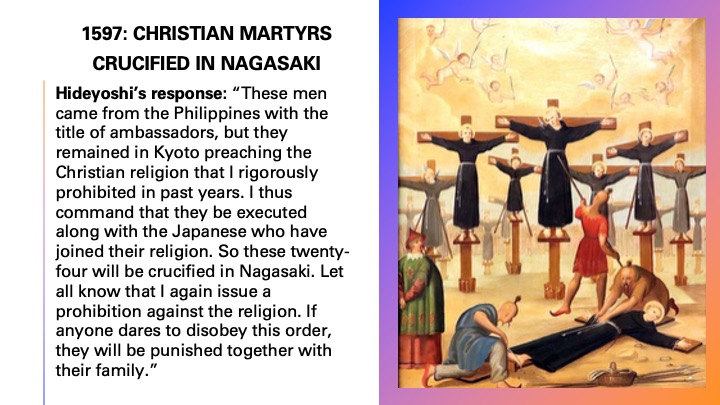
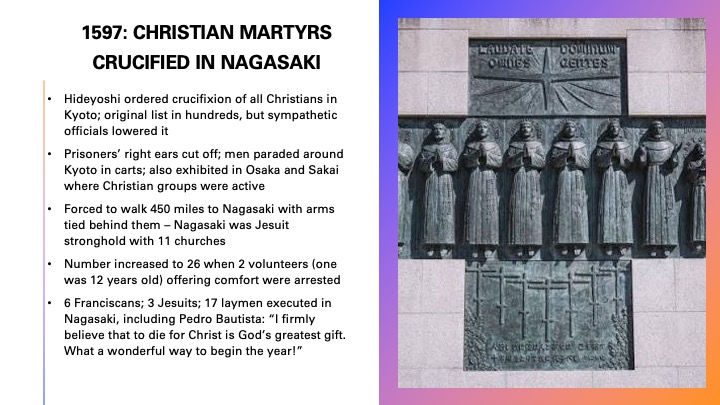
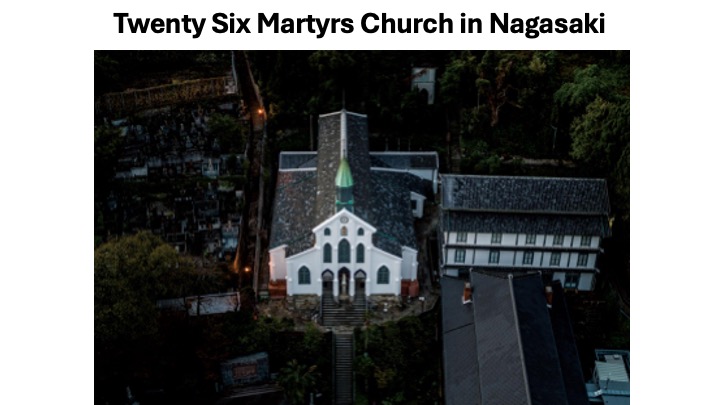
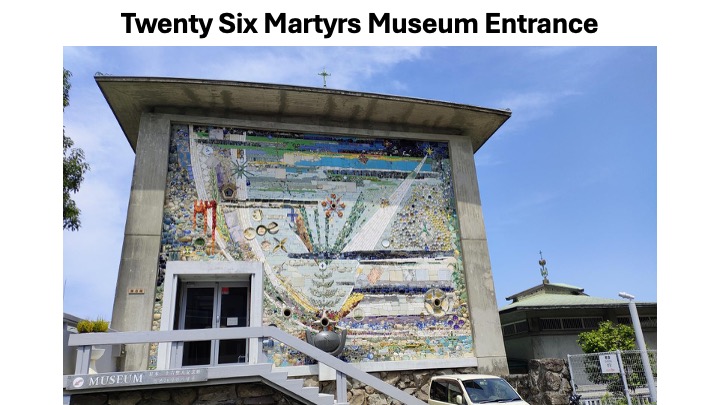
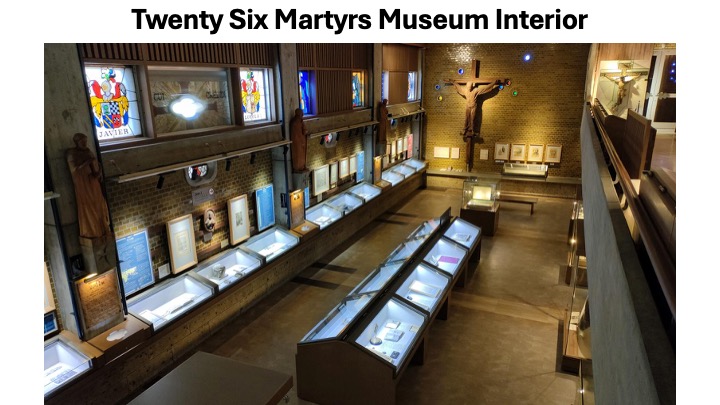
• 1597: Christian martyrs crucified in nagasaki
• Hideyoshi’s response: “These men came from the Philippines with the title of ambassadors, but they remained in Kyoto preaching the Christian religion that I rigorously prohibited in past years. I thus command that they be executed along with the Japanese who have joined their religion. So these twenty-four will be crucified in Nagasaki. Let all know that I again issue a prohibition against the religion. If anyone dares to disobey this order, they will be punished together with their family.”
• Hideyoshi ordered crucifixion of all Christians in Kyoto; original list in hundreds, but sympathetic officials lowered it
• Prisoners’ right ears cut off; men paraded around Kyoto in carts; also exhibited in Osaka and Sakai where Christian groups were active
• Forced to walk 450 miles to Nagasaki with arms tied behind them – Nagasaki was Jesuit stronghold with 11 churches
• Number increased to 26 when 2 volunteers (one was 12 years old) offering comfort were arrested
• 6 Franciscans; 3 Jesuits; 17 laymen executed in Nagasaki, including Pedro Bautista: “I firmly believe that to die for Christ is God’s greatest gift. What a wonderful way to begin the year!”
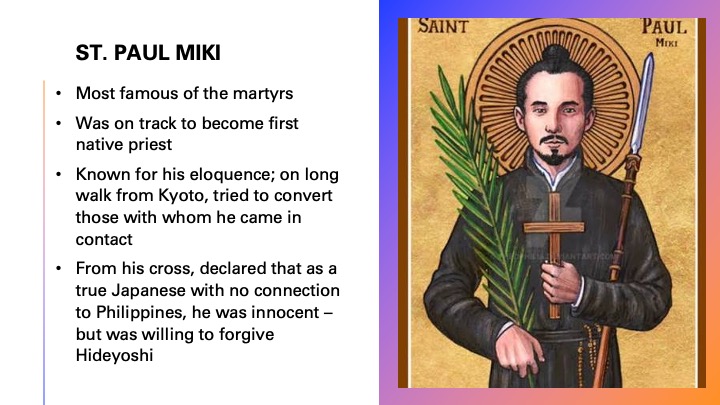
• St. Paul Miki
• Most famous of the martyrs
• Was on track to become first native priest
• Known for his eloquence; on long walk from Kyoto, tried to convert those with whom he came in contact
• From his cross, declared that as a true Japanese with no connection to Philippines, he was innocent – but was willing to forgive Hideyoshi
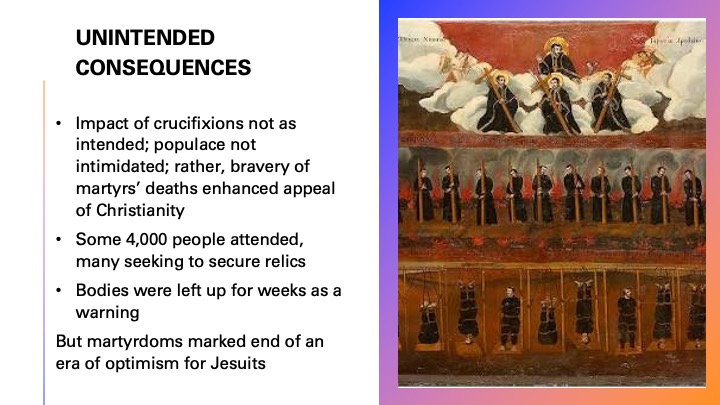
• Unintended consequences
• Impact of crucifixions not as intended; populace not intimidated; rather, bravery of martyrs’ deaths enhanced appeal of Christianity
• Some 4,000 people attended, many seeking to secure relics
• Bodies were left up for weeks as a warning
• But martyrdoms marked end of an era of optimism for Jesuits
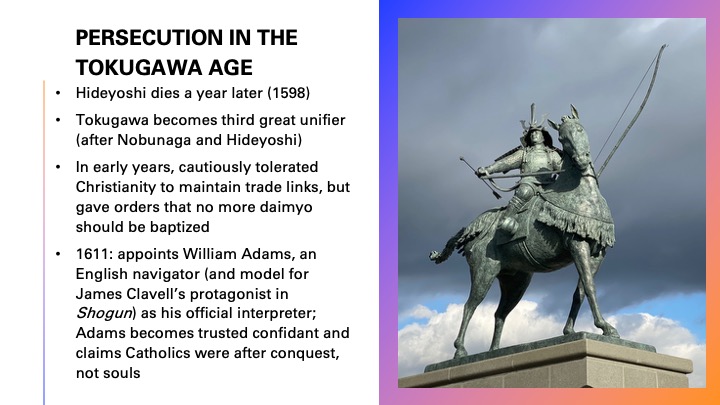
• Persecution in the Tokugawa Age
• Hideyoshi dies a year later (1598)
• Tokugawa becomes third great unifier (after Nobunaga and Hideyoshi)
• In early years, cautiously tolerated Christianity to maintain trade links, but gave orders that no more daimyo should be baptized
• 1611: appoints William Adams, an English navigator (and model for James Clavell’s protagonist in Shogun) as his official interpreter; Adams becomes trusted confidant and claims Catholics were after conquest, not souls
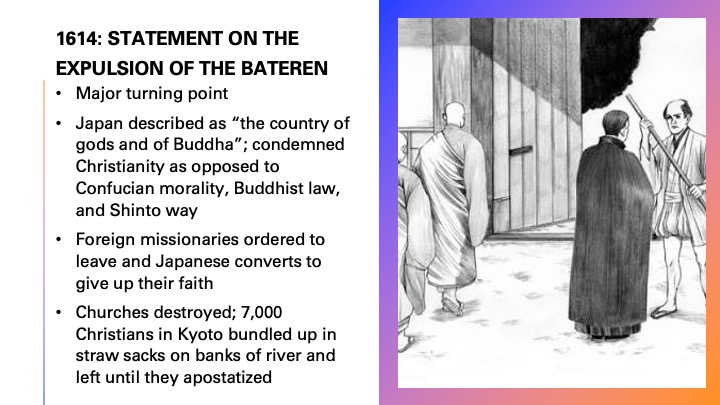
• 1614: Statement on the Expulsion of the Bateren
• Major turning point
• Japan described as “the country of gods and of Buddha”; condemned Christianity as opposed to Confucian morality, Buddhist law, and Shinto way
• Foreign missionaries ordered to leave and Japanese converts to give up their faith
• Churches destroyed; 7,000 Christians in Kyoto bundled up in straw sacks on banks of river and left until they apostatized
• Major turning point
• Japan described as “the country of gods and of Buddha”; condemned Christianity as opposed to Confucian morality, Buddhist law, and Shinto way
• Foreign missionaries ordered to leave and Japanese converts to give up their faith
• Churches destroyed; 7,000 Christians in Kyoto bundled up in straw sacks on banks of river and left until they apostatized
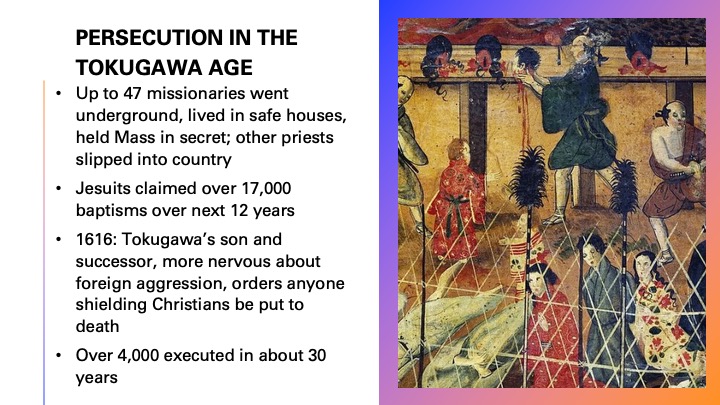
• Persecution in the Tokugawa Age
• Up to 47 missionaries went underground, lived in safe houses, held Mass in secret; other priests slipped into country
• Jesuits claimed over 17,000 baptisms over next 12 years
• 1616: Tokugawa’s son and successor, more nervous about foreign aggression, orders anyone shielding Christians be put to death
• Over 4,000 executed in about 30 years
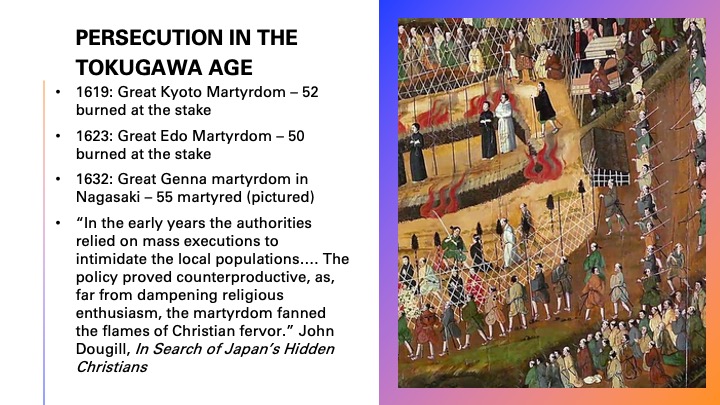
• 1619: Great Kyoto Martyrdom – 52 burned at the stake
• 1623: Great Edo Martyrdom – 50 burned at the stake
• 1632: Great Genna martyrdom in Nagasaki – 55 martyred (pictured)
• “In the early years the authorities relied on mass executions to intimidate the local populations…. The policy proved counterproductive, as, far from dampening religious enthusiasm, the martyrdom fanned the flames of Christian fervor.” John Dougill, In Search of Japan’s Hidden Christians
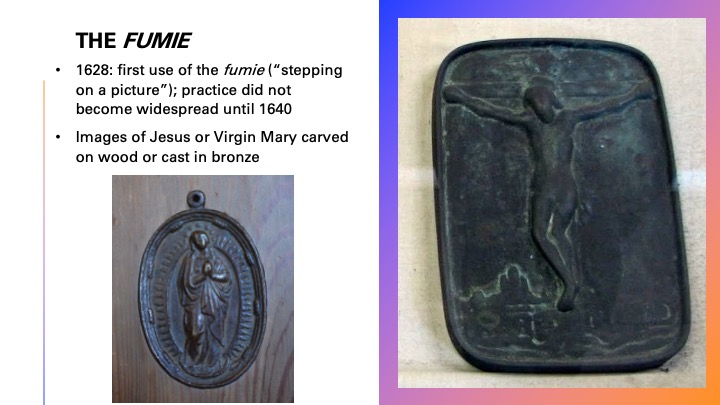
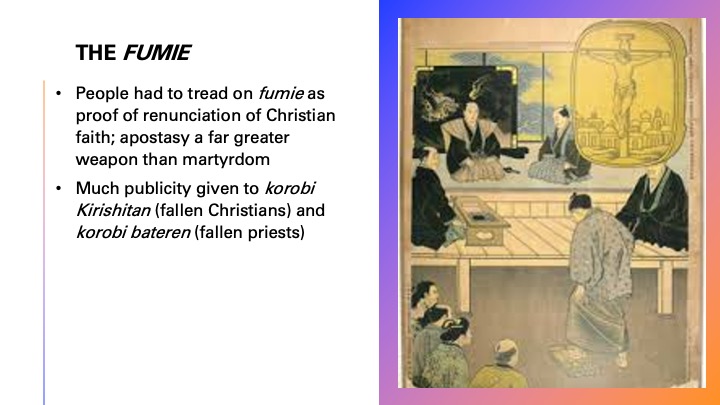
• The fumie
• 1628: first use of the fumie (“stepping on a picture”); practice did not become widespread until 1640
• Images of Jesus or Virgin Mary carved on wood or cast in bronze
• People had to tread on fumie as proof of renunciation of Christian faith; apostasy a far greater weapon than martyrdom
• Much publicity given to korobi Kirishitan (fallen Christians) and korobi bateren (fallen priests)
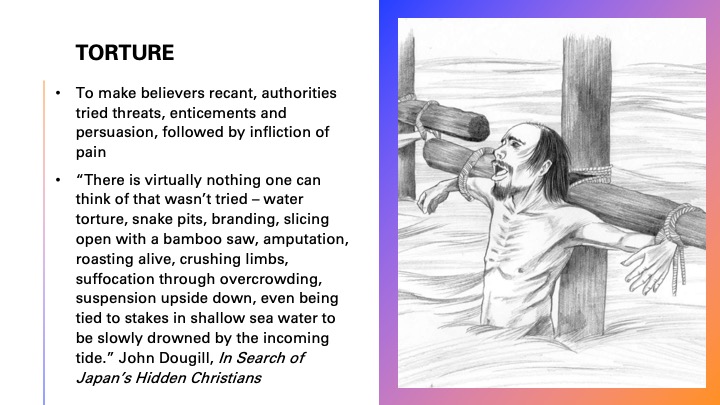
• Torture
• To make believers recant, authorities tried threats, enticements and persuasion, followed by infliction of pain
• “There is virtually nothing one can think of that wasn’t tried – water torture, snake pits, branding, slicing open with a bamboo saw, amputation, roasting alive, crushing limbs, suffocation through overcrowding, suspension upside down, even being tied to stakes in shallow sea water to be slowly drowned by the incoming tide.” John Dougill, In Search of Japan’s Hidden Christians
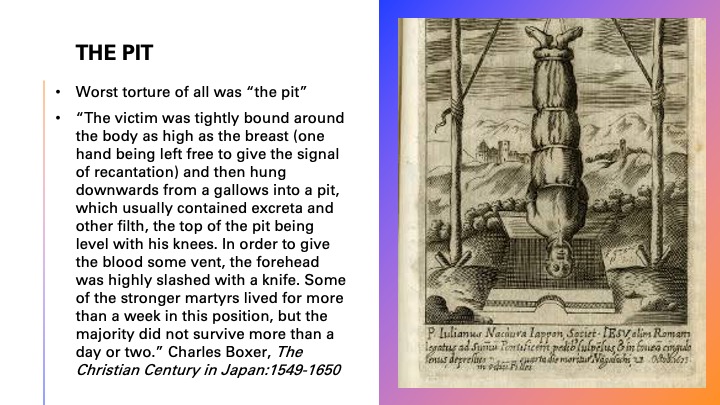
• The PIT
• Worst torture of all was “the pit”
• “The victim was tightly bound around the body as high as the breast (one hand being left free to give the signal of recantation) and then hung downwards from a gallows into a pit, which usually contained excreta and other filth, the top of the pit being level with his knees. In order to give the blood some vent, the forehead was highly slashed with a knife. Some of the stronger martyrs lived for more than a week in this position, but the majority did not survive more than a day or two.” Charles Boxer, The Christian Century in Japan:1549-1650
• Further edicts
• Sharp drop in number of Christians, from over 300,000 in 1612 to less than half that by 1625
• Those who remained went underground; concealed their religion and lived in remote regions
• 1633: Edict stipulated rewards for whereabouts of priests
• 1636: Poruguese traders confined to small island of Dejima (connected by bridge to Nagasaki), constructed specifically to restrict contact with Japanese and infiltration of Christianity
• 1639: Banned Portuguese ships altogether due to smuggling of missionaries into the country; Japanese who had gone abroad banned from re-entering
• 1644: Last surviving missionary, Brother Konishi Mancio, put to death
• 1637-38: the Shimabara rebellion
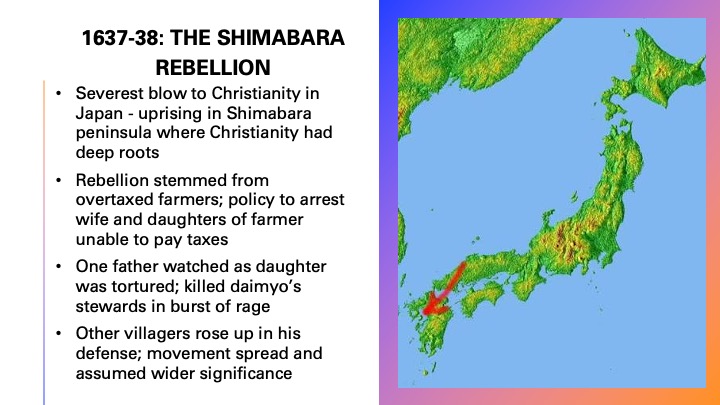
• Severest blow to Christianity in Japan - uprising in Shimabara peninsula where Christianity had deep roots
• Rebellion stemmed from overtaxed farmers; policy to arrest wife and daughters of farmer unable to pay taxes
• One father watched as daughter was tortured; killed daimyo’s stewards in burst of rage
• Other villagers rose up in his defense; movement spread and assumed wider significance
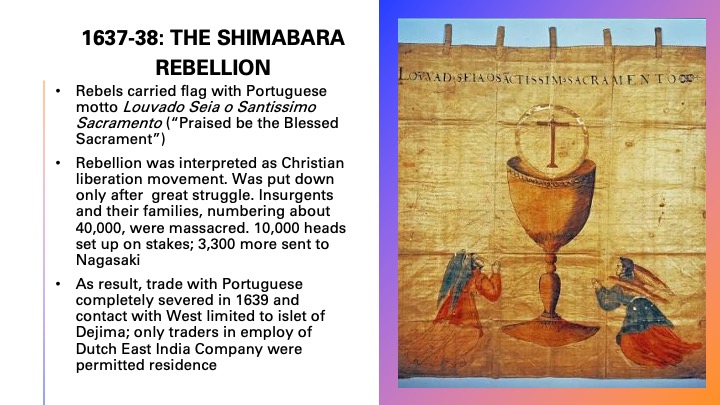
• Rebels carried flag with Portuguese motto Louvado Seia o Santissimo Sacramento (“Praised be the Blessed Sacrament”)
• Rebellion was interpreted as Christian liberation movement. Was put down only after great struggle. Insurgents and their families, numbering about 40,000, were massacred. 10,000 heads set up on stakes; 3,300 more sent to Nagasaki
• As result, trade with Portuguese completely severed in 1639 and contact with West limited to islet of Dejima; only traders in employ of Dutch East India Company were permitted residence
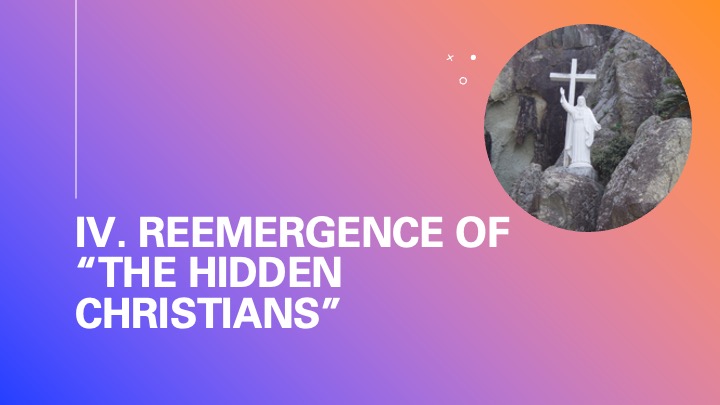
• Iv. Reemergence of “The Hidden Christians”
• Japan reopens for business
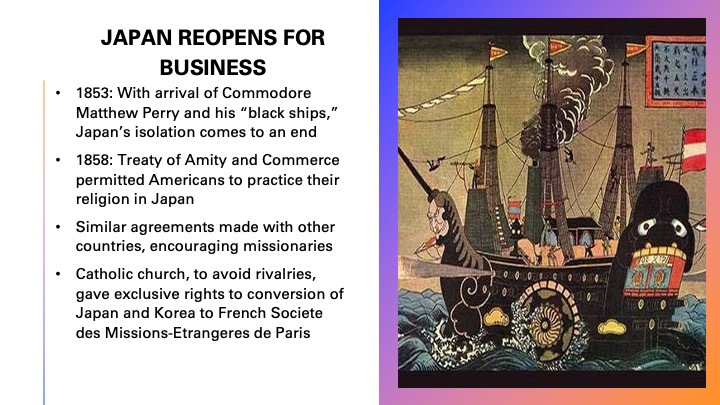
• 1853: With arrival of Commodore Matthew Perry and his “black ships,” Japan’s isolation comes to an end
• 1858: Treaty of Amity and Commerce permitted Americans to practice their religion in Japan
• Similar agreements made with other countries, encouraging missionaries
• Catholic church, to avoid rivalries, gave exclusive rights to conversion of Japan and Korea to French Societe des Missions-Etrangeres de Paris
• The Kakure Kirishitan
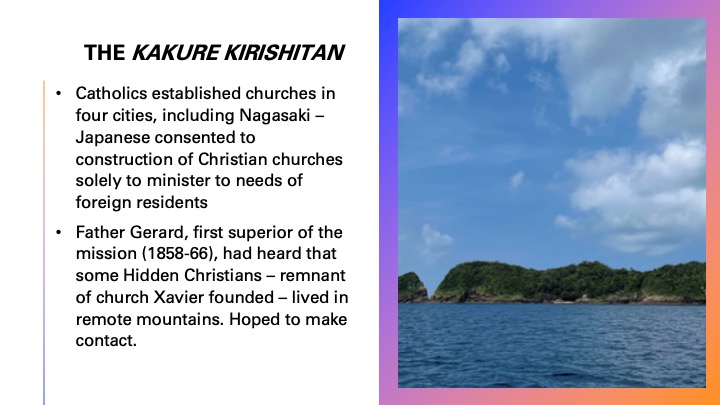
• Catholics established churches in four cities, including Nagasaki – Japanese consented to construction of Christian churches solely to minister to needs of foreign residents
• Father Gerard, first superior of the mission (1858-66), had heard that some Hidden Christians – remnant of church Xavier founded – lived in remote mountains. Hoped to make contact.
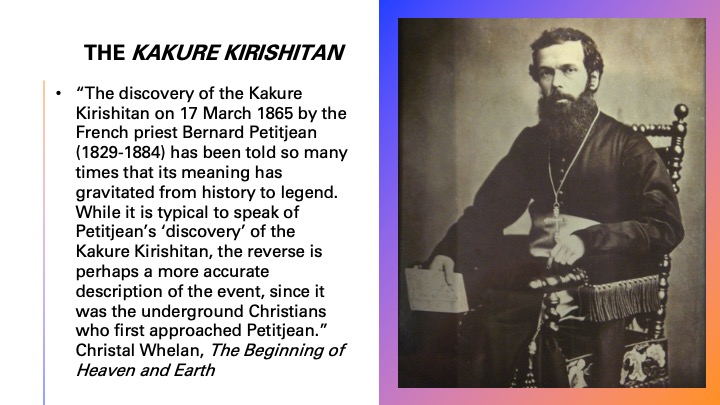
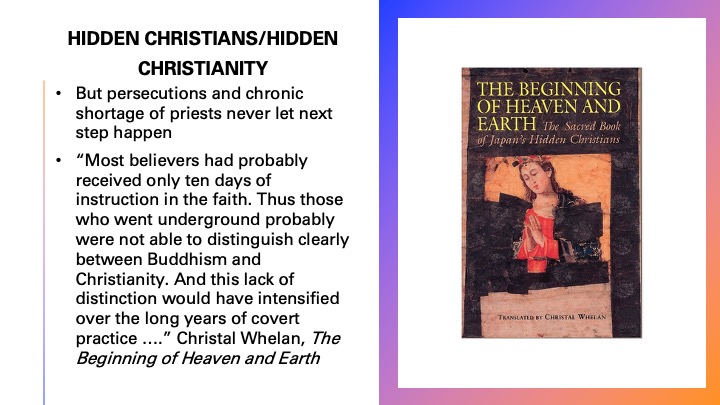
• “The discovery of the Kakure Kirishitan on 17 March 1865 by the French priest Bernard Petitjean (1829-1884) has been told so many times that its meaning has gravitated from history to legend. While it is typical to speak of Petitjean’s ‘discovery’ of the Kakure Kirishitan, the reverse is perhaps a more accurate description of the event, since it was the underground Christians who first approached Petitjean.” Christal Whelan, The Beginning of Heaven and Earth
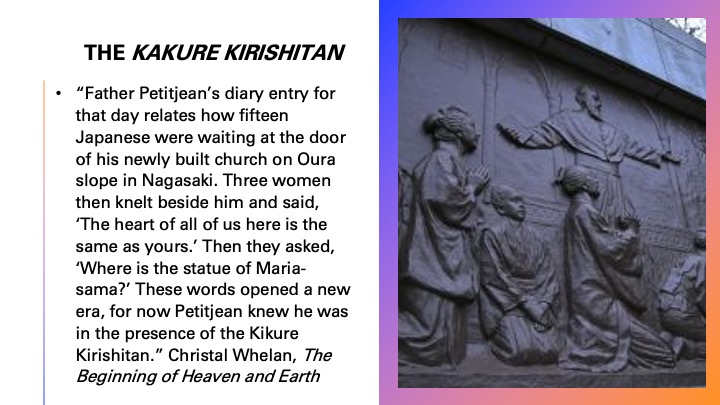
• “Father Petitjean’s diary entry for that day relates how fifteen Japanese were waiting at the door of his newly built church on Oura slope in Nagasaki. Three women then knelt beside him and said, ‘The heart of all of us here is the same as yours.’ Then they asked, ‘Where is the statue of Maria- sama?’ These words opened a new era, for now Petitjean knew he was in the presence of the Kikure Kirishitan.” Christal Whelan, The Beginning of Heaven and Earth
• Hidden Christians/hidden Christianity
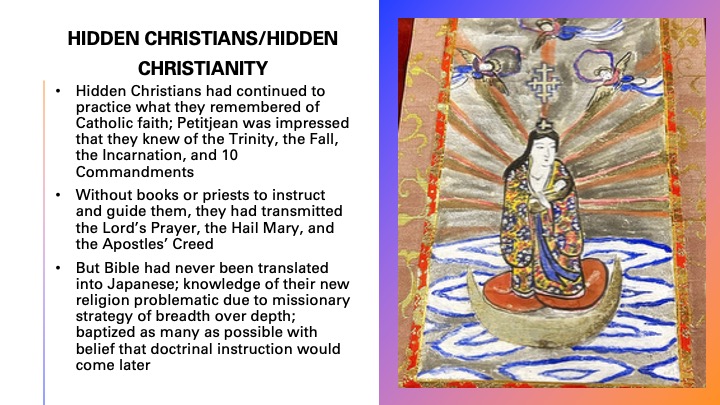
• Hidden Christians had continued to practice what they remembered of Catholic faith; Petitjean was impressed that they knew of the Trinity, the Fall, the Incarnation, and 10 Commandments
• Without books or priests to instruct and guide them, they had transmitted the Lord’s Prayer, the Hail Mary, and the Apostles’ Creed
• But Bible had never been translated into Japanese; knowledge of their new religion problematic due to missionary strategy of breadth over depth; baptized as many as possible with belief that doctrinal instruction would come later
• But persecutions and chronic shortage of priests never let next step happen
• “Most believers had probably received only ten days of instruction in the faith. Thus those who went underground probably were not able to distinguish clearly between Buddhism and Christianity. And this lack of distinction would have intensified over the long years of covert practice ….” Christal Whelan, The Beginning of Heaven and Earth
• But persecutions and chronic shortage of priests never let next step happen
• “Most believers had probably received only ten days of instruction in the faith. Thus those who went underground probably were not able to distinguish clearly between Buddhism and Christianity. And this lack of distinction would have intensified over the long years of covert practice ….” Christal Whelan, The Beginning of Heaven and Earth
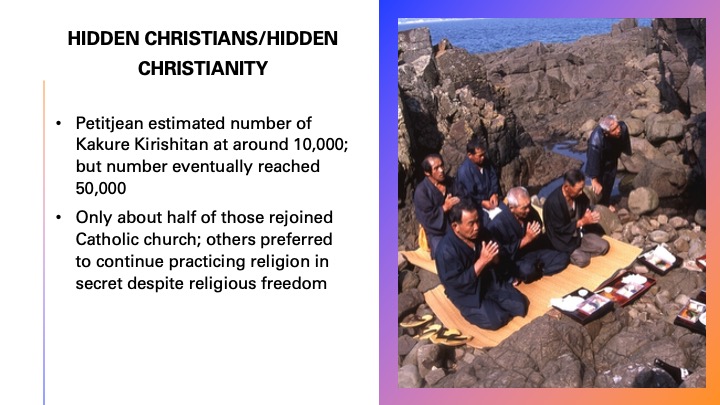
• Petitjean estimated number of Kakure Kirishitan at around 10,000; but number eventually reached 50,000
• Only about half of those rejoined Catholic church; others preferred to continue practicing religion in secret despite religious freedom
• The Tenchi
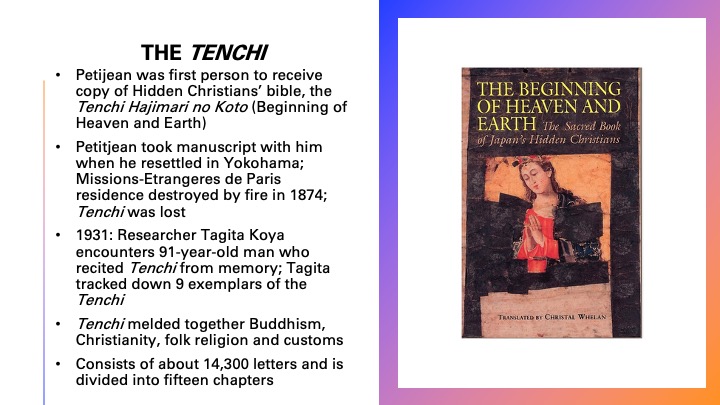
• Petijean was first person to receive copy of Hidden Christians’ bible, the Tenchi Hajimari no Koto (Beginning of Heaven and Earth)
• Petitjean took manuscript with him when he resettled in Yokohama; Missions-Etrangeres de Paris residence destroyed by fire in 1874; Tenchi was lost
• 1931: Researcher Tagita Koya encounters 91-year-old man who recited Tenchi from memory; Tagita tracked down 9 exemplars of the Tenchi
• Tenchi melded together Buddhism, Christianity, folk religion and customs
• Consists of about 14,300 letters and is divided into fifteen chapters
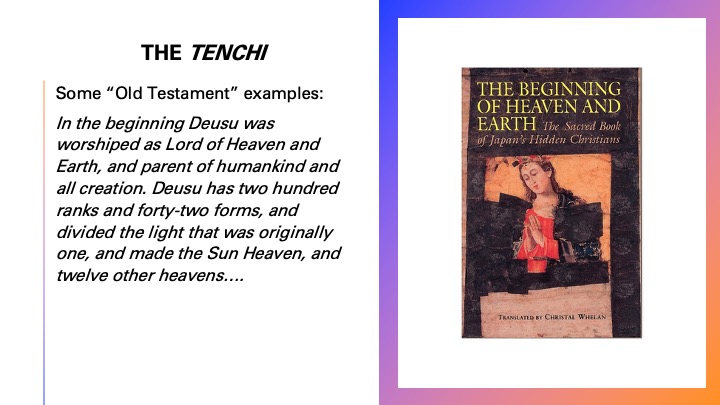
• Some “Old Testament” examples:
• In the beginning Deusu was worshiped as Lord of Heaven and Earth, and parent of humankind and all creation. Deusu has two hundred ranks and forty-two forms, and divided the light that was originally one, and made the Sun Heaven, and twelve other heavens….
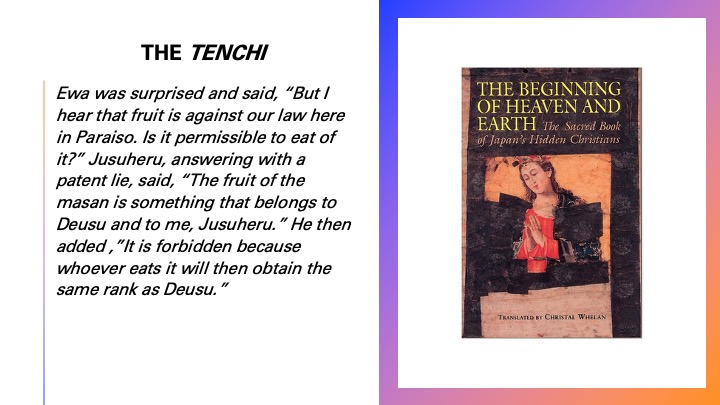
• Ewa was surprised and said, “But I hear that fruit is against our law here in Paraiso. Is it permissible to eat of it?” Jusuheru, answering with a patent lie, said, “The fruit of the masan is something that belongs to Deusu and to me, Jusuheru.” He then added ,”It is forbidden because whoever eats it will then obtain the same rank as Deusu.”
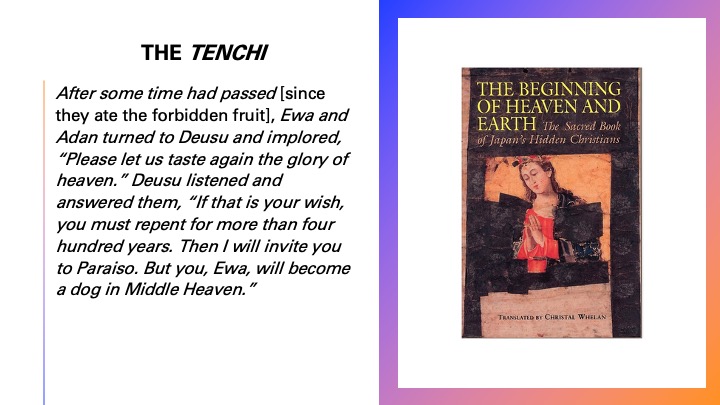
• After some time had passed [since they ate the forbidden fruit], Ewa and Adan turned to Deusu and implored, “Please let us taste again the glory of heaven.” Deusu listened and answered them, “If that is your wish, you must repent for more than four hundred years. Then I will invite you to Paraiso. But you, Ewa, will become a dog in Middle Heaven.”
• Some “New Testament” examples:
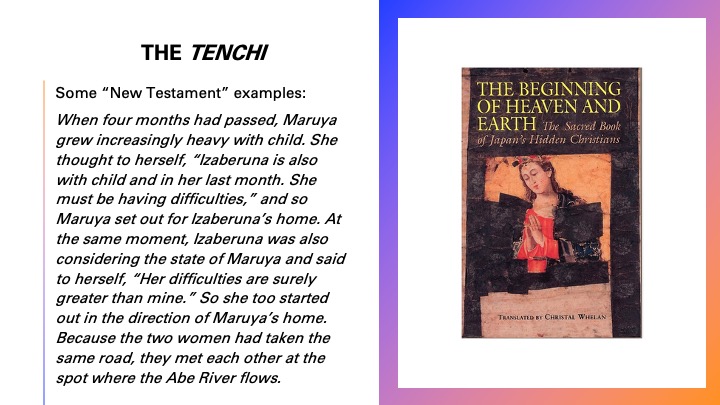
• When four months had passed, Maruya grew increasingly heavy with child. She thought to herself, “Izaberuna is also with child and in her last month. She must be having difficulties,” and so Maruya set out for Izaberuna’s home. At the same moment, Izaberuna was also considering the state of Maruya and said to herself, “Her difficulties are surely greater than mine.” So she too started out in the direction of Maruya’s home. Because the two women had taken the same road, they met each other at the spot where the Abe River flows.
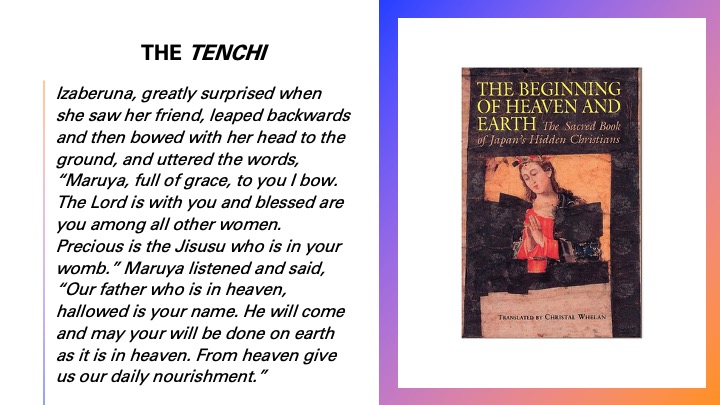
• Izaberuna, greatly surprised when she saw her friend, leaped backwards and then bowed with her head to the ground, and uttered the words, “Maruya, full of grace, to you I bow. The Lord is with you and blessed are you among all other women. Precious is the Jisusu who is in your womb.” Maruya listened and said, “Our father who is in heaven, hallowed is your name. He will come and may your will be done on earth as it is in heaven. From heaven give us our daily nourishment.”
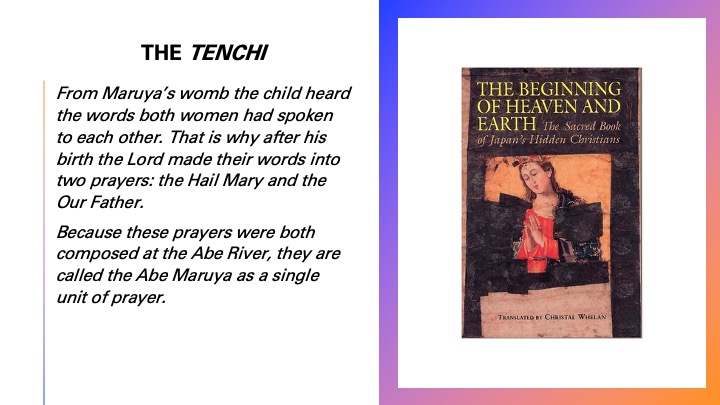
• From Maruya’s womb the child heard the words both women had spoken to each other. That is why after his birth the Lord made their words into two prayers: the Hail Mary and the Our Father.
• Because these prayers were both composed at the Abe River, they are called the Abe Maruya as a single unit of prayer.
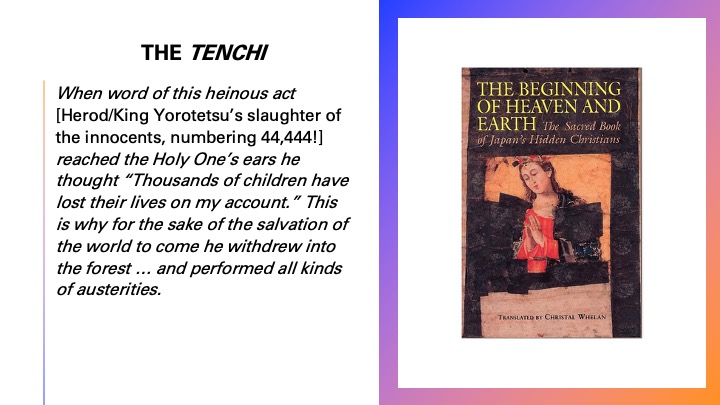
• When word of this heinous act [Herod/King Yorotetsu’s slaughter of the innocents, numbering 44,444!] reached the Holy One’s ears he thought “Thousands of children have lost their lives on my account.” This is why for the sake of the salvation of the world to come he withdrew into the forest … and performed all kinds of austerities.
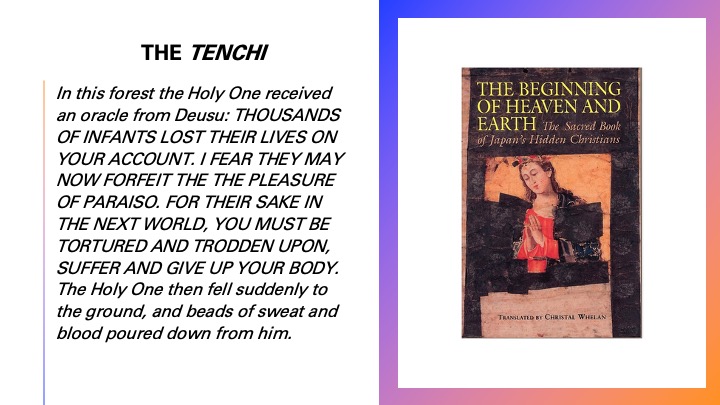
• In this forest the Holy One received an oracle from Deusu: THOUSANDS OF INFANTS LOST THEIR LIVES ON YOUR ACCOUNT. I FEAR THEY MAY NOW FORFEIT THE THE PLEASURE OF PARAISO. FOR THEIR SAKE IN THE NEXT WORLD, YOU MUST BE TORTURED AND TRODDEN UPON, SUFFER AND GIVE UP YOUR BODY. The Holy One then fell suddenly to the ground, and beads of sweat and blood poured down from him.
• v. Christianity in Japan today
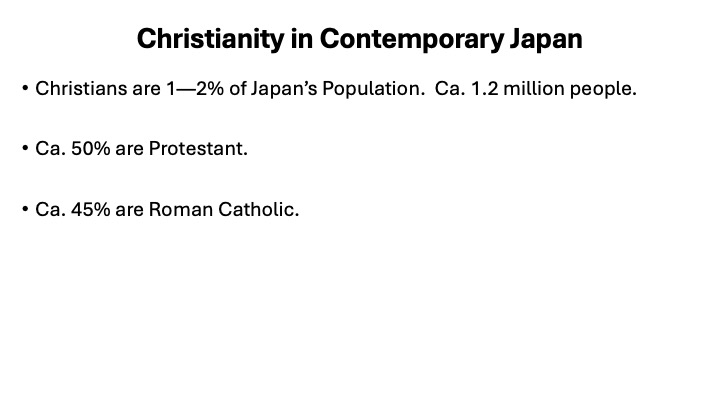
• Christianity in Contemporary Japan
• Christians are 1—2% of Japan’s Population. Ca. 1.2 million people.
• Ca. 50% are Protestant.
• Ca. 45% are Roman Catholic.
• Protestantism in Japan
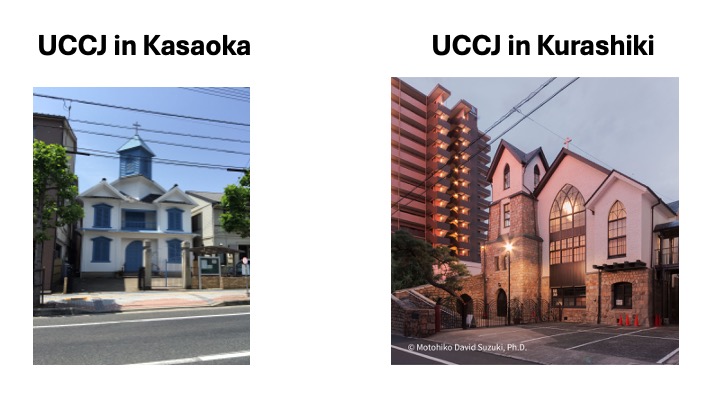
• The largest Protestant Group is the United Church of Christ in Japan.
• It is a merger of 33 Protestant “denominations,” created in 1941 to increase governmental oversight.
• Ca 1600 congregations with a membership of ca 152,000.
• Member of the World Council of Churches.
• Evangelical Churches
• Evangelical Free Church of Japan.
• Japan Assembly of God.
• Japanese Evangelical Association includes several movements/fellowships.
• Some of these are bilingual congregations (English-Japanese) with both Japanese and ex-pat attendees.
• Indigenous Japanese Churches
• Mukyōkai (Non-Church Movement). Uniquely Japanese. No sacraments or clergy. Emphases are personal Bible study and devotion.
• Living Christ One Ear of Wheat Church. Indigenous with connections to holiness movements.
• Holy Ecclesia of Jesus. Founded in 1946. Recovers Apostolic Christianity.
• Roman Catholic Churches
• Mixture of Japanese congregations and those with ex-pat connections.
• There are 15 dioceses in the country.
• Nagasaki is the traditional center of Catholicism in Japan.
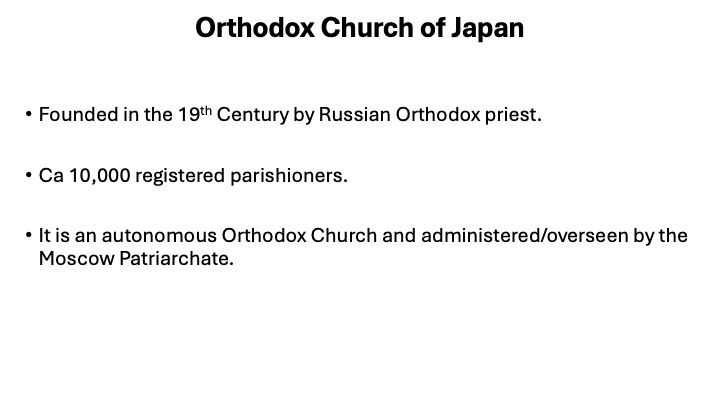
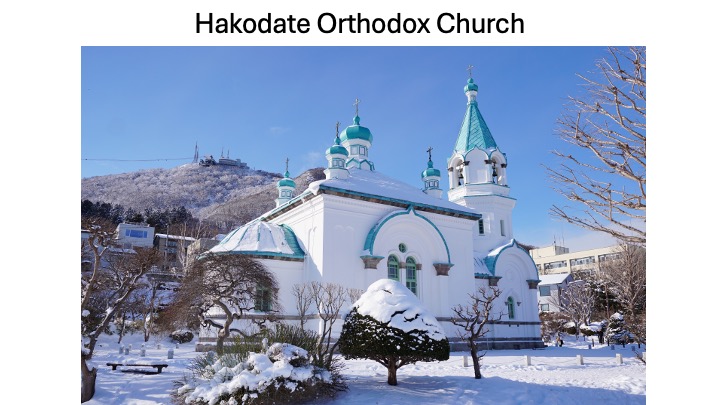
• Orthodox Church of Japan
• Founded in the 19th Century by Russian Orthodox priest.
• Ca 10,000 registered parishioners.
• It is an autonomous Orthodox Church and administered/overseen by the Moscow Patriarchate.
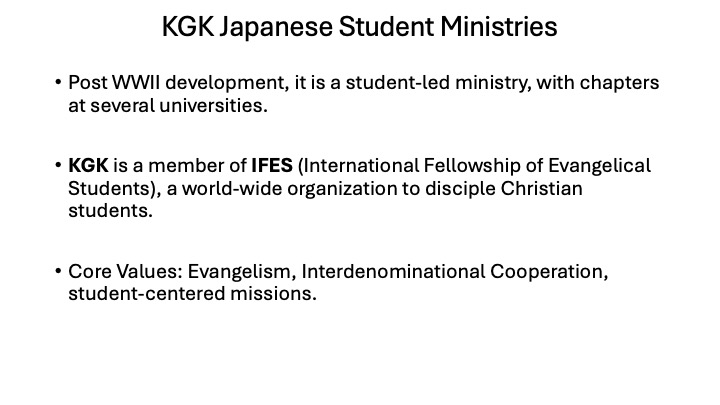
• KGK Japanese Student Ministries
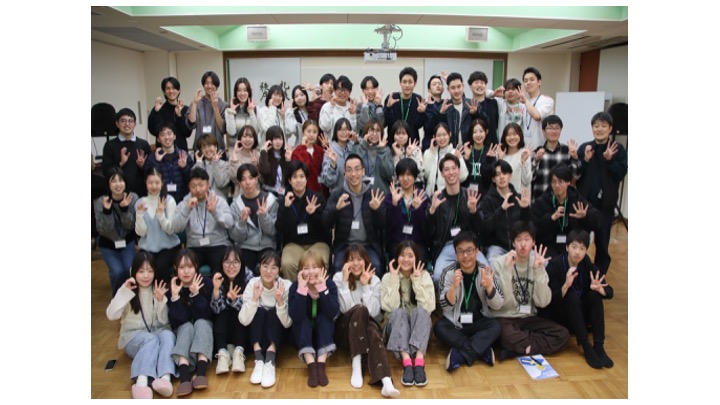
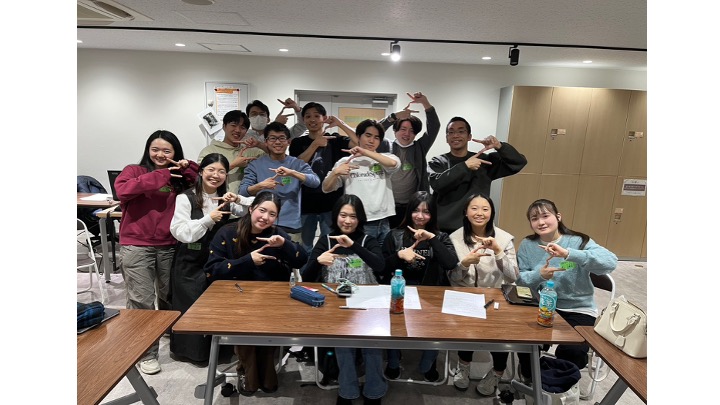
• Post WWII development, it is a student-led ministry, with chapters at several universities.
• KGK is a member of IFES (International Fellowship of Evangelical Students), a world-wide organization to disciple Christian students.
• Core Values: Evangelism, Interdenominational Cooperation, student-centered missions.
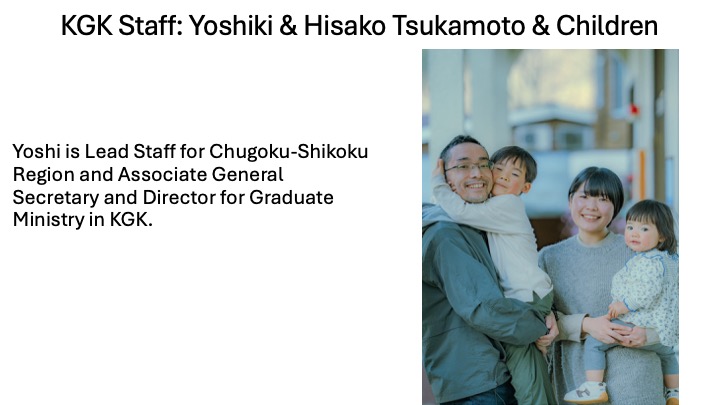
• KGK Staff: Yoshiki & Hisako Tsukamoto & Children
Yoshi is Lead Staff for Chugoku-Shikoku Region and Associate General Secretary and Director for Graduate Ministry in KGK.