A Social Justice Vocation - Lesson 1
Mike Ervin
A Social Justice Vocation - Lesson 1
Links
<< Home Page > > << A Social Justice Vocation Menu > >
A Social Justice Vocation - Lesson 1 - The Text
A Social Justice Vocation? Class 1 Mike Ervin
SLIDE 1
One of the many reasons I have enjoyed our many years of study together is as our total portfolio of classes has grown, I have observed so many linkages between subjects that we study.
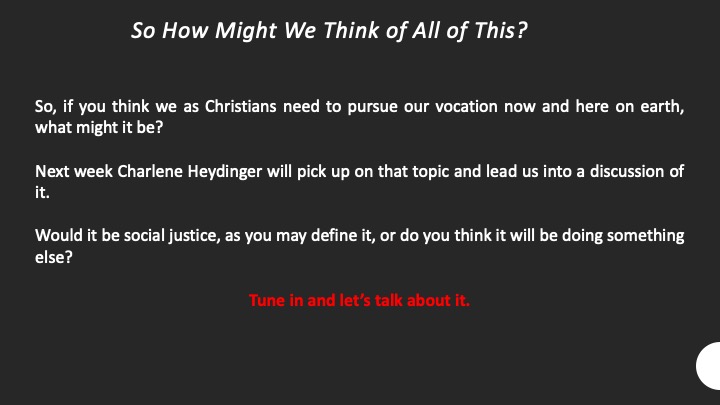
Chris Knepp just took us through a deep dive into N. T Wright’s : “The Day the Revolution Began” which as you remember included Wright’s interpretation that his real learning from his intensive study of the biblical message was that the death and resurrection of Jesus was about a new revolution that involved defining a new vocation for people of faith to advance the Kingdom of God here and now. But what might that vocation involve?
SLIDE 2
Over our next two classes, Charlene Heydinger and I are planning to explore a possibility vocation for Christians. Who knew that Chris would set that up for us.
To tackle this, I will teach this Sunday and Charlene next Sunday.
So my title this week is a question – “A Social Justice Vocation?
And to introduce this subject I am going to bring another prominent theologian into play who has written many books and it turns out is a good friend of N. T. Wright and comes from exactly the same academic linage.
SLIDE 3
Marcus Borg, an American scholar and theologian was a friend of N. T. Wright. Not only did they both attend Oxford University in the U.K., they studied under the same doctorial professor – G. B. Caird. And since their university days they stayed in touch, despite have some theological differences. Interestingly they discussed these differences together in a book “The Meaning of Jesus: Two Visions” (1999, rev. 2007).
SLIDE 4
Although they, as all scholars do, developed their theology and views independently, they shared a few broad traits that they developed from their advisor, especially the absolute importance of putting everything they read into its probable religious, historical, economic, and political context - a trait of many modern bible scholars.
Borg, probably more so than Wright, put considerably more emphasis on the economic and political context than Wright. And that is what I would like to bring to bear today, because this is where his emphasis on the need for social justice comes into play.
SLIDE 5
Social Justice
The term “Social Justice” is a very complex one, with a very long history. It has been discussed in many ways, in both Greek and Roman philosophy, (Plato, Socrates, Aristotle) by many Christian writers (Augustine, Thomas Aquinas, and many others), and by a score of modern philosophers (too numerous to mention today.)
In the 20th century the United Nations began to articulate their stand on social justice under the title: “A Declaration on Social Progress and Development (1969)”, which stated “From the comprehensive global perspective shaped by the United Nations Charter and the Universal Declaration of Human Rights, neglect of the pursuit of social justice in all its dimensions translates into de facto acceptance of a future marred by permanent violence, repression and chaos.
SLIDE 6
One thing that can be observed however, is that today there seems to be broad disagreements about exactly what Social Justice really means, and whether it is that important. I do not propose to get into that argument today, but instead to present some of the analysis proposed by Marcus Borg, based on his study of the economic and political context of the times in which the bible was created and the biblical record and in particular on the writings of the biblical prophets.
And particularly today we are going to meet Amos, a very interesting and challenging prophet.
SLIDE 7
The key to seeing the political passion of the Bible is hearing and understanding its primary voices in their ancient historical contexts.
These contexts are not only literary, but also political. The political context of the Bible is “the ancient domination system,” sometimes also called “the premodern domination system.” Both phrases are used in historical scholarship for the way “this world”—the humanly created world of societies, nations, and empires—was structured until the democratic and industrial revolutions of the past few centuries.
SLIDE 8
POPULATION GRAPH
SLIDE 9
Ancient domination systems began in the 3000s BCE. Two developments account for their emergence. The first was large-scale agriculture and the production of agricultural surpluses, made possible by the invention of metal and metal farm instruments, especially the plow, and the domestication of large animals. The second was the direct result of the first: cities—large concentrations of settled population—became possible.
SLIDE 10
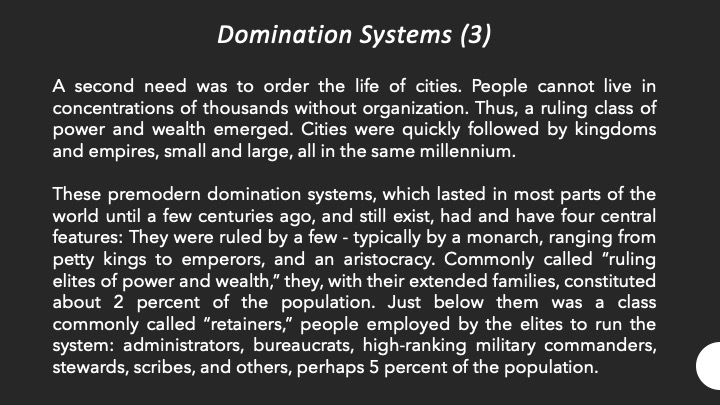
A second need was to order the life of cities. People cannot live in concentrations of thousands without organization. Thus a ruling class of power and wealth emerged. Cities were quickly followed by kingdoms and empires, small and large, all in the same millennium. These premodern domination systems, which lasted in most parts of the world until a few centuries ago, and still exist, had and have four central features: They were ruled by a few—typically by a monarch, ranging from petty kings to emperors, and an aristocracy. Commonly called “ruling elites of power and wealth,” they, with their extended families, constituted about 2 percent of the population. Just below them was a class commonly called “retainers,” people employed by the elites to run the system: administrators, bureaucrats, high-ranking military commanders, stewards, scribes, and others, perhaps 5 percent of the population.
SLIDE 11
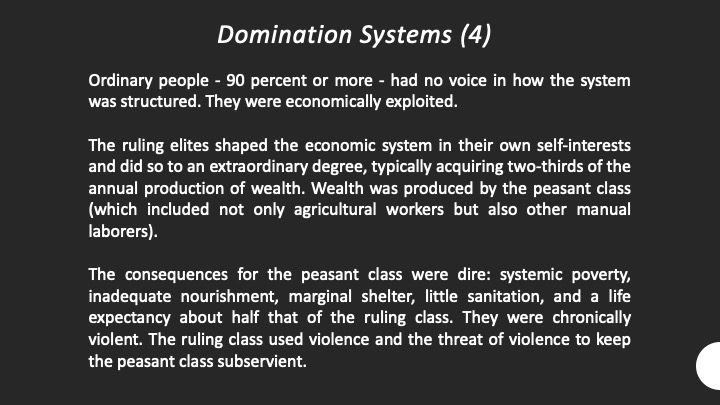
Ordinary people - 90 percent or more - had no voice in how the system was structured. They were economically exploitative. The ruling elites shaped the economic system in their own self-interests and did so to an extraordinary degree, typically acquiring half to two-thirds of the annual production of wealth. Wealth was largely the product of the peasant class (which included not only agricultural workers but also other manual laborers). The consequences for the peasant class were dire: systemic poverty, inadequate nourishment, marginal shelter, little sanitation, and a life expectancy about half that of the ruling class. They were chronically violent. The ruling class used violence and the threat of violence to keep their own population subservient.
SLIDE 12
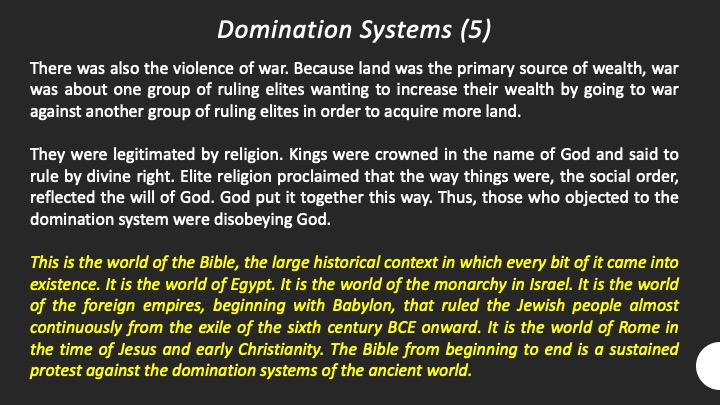
There was also the violence of war. Because land was the primary source of wealth, war was about one group of ruling elites wanting to increase their wealth by going to war against another group of ruling elites in order to acquire more land. They were legitimated by religion. Kings were crowned in the name of God and said to rule by divine right. Elite religion proclaimed that the way things were, the social order, reflected the will of God. God put it together this way. Thus those who objected to the domination system were disobeying God. This is the world of the Bible, the large historical context in which it came into existence. It is the world of Egypt. It is the world of the monarchy in Israel. It is the world of the foreign empires, beginning with Babylon, that ruled the Jewish people almost continuously from the exile of the sixth century BCE onward. It is the world of Rome in the time of Jesus and early Christianity. The Bible from beginning to end is a sustained protest against the domination systems of the ancient world.
SLIDE 13
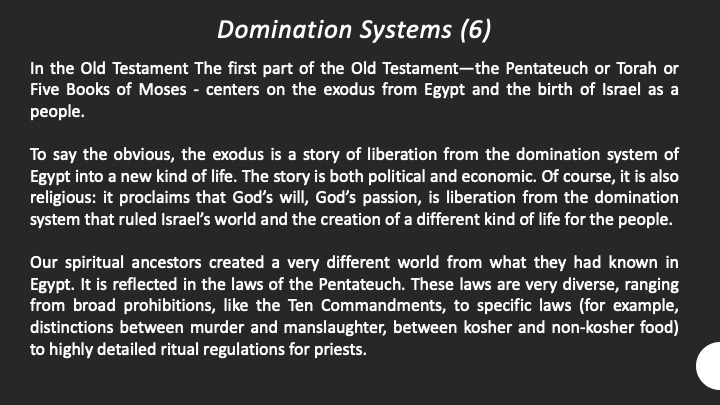
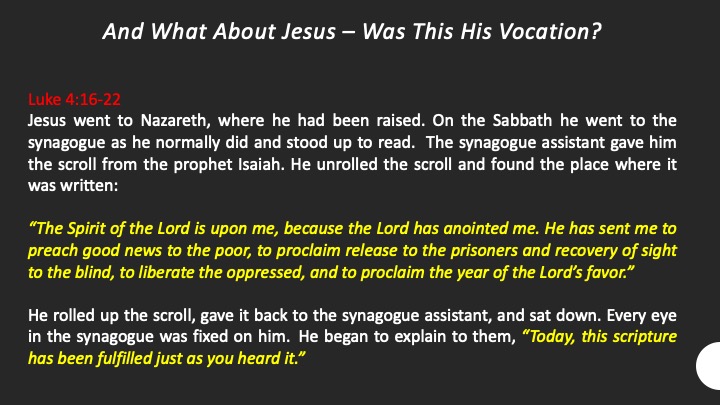
In the Old Testament The first part of the Old Testament - the Pentateuch or Torah or Five Books of Moses - centers on the exodus from Egypt and the birth of Israel as a people. To say the obvious, the exodus is a story of liberation from the domination system of Egypt into a new kind of life. The story is both political and economic. Of course, it is also religious: it proclaims that God’s will, God’s passion, is liberation from the domination system that ruled Israel’s world and the creation of a different kind of life for the people. Our spiritual ancestors created a very different world from what they had known in Egypt. It is reflected in the laws of the Pentateuch. These laws are very diverse, ranging from broad prohibitions, like the Ten Commandments, to specific laws (for example, distinctions between murder and manslaughter, between kosher and non-kosher food) to highly detailed ritual regulations for priests.
SLIDE 14
They also include some of the most radical economic principles in human history concerning land and debt: Every family was to have its own piece of agricultural land. The reason: in that world, land was the material basis of existence. A family that had its own land, even if only a few acres, could provide for itself by raising its own food: grain, vegetables, fruit, a few animals. Nobody would go hungry. Agricultural land could not be bought or sold. The intention is clear: to prevent the emergence of large landowners and the growth of a class of landless peasants. Debt was not entered into lightly, as in our world today of credit cards and mortgages. Only the most serious circumstances - namely, the need to have food - led to debt.
The reasons can easily be imagined: drought, a terrible crop year, serious illness that made it impossible for the family to work the fields, the death of farm animals, and so forth. No interest was to be charged on debts.
SLIDE 15
If a prosperous family could afford to make a loan to an unfortunate family, they were not to profit from it. Every seventh year (the Sabbath year), all debts were to be forgiven, and indentured slaves (those who had fallen into servitude because of debt) were to be set free. The intention is clear: to prevent the growth of a permanently impoverished underclass. The Sabbath year was about the opportunity to begin again. Though land could not be bought or sold, there was one way that it could be lost: foreclosure for debt. And thus the law of Jubilee: every fiftieth year, all agricultural land was to be returned to the original family of ownership, without compensation.
SLIDE 16
The reason for all these laws about land and debt was to create a world unlike that of Egypt. It was to be a world in which every family has the material basis of existence and thus has enough to live and in which no one is permanently enslaved and impoverished. In yet another way, our spiritual ancestors created a world unlike Egypt. For the first few centuries after the exodus, there was no monarchy in Israel, and thus no aristocracy, no ruling elites of wealth and power. Then, around 1000 BCE, a monarchy emerged within Israel. Under Saul and David, the first two kings, it was a modest institution. But during the nearly half century reign of David’s son Solomon, it became a domination system ruled by elites of power and wealth. As Walter Brueggemann, one of today’s most important Old Testament scholars, puts it: Egypt had been re-created within Israel; the Israelite king had become a new Pharaoh.
SLIDE 17
The first book of Samuel narrates the emergence of kingship in Israel. Samuel—the last of the “judges” of Israel—warns those who wanted a king what would happen under a monarchy. “These will be the ways of the king who will reign over you: he will take your sons and appoint them to his chariots and to be his horsemen, and to run before his chariots; and he will appoint for himself commanders of thousands and commanders of fifties, and some to plow his ground and to reap his harvest, and to make his implements of war and the equipment of his chariots. He will take your daughters to be perfumers and cooks and bakers. He will take the best of your fields and vineyards and olive orchards and give them to his courtiers. He will take one-tenth of your grain and of your vineyards and give it to his officers and his courtiers. He will take your male and female slaves, and the best of your cattle and donkeys, and put them to his work. He will take one-tenth of your flocks, and you shall be his slaves. (1 Sam 8.11–17). The relentless repetition of “he will take” is like an ominous drumbeat.
Slide 18
That indictment continues in the second main part of the Old Testament, the Prophets. Figures like Amos, Micah, Isaiah, Jeremiah, and so forth, were voices of radical protest against the economic injustice and violence of what was now a native domination system. In the name of God, they indicted the wealthy and powerful for serving their own interests at the expense of the many—the peasant class, the vast majority of the population. Their words warned that the future of their unjust and violent society was destruction. They not only criticized the way things were, but also spoke of God’s dream, God’s passion, for a different kind of world—not in an afterlife, but in this world, here on earth
Slide 19
All of them emphasize justice—not primarily punitive justice (the punishment of wrongdoing), but economic justice, economic fairness, in which everybody had enough of the basic necessities of life. They also dreamed of a world in which violence, especially the violence of war, would be no more. The reason is obvious: the God of the Bible cares about human suffering. Economic injustice and war were, and still are, the two primary sources of unnecessary human misery. Two texts from the prophet Micah illustrate this. The first and probably the best known emphasizes justice:
Slide 20
God] has told you, O mortal, what is good; and what does the LORD require of you but to do justice, and to love kindness, and to walk humbly with your God? (6.8) The second combines justice and the end of war. God’s dream is that [the nations] shall beat their swords into plowshares, and their spears into pruning hooks; nation shall not lift up sword against nation, neither shall they learn war any more; but they shall all sit under their own vines and under their own fig trees and no one shall make them afraid. (4.3–4) Note the twofold emphasis on the end of war and all nations sitting “under their own vines and under their own fig trees,” an image of every family having its own land. The result: “no one shall make them afraid.” War will be no more, and everybody will have enough.
Slide 21
In the New Testament Jesus and early Christians lived within the largest and most powerful domination system of the ancient world. The Jewish homeland fell under Roman control in 63 BCE, about six decades before Jesus’s birth. Rome ruled through client kings who owed their allegiance to Rome. In the gospels, the most important of these were Herod the Great (the Herod of the stories of Jesus’s birth, who ruled from 37 BCE to 4 BCE) and his son Herod Antipas (the Herod of the gospels during Jesus’s adult life, who ruled Galilee from 4 BCE to 39 CE). In Judea, beginning in 6 CE, Rome ruled through the high priest and temple authorities in Jerusalem who were appointed by Roman governors, the most famous of whom was Pontius Pilate.
Slide 22
Roman rule negatively affected the peasant class in the Jewish homeland as well as throughout the empire. The commercialization of agriculture and the monetization of the economy resulted in the creation of large estates and the consequent loss of land by peasants. Moreover, land was increasingly used to produce crops for sale and export. No longer did most peasants farm small parcels of land to produce food for their families. Instead, landless laborers had to purchase their own food from the meager amount they were paid, most often barely enough to survive on and often less. In this setting, Jesus proclaimed the coming of “the kingdom of God.”
Slide 23
A Focus on Amos
“Amos” refers to both a person and a book. He was historically the first of what are commonly called the “classical” prophets of ancient Israel, the ones who have books named after them, figures like Hosea, Micah, Isaiah, Jeremiah, and so forth. Though we have his message in a book, he (like the other prophets) spoke it in relatively brief “oracles,” shorthand for oral prophetic speeches. Proclaimed in public settings, they most often used poetic structure, vivid metaphor, and wordplay so they would have been memorable in an oral culture. As brief public pronouncements, each may have been spoken many times. The book of Amos is a collection of Amos’s oracles put into writing a generation or more after his death. Putting them into writing involved not only collecting them, but also arranging and editing them. A few passages most likely come from a later time. But scholars generally agree that most of the book is memory of the gist of what Amos said.
Slide 24
Amos spoke in the northern kingdom of Israel near the end of the long reign (786 to 746 BCE) of King Jeroboam II. The kingdom of David and Solomon had divided in two at the end of Solomon’s reign in the late 900s. The north, with its capital in Samaria, continued to be known as Israel. The south, with its capital in Jerusalem, was known as Judah. The two kingdoms were often enemies and sometimes at war with each other. It was a time when the wealth and power of the monarchy and ruling class greatly increased and the condition of most of the population deteriorated. Often in fierce language Amos indicted the wealthy and powerful and advocated the cause of the poor in the name of God: “Thus says the Lord” and “Hear the word of the Lord” ring throughout his oracles. His words include both indictment and judgment.
Slide 25
Indictment Some of Amos’s oracles indicting the ruling elites use “you” language, suggesting they were directed at the ruling elites. Some use “they” language about the wealthy and powerful. Perhaps these were spoken to the peasant class and sought to raise their consciousness about their oppression and that it was not God’s will. In “they” language Amos painted a picture of the luxurious lifestyles of the wealthy and powerful: Alas for those who lie on beds of ivory, and lounge on their couches, and eat lambs from the flock, and calves from the stall; who sing idle songs to the sound of the harp, and like David improvise on instruments of music; who drink wine from bowls, and anoint themselves with the finest oils, but are not grieved over the ruin of Joseph [the ruin of the poor]! (6.4–6) In another oracle he zeroed in on what the elites have done to the poor: . . . they sell the righteous [the innocent, those who have done no wrong] for silver, and the needy for a pair of sandals— they who trample the . . . poor into the dust of the earth, and push the afflicted out of the way. (2.6–7)
Slide 26
In “you” language, Amos indicted the ruling elites directly: Therefore because you trample on the poor and take from them levies of grain, you have built houses of hewn stone, but you shall not live in them; you have planted pleasant vineyards, but you shall not drink their wine.
For I know how many are your transgressions, and how great are your sins— you who afflict the righteous, who take a bribe, and push aside the needy in the gate. (5.11–12) Hear this, you that trample on the needy, and bring to ruin the poor of the land, ….
He called the wives of the wealthy and powerful in the capital city Samaria sleek and fat “cows”: Hear this word, you cows of Bashan who are on Mount Samaria, who oppress the poor, who crush the needy, who say to their husbands, “Bring something to drink!” (4.1)
Slide 27
And in most blistering language he indicted the worship of the elites - their festivals, solemn gatherings, sacrifices, hymns, and music - in “you” language. In this text, as often in the prophets, the “I” is God - that is, Amos speaking in the name of God: I hate, I despise your festivals, and I take no delight in your solemn assemblies. Even though you offer me your burnt offerings and grain offerings, I will not accept them; and the offerings of well-being of your fatted animals I will not look upon. Take away from me the noise of your songs; I will not listen to the melody of your harps. But let justice roll down like waters, and righteousness like an ever-flowing stream. (5.21–24) Importantly, the issue was not that the elites were worshipping “other gods,” but what we might call their “orthodox” worship of the God of Israel.
Slide 28
Instead of their worship, Amos proclaims in the final verse what God really wants from them: justice rolling down like waters and righteousness like an ever-flowing stream. This verse is a classic example of what scholars of the prophets call “synonymous parallelism”: the second half of the sentence says the same thing as the first half but in different language. What God wants is not justice plus righteousness; rather, they are the same. Judgment Amos also threatened the elites of power and wealth with God’s judgment. The threat was not what is often called “the final judgment,” that is, not hell, not punishment beyond death. Recall that an afterlife in heaven or hell was not part of ancient Israel’s belief system. Rather, Amos’s threat was within history: loss of the privileged status of the elites through the destruction of their social order and exile.