What About the Rapture?
Chris Knepp


What About the Rapture?
Links
<< Home >>
The Rapture Text
The Rapture Text
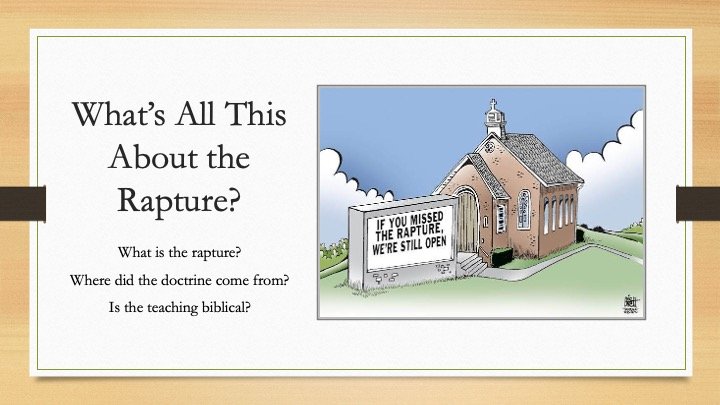
What’s All This About the Rapture?
What is the rapture?
Where did the doctrine come from?
Is the teaching biblical?
• Definition: An end-times event where living and dead Christians are "caught up" to meet Jesus Christ in the air. The term “rapture” does not appear in English Bibles.
• Biblical Root: Based on the Greek word harpazo (meaning to snatch away or seize) used in 1 Thessalonians 4:17, which was translated into Latin as raptura.
• The debate: Is there a two-step process with a secret rapture of believers followed at another time by Jesus’s return in visible glory to judge the living and the dead; or is there only a single event remaining on the church’s end-times calendar? For Catholics, Orthodox, and traditional Protestants, it is the latter.
1 Thessalonians 4:13-18
13 But we do not want you to be uninformed, brothers, about those who are asleep, that you may not grieve as others do who have no hope. 14 For since we believe that Jesus died and rose again, even so, through Jesus, God will bring with him those who have fallen asleep. 15 For this we declare to you by a word from the Lord, that we who are alive, who are left until the coming of the Lord, will not precede those who have fallen asleep. 16 For the Lord himself will descend from heaven with a cry of command, with the voice of an archangel, and with the sound of the trumpet of God. And the dead in Christ will rise first. 17 Then we who are alive, who are left, will be caught up together with them in the clouds to meet the Lord in the air, and so we will always be with the Lord. 18 Therefore encourage one another with these words.
1 Thessalonians
4:13-18
Paul writes to Gentile converts in Thessalonica who are distressed because some members of their community have died before the return of Christ (Parousia), fearing the deceased have missed out on the glory to come. Paul contrasts Christian grief with "others who have no hope," urging them to mourn with the assurance of resurrection rather than despair.
For over 1800 years, Paul’s words were understood to refer to the return of Jesus Christ to renew and reign over the new creation as depicted in Revelation 21. So where did the idea of a secret “rapture” which removes believers from this world before final judgment originate?
• Dispensational Premillennialism
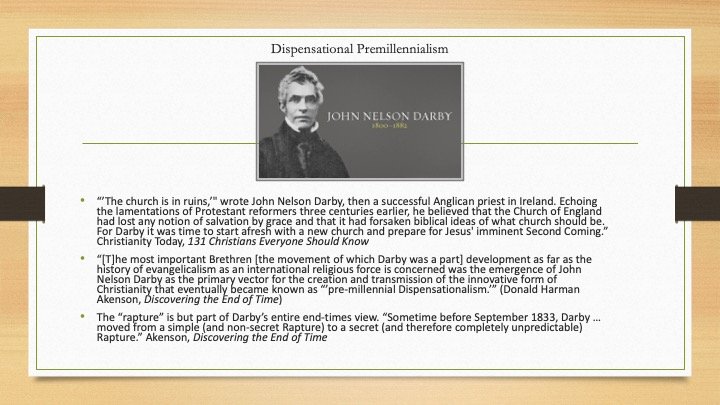
“’The church is in ruins,’" wrote John Nelson Darby, then a successful
Anglican priest in Ireland. Echoing the lamentations of Protestant reformers
three centuries earlier, he believed that the Church of England had lost any
notion of salvation by grace and that it had forsaken biblical ideas of what
church should be. For Darby it was time to start afresh with a new church and
prepare for Jesus' imminent Second Coming.” Christianity Today, 131 Christians
Everyone Should Know
• “[T]he most important Brethren [the movement of which Darby was a part] development as far as the history of evangelicalism as an international religious force is concerned was the emergence of John Nelson Darby as the primary vector for the creation and transmission of the innovative form of Christianity that eventually became known as “’pre-millennial Dispensationalism.’” (Donald Harman Akenson, Discovering the End of Time)
• The “rapture” is but part of Darby’s entire end-times view. “Sometime before September 1833, Darby … moved from a simple (and non-secret Rapture) to a secret (and therefore completely unpredictable) Rapture.” Akenson, Discovering the End of Time
Dispensational Premillennialism:
John Nelson Darby (1800-1882)
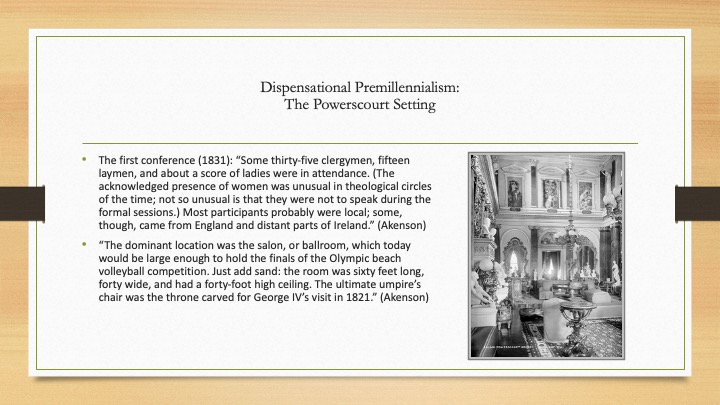
• Powerscourt: an impressive mansion in County Wicklow, Ireland (south of Dublin)
• The Powerscourt Conferences (1831-1833): Where Darby proclaimed and defended his end-time theories. Genteel house parties with a formal 5-day agenda, hosted by Lady Theodosia Powerscourt
Dispensational Premillennialism:
The Powerscourt Setting
• The first conference (1831): “Some thirty-five clergymen, fifteen laymen, and about a score of ladies were in attendance. (The acknowledged presence of women was unusual in theological circles of the time; not so unusual is that they were not to speak during the formal sessions.) Most participants probably were local; some, though, came from England and distant parts of Ireland.” (Akenson)
• “The dominant location was the salon, or ballroom, which today would be large enough to hold the finals of the Olympic beach volleyball competition. Just add sand: the room was sixty feet long, forty wide, and had a forty-foot high ceiling. The ultimate umpire’s chair was the throne carved for George IV’s visit in 1821.” (Akenson)
Dispensational Premillennialism:
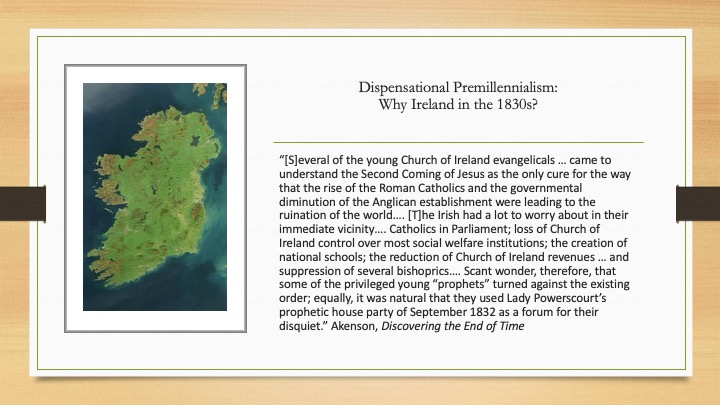
Why Ireland in the 1830s?
“[S]everal of the young Church of Ireland evangelicals … came to understand the Second Coming of Jesus as the only cure for the way that the rise of the Roman Catholics and the governmental diminution of the Anglican establishment were leading to the ruination of the world…. [T]he Irish had a lot to worry about in their immediate vicinity…. Catholics in Parliament; loss of Church of Ireland control over most social welfare institutions; the creation of national schools; the reduction of Church of Ireland revenues … and suppression of several bishoprics…. Scant wonder, therefore, that some of the privileged young “prophets” turned against the existing order; equally, it was natural that they used Lady Powerscourt’s prophetic house party of September 1832 as a forum for their disquiet.” Akenson, Discovering the End of Time
Dispensational Premillennialism: Why “Dispensational”?
• Refers to “a system of biblical interpretation that arose in the nineteenth century … based on the conviction that the unfolding biblical revelation should be divided into different dispensations, that is, into discreet time periods.” (J. Andrew Dearman, Reading the Bible with Dispensationalists)
• Darby was the “theological architect” of dispensationalism; C.I Scofield was the American theologian and minister who codified – and popularized – Darby’s framework in The Scofield Reference Bible in 1909.
• A “dispensation” is defined as “a period of time during which man is tested in respect of obedience to some specific revelation of the will of God.” (Scofield)
• “These periods are marked off in Scripture by some change in God’s method of dealing with mankind, in respect to two questions: of sin, and of man’s responsibility. Each of the dispensations is a new test of the natural man, and each ends in judgment – marking his utter failure in every dispensation.” (Scofield)
• “Rightly dividing the word of truth” (2 Tim 2:15, KJV), “not only into compartments of time, but also into sections that apply to Israel, the church, and the Gentiles…. [N]ot all portions of Scripture apply equally to the believer.” (Clouse, Hosack and Pierard, The New Millennium Manual)
Dispensational Premillennialism: Characteristics
• Literalism as the basic principle for interpreting the words of Scripture.
• Primacy of OT prophecy. OT promises concerning Israel’s future must have a literal earthly fulfillment.
• Whereas much of western and eastern Christianity understands the church to inherit the promises to Israel, in dispensationalism the terms Israel and church are to be kept separate. God’s plans for Israel and the church remain distinct until near the end. “For some dispensationalists, the Christian church (the dispensation of grace) is a parentheses in what is otherwise an unfolding history with Israel at center stage.” (Dearman)
• A future rapture (removal) of Christians from planet Earth prior to an accelerating reign of wickedness on the earth (Tribulation).
Dispensational Premillennialism:
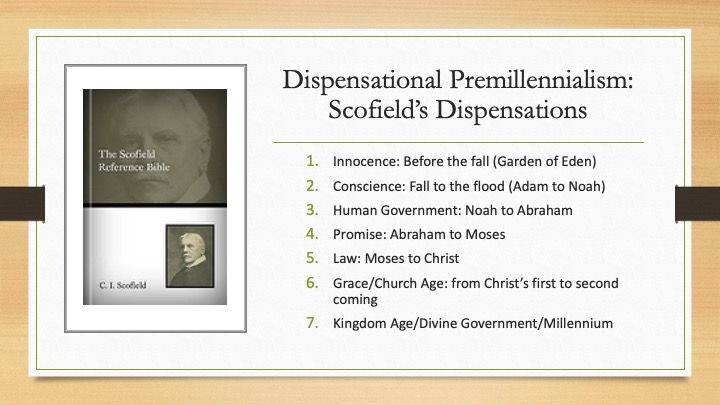
Scofield’s Dispensations
- Innocence: Before the fall (Garden of Eden)
- Conscience: Fall to the flood (Adam to Noah)
- Human Government: Noah to Abraham
- Promise: Abraham to Moses
- Law: Moses to Christ
- Grace/Church Age: from Christ’s first to second coming
- Kingdom Age/Divine Government/Millennium
Dispensational Premillennialism:
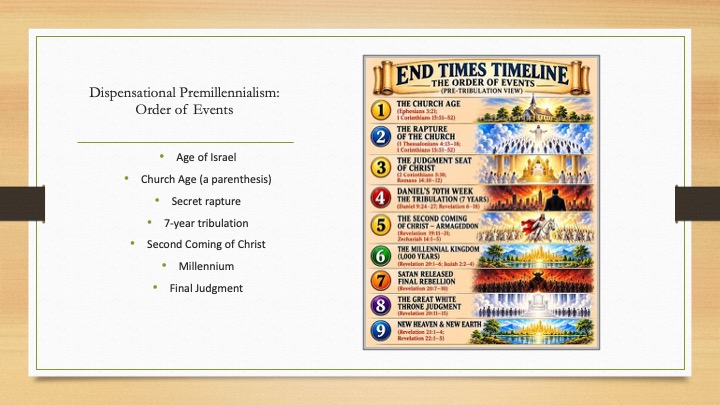
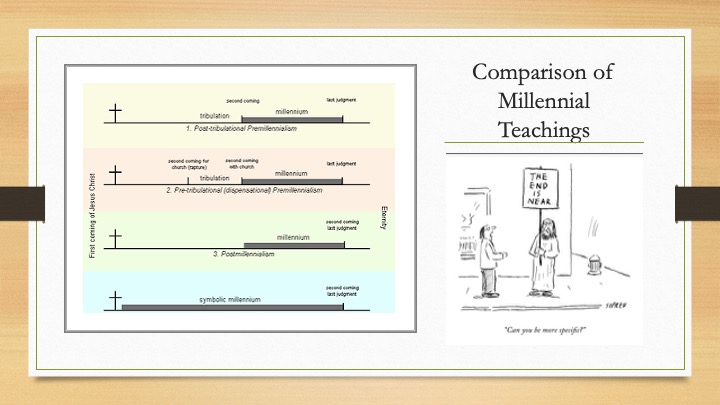
Order of Events
• Age of Israel
• Church Age (a parenthesis)
• Secret rapture
• 7-year tribulation
• Second Coming of Christ
• Millennium
• Final Judgment
Dispensational Premillennialism vs.
Covenant Theology
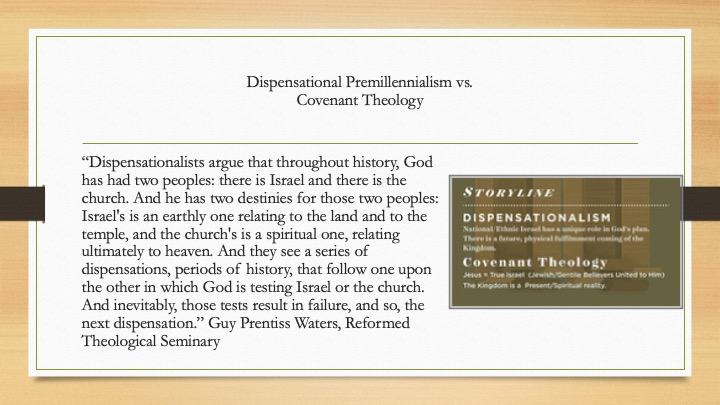
“Dispensationalists argue that throughout history, God has had two peoples: there is Israel and there is the church. And he has two destinies for those two peoples: Israel's is an earthly one relating to the land and to the temple, and the church's is a spiritual one, relating ultimately to heaven. And they see a series of dispensations, periods of history, that follow one upon the other in which God is testing Israel or the church. And inevitably, those tests result in failure, and so, the next dispensation.” Guy Prentiss Waters, Reformed Theological Seminary
Dispensational Premillennialism vs.
Covenant Theology
“Covenant theologians argue that God has one people, one people of God throughout redemptive history, called 'Israel' under the Old Testament, and called 'the church' under the New. And this one people, God has one saving purpose for them, and that purpose is to redeem sinners from every tribe, tongue, nation, and race through the blood of Jesus Christ. And that purpose is worked out in a series of covenants. We begin in history in the garden. We have the covenant of works. And Adam, when he disobeyed God, he fell into sin and we fell with him and in him. And God announced his purposes to save sinners through the last Adam, Jesus Christ. And he announces that as early as Genesis 3:15. And so the rest of the Bible is the outworking of that promise until in the fullness of time Christ comes. And by his obedience, his death, and his resurrection, he saves sinners from their sins. And so covenant theology helps us to see the grand and glorious unity in Scripture. It helps us to see how scripture exalts Jesus Christ as the savior of sinners. And it puts the spotlight on God as our maker and our redeemer.”
Dispensational Premillennialism: Why “Premillennialism”?
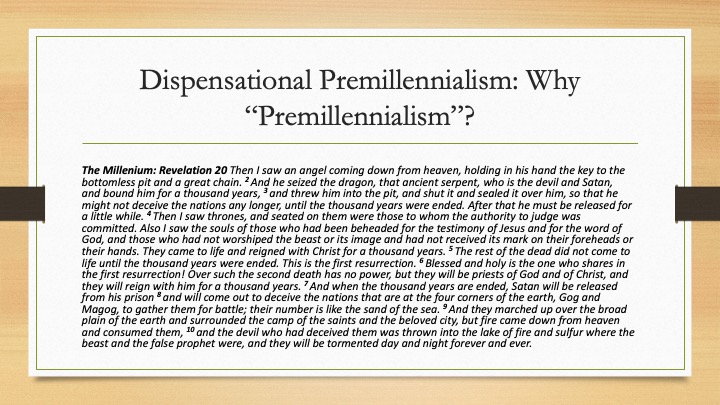
The Millenium: Revelation 20 Then I saw an angel coming down from heaven, holding in his hand the key to the bottomless pit and a great chain. 2 And he seized the dragon, that ancient serpent, who is the devil and Satan, and bound him for a thousand years, 3 and threw him into the pit, and shut it and sealed it over him, so that he might not deceive the nations any longer, until the thousand years were ended. After that he must be released for a little while. 4 Then I saw thrones, and seated on them were those to whom the authority to judge was committed. Also I saw the souls of those who had been beheaded for the testimony of Jesus and for the word of God, and those who had not worshiped the beast or its image and had not received its mark on their foreheads or their hands. They came to life and reigned with Christ for a thousand years. 5 The rest of the dead did not come to life until the thousand years were ended. This is the first resurrection. 6 Blessed and holy is the one who shares in the first resurrection! Over such the second death has no power, but they will be priests of God and of Christ, and they will reign with him for a thousand years. 7 And when the thousand years are ended, Satan will be released from his prison 8 and will come out to deceive the nations that are at the four corners of the earth, Gog and Magog, to gather them for battle; their number is like the sand of the sea. 9 And they marched up over the broad plain of the earth and surrounded the camp of the saints and the beloved city, but fire came down from heaven and consumed them, 10 and the devil who had deceived them was thrown into the lake of fire and sulfur where the beast and the false prophet were, and they will be tormented day and night forever and ever.
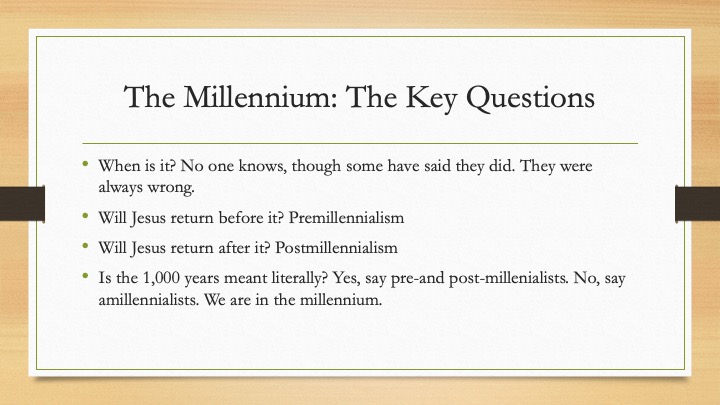
The Millennium: The Key Questions
• When is it? No one knows, though some have said they did. They were always wrong.
• Will Jesus return before it? Premillennialism
• Will Jesus return after it? Postmillennialism
• Is the 1,000 years meant literally? Yes, say pre-and post-millenialists. No, say amillennialists. We are in the millennium.
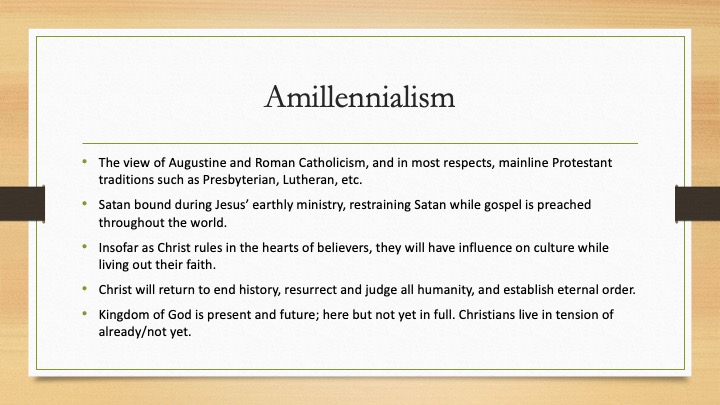
Amillennialism
• The view of Augustine and Roman Catholicism, and in most respects, mainline Protestant traditions such as Presbyterian, Lutheran, etc.
• Satan bound during Jesus’ earthly ministry, restraining Satan while gospel is preached throughout the world.
• Insofar as Christ rules in the hearts of believers, they will have influence on culture while living out their faith.
• Christ will return to end history, resurrect and judge all humanity, and establish eternal order.
• Kingdom of God is present and future; here but not yet in full. Christians live in tension of already/not yet.
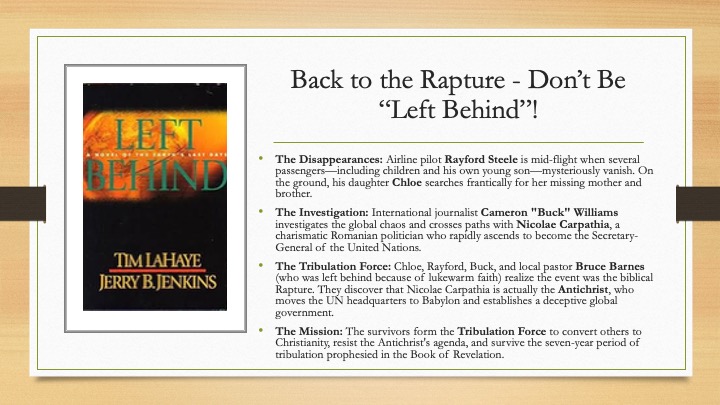
Back to the Rapture - Don’t Be
“Left Behind”!
• The Disappearances: Airline pilot Rayford Steele is mid-flight when several passengers—including children and his own young son—mysteriously vanish. On the ground, his daughter Chloe searches frantically for her missing mother and brother.
• The Investigation: International journalist Cameron "Buck" Williams investigates the global chaos and crosses paths with Nicolae Carpathia, a charismatic Romanian politician who rapidly ascends to become the Secretary-General of the United Nations.
• The Tribulation Force: Chloe, Rayford, Buck, and local pastor Bruce Barnes (who was left behind because of lukewarm faith) realize the event was the biblical Rapture. They discover that Nicolae Carpathia is actually the Antichrist, who moves the UN headquarters to Babylon and establishes a deceptive global government.
• The Mission: The survivors form the Tribulation Force to convert others to Christianity, resist the Antichrist's agenda, and survive the seven-year period of tribulation prophesied in the Book of Revelation.
Key Scriptures Cited for the Rapture
1 Thessalonians 4:13-18
13 But we do not want you to be uninformed, brothers, about those who are asleep, that you may not grieve as others do who have no hope. 14 For since we believe that Jesus died and rose again, even so, through Jesus, God will bring with him those who have fallen asleep. 15 For this we declare to you by a word from the Lord, that we who are alive, who are left until the coming of the Lord, will not precede those who have fallen asleep. 16 For the Lord himself will descend from heaven with a cry of command, with the voice of an archangel, and with the sound of the trumpet of God. And the dead in Christ will rise first. 17 Then we who are alive, who are left, will be caught up together with them in the clouds to meet the Lord in the air, and so we will always be with the Lord. 18 Therefore encourage one another with these words.
1 Thessalonians 4:13-18 Properly Understood
• There does not appear to be anything “secret” about Paul’s description. “16 For the Lord himself will descend from heaven with a cry of command, with the voice of an archangel, and with the sound of the trumpet of God.”
• N.T. Wright [and many other prominent theologians and pastors] interpret 1 Thessalonians 4:13–18 not as a prediction of a secret, pre-tribulation "rapture" where Christians permanently escape to heaven, but as a vivid, metaphorical description of Christ's public return to renew and reign over the earth as depicted in Revelation 21.
• Wright argues that modern popular views (such as those in the Left Behind series) misread Paul by turning vivid apocalyptic metaphors into a literal, disembodied flight away from Earth. He emphasizes that the New Testament does not teach an escape from creation, but the renewal of heaven and earth.
• The Royal Welcome (Apantēsis): Wright explains the phrase "meeting the Lord in the air" (1 Thessalonians 4:17) using ancient Greco-Roman civic customs. When a visiting emperor or dignitary approached a city, the citizens would go out outside the city gates to meet him in the open air and then escort him back into the city. Therefore, believers meeting Jesus in the air means they rise to greet him and immediately accompany him down to Earth to establish God's kingdom, not fly up to heaven.
Key Scriptures Cited for the Rapture
Matthew 24:36-44
• 36 “But concerning that day and hour no one knows, not even the angels of heaven, nor the Son, but the Father only. 37 For as were the days of Noah, so will be the coming of the Son of Man. 38 For as in those days before the flood they were eating and drinking, marrying and giving in marriage, until the day when Noah entered the ark, 39 and they were unaware until the flood came and swept them all away, so will be the coming of the Son of Man. 40 Then two men will be in the field; one will be taken and one left. 41 Two women will be grinding at the mill; one will be taken and one left. 42 Therefore, stay awake, for you do not know on what day your Lord is coming. 43 But know this, that if the master of the house had known in what part of the night the thief was coming, he would have stayed awake and would not have let his house be broken into. 44 Therefore you also must be ready, for the Son of Man is coming at an hour you do not expect.
Matthew 24:36-44 Properly Understood
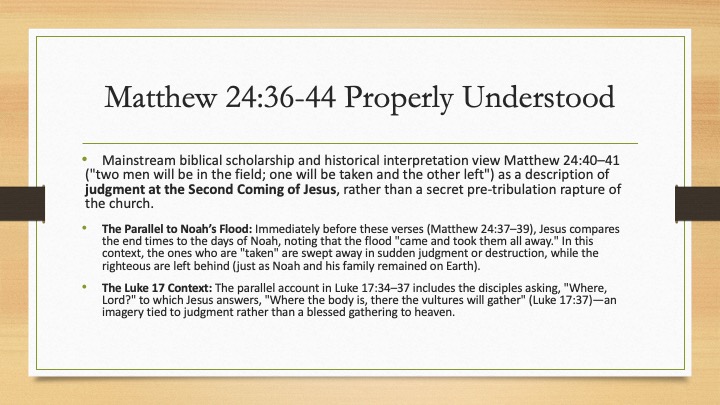
• Mainstream biblical scholarship and historical interpretation view Matthew 24:40–41 ("two men will be in the field; one will be taken and the other left") as a description of judgment at the Second Coming of Jesus, rather than a secret pre-tribulation rapture of the church.
• The Parallel to Noah’s Flood: Immediately before these verses (Matthew 24:37–39), Jesus compares the end times to the days of Noah, noting that the flood "came and took them all away." In this context, the ones who are "taken" are swept away in sudden judgment or destruction, while the righteous are left behind (just as Noah and his family remained on Earth).
• The Luke 17 Context: The parallel account in Luke 17:34–37 includes the disciples asking, "Where, Lord?" to which Jesus answers, "Where the body is, there the vultures will gather" (Luke 17:37)—an imagery tied to judgment rather than a blessed gathering to heaven.
Some Questions
• What do you see as the strengths and weaknesses of the end-times doctrines we have considered?
How, if at all, does your understanding of these end-times doctrines influence how you live your Christian life?