Japanese Christianity 1
Chris Knepp & Andy Dearman
The Story of Japanese Christianity..

Japanese Christianity 1
Links
<< Home >> << Japanese Christianity Menu >>
Hidden Christians of Japan - the Text
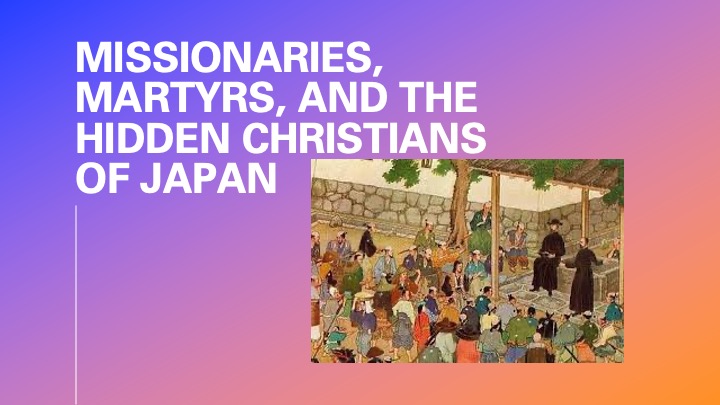
MISSIONARIES, MARTYRS, AND THE HIDDEN CHRISTIANS OF JAPAN
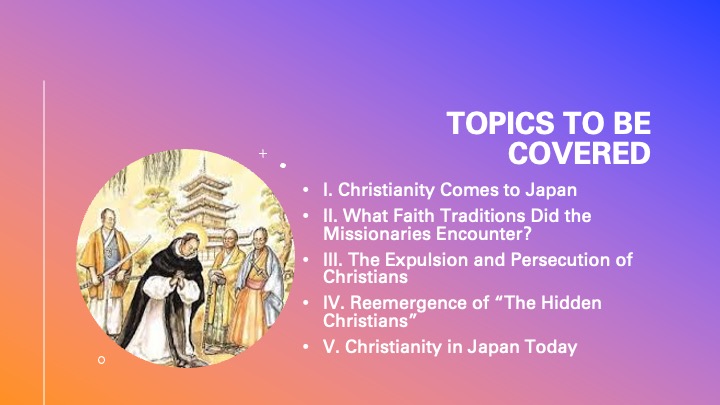
TOPICS TO BE COVERED
• I. Christianity Comes to Japan
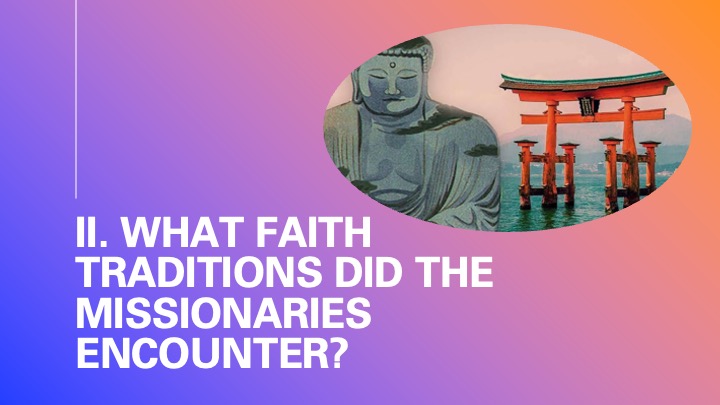
• II. What Faith Traditions Did the Missionaries Encounter?
• III. The Expulsion and Persecution of Christians
• IV. Reemergence of “The Hidden Christians”
• V. Christianity in Japan Today
I. Christianity comes to Japan
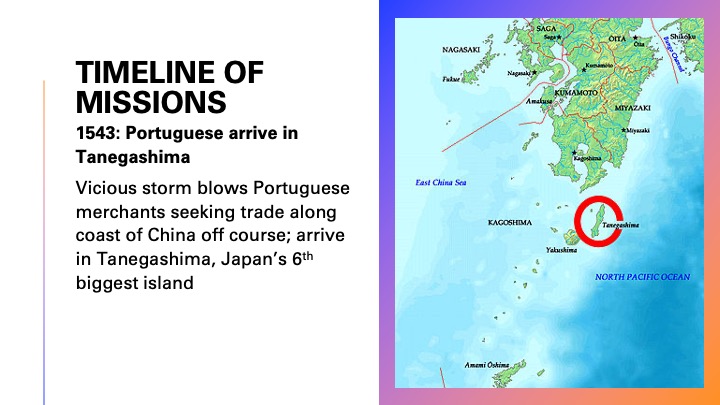
II. Timeline of missions
III. 1543: Portuguese arrive in Tanegashima
IV. Vicious storm blows Portuguese merchants seeking trade along coast of China off course; arrive in Tanegashima, Japan’s 6th biggest island
V. Timeline of missions
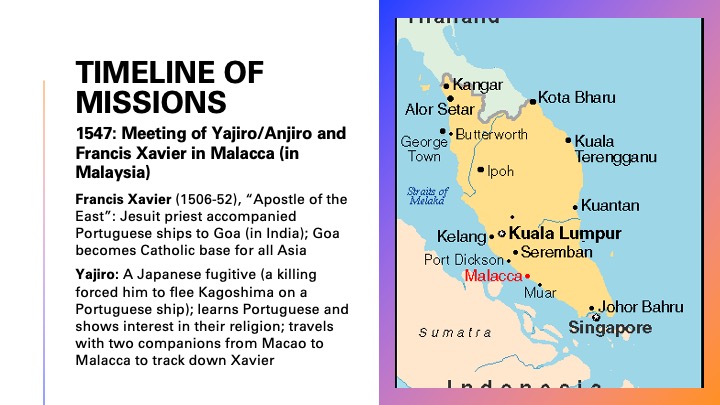
VI. 1547: Meeting of Yajiro/Anjiro and Francis Xavier in Malacca (in Malaysia)
VII. Francis Xavier (1506-52), “Apostle of the East”: Jesuit priest accompanied Portuguese ships to Goa (in India); Goa becomes Catholic base for all Asia
VIII. Yajiro: A Japanese fugitive (a killing forced him to flee Kagoshima on a Portuguese ship); learns Portuguese and shows interest in their religion; travels with two companions from Macao to Malacca to track down Xavier
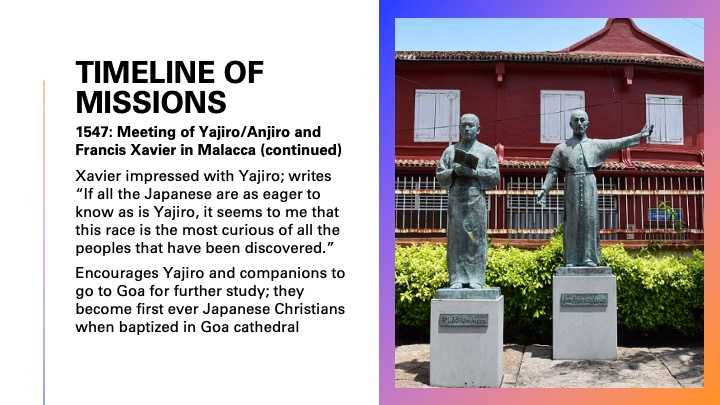
IX. 1547: Meeting of Yajiro/Anjiro and Francis Xavier in Malacca (continued)
X. Xavier impressed with Yajiro; writes “If all the Japanese are as eager to know as is Yajiro, it seems to me that this race is the most curious of all the peoples that have been discovered.”
XI. Encourages Yajiro ç
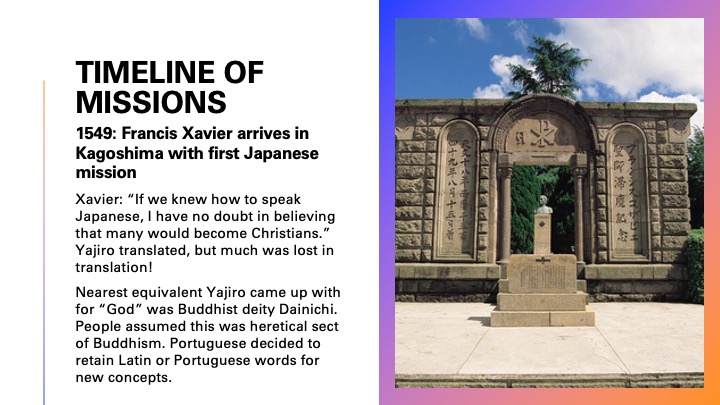
XII. 1549: Francis Xavier arrives in Kagoshima with first Japanese mission
XIII. Xavier: “If we knew how to speak Japanese, I have no doubt in believing that many would become Christians.” Yajiro translated, but much was lost in translation!
XIV. Nearest equivalent Yajiro came up with for “God” was Buddhist deity Dainichi. People assumed this was heretical sect of Buddhism. Portuguese decided to retain Latin or Portuguese words for new concepts.
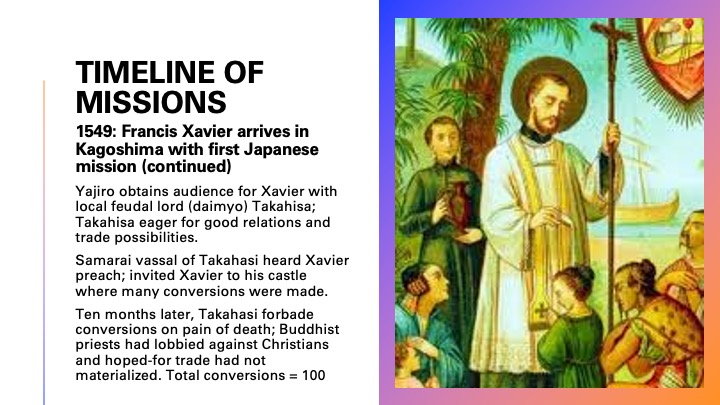
XV. 1549: Francis Xavier arrives in Kagoshima with first Japanese mission (continued)
XVI. Yajiro obtains audience for Xavier with local feudal lord (daimyo) Takahisa; Takahisa eager for good relations and trade possibilities.
XVII. Samarai vassal of Takahasi heard Xavier preach; invited Xavier to his castle where many conversions were made.
XVIII. Ten months later, Takahasi forbade conversions on pain of death; Buddhist priests had lobbied against Christians and hoped-for trade had not materialized. Total conversions = 100
XIX. 1549: Francis Xavier arrives in Kagoshima with first Japanese mission (continued)
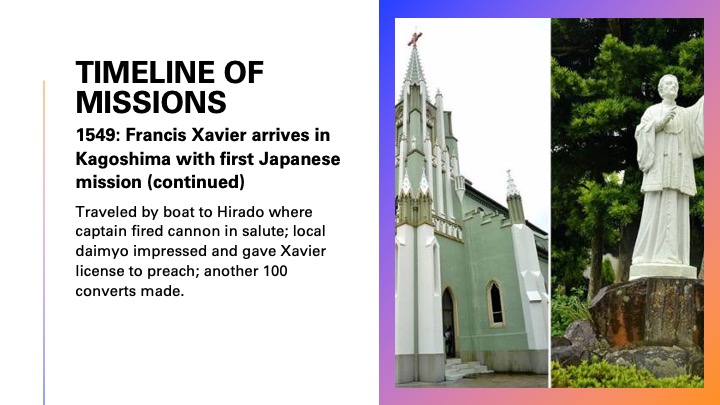
XX. Traveled by boat to Hirado where captain fired cannon in salute; local daimyo impressed and gave Xavier license to preach; another 100 converts made.
XXI. 1550: Xavier begins journey to visit “king of Japan” in capital of Kyoto/Miyako
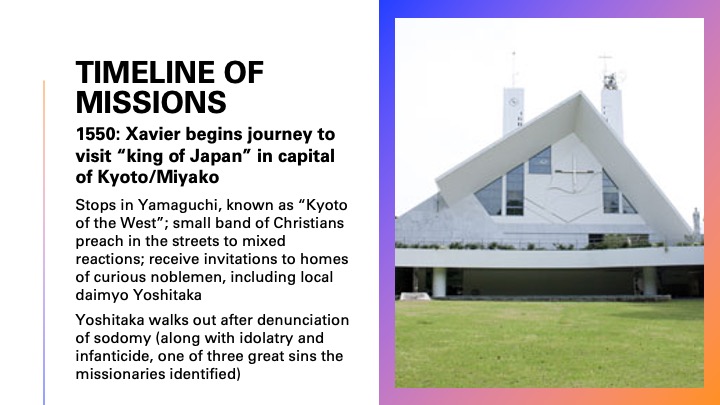
XXII. Stops in Yamaguchi, known as “Kyoto of the West”; small band of Christians preach in the streets to mixed reactions; receive invitations to homes of curious noblemen, including local daimyo Yoshitaka
XXIII. Yoshitaka walks out after denunciation of sodomy (along with idolatry and infanticide, one of three great sins the missionaries identified)
XXIV. 1551: Xavier arrives in Kyoto
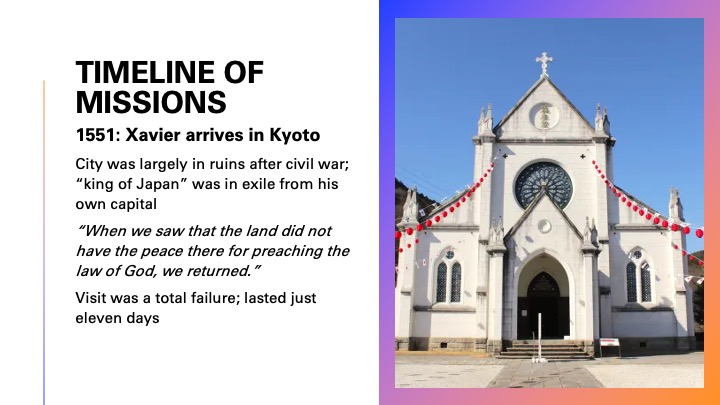
XXV. City was largely in ruins after civil war; “king of Japan” was in exile from his own capital
XXVI. “When we saw that the land did not have the peace there for preaching the law of God, we returned.”
XXVII. Visit was a total failure; lasted just eleven days
XXVIII. 1551-52: A Second Try in Yamaguchi
XXIX. Xavier had learned some lessons:
XXX. Significance of regional lords in absence of central rule
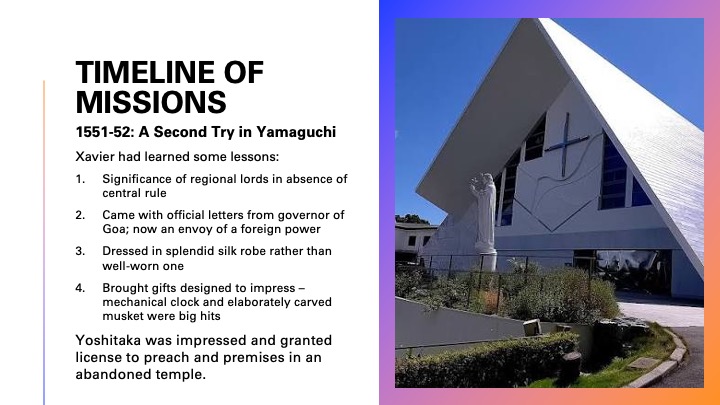
XXXI. Came with official letters from governor of Goa; now an envoy of a foreign power
XXXII. Dressed in splendid silk robe rather than well-worn one
XXXIII. Brought gifts designed to impress – mechanical clock and elaborately carved musket were big hits
XXXIV. Yoshitaka was impressed and granted license to preach and premises in an abandoned temple.
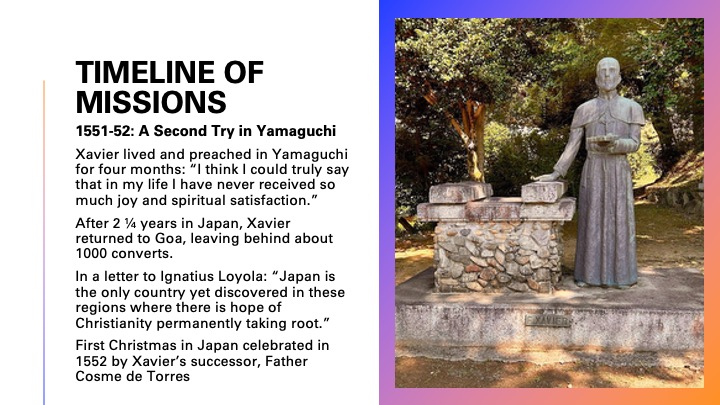
XXXV. 1551-52: A Second Try in Yamaguchi
XXXVI. Xavier lived and preached in Yamaguchi for four months: “I think I could truly say that in my life I have never received so much joy and spiritual satisfaction.”
XXXVII. After 2 ¼ years in Japan, Xavier returned to Goa, leaving behind about 1000 converts.
XXXVIII. In a letter to Ignatius Loyola: “Japan is the only country yet discovered in these regions where there is hope of Christianity permanently taking root.”
XXXIX. First Christmas in Japan celebrated in 1552 by Xavier’s successor, Father Cosme de Torres
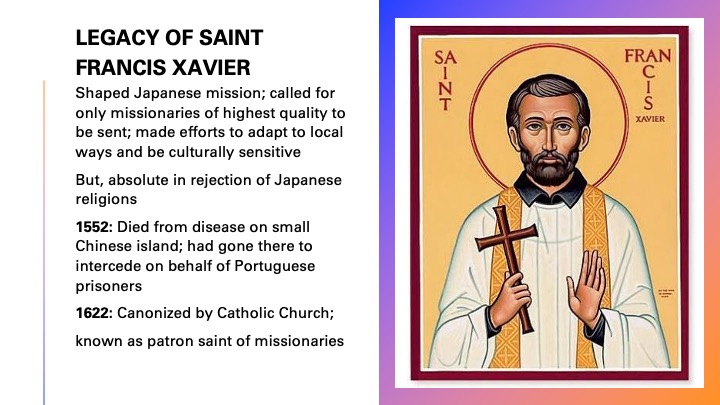
XL. Legacy of Saint Francis Xavier
XLI. Shaped Japanese mission; called for only missionaries of highest quality to be sent; made efforts to adapt to local ways and be culturally sensitive
XLII. But, absolute in rejection of Japanese religions
XLIII. 1552: Died from disease on small Chinese island; had gone there to intercede on behalf of Portuguese prisoners
XLIV. 1622: Canonized by Catholic Church;
XLV. known as patron saint of missionaries
XLVI. Tough Going!
XLVII. By 1559, only 6000 converts and six missionaries in Japan
XLVIII. Fortunes of mission depended on patronage of feudal lords; isolation of Christian groups made conversion an uphill task
XLIX. Some religious concepts baffled Japanese, e.g., notion of an eternal soul (What was its color and shape?); concept of an eternal hell (Buddhism promised possibility of rebirth into better life); in culture of ancestor worship, idea that family members might be eternally damned was unimaginable
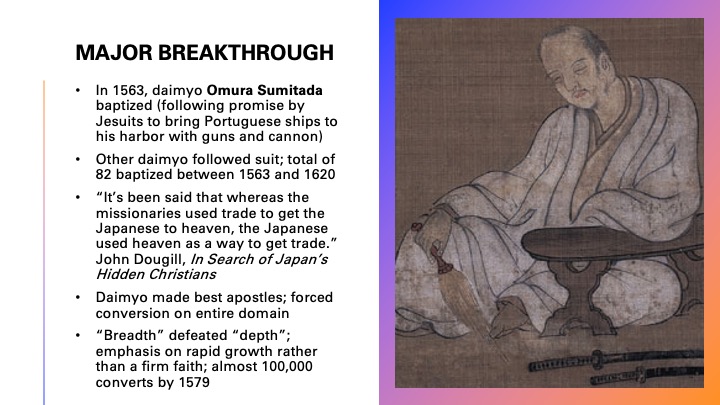
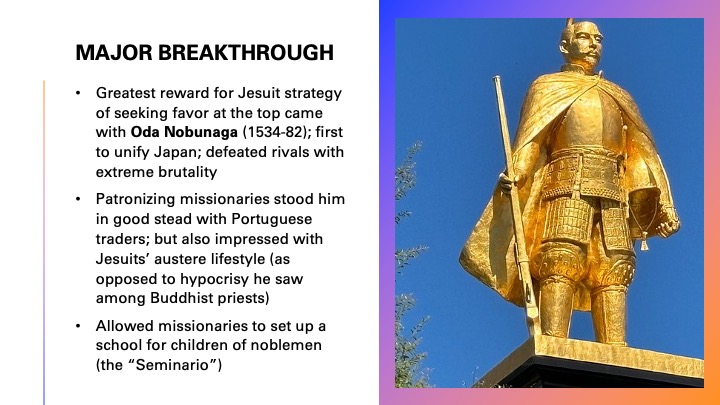
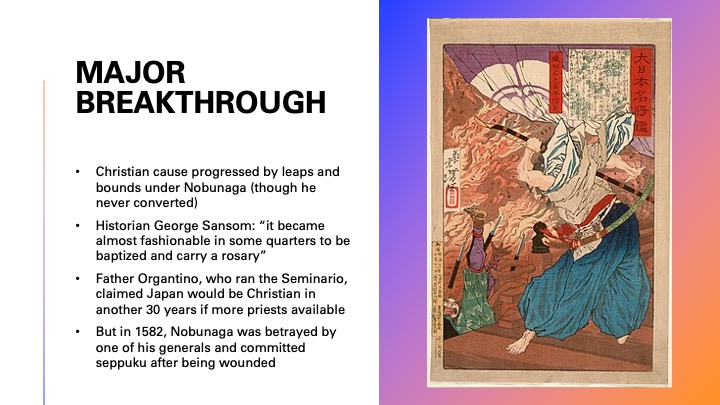
L. Major breakthrough
LI. In 1563, daimyo Omura Sumitada baptized (following promise by Jesuits to bring Portuguese ships to his harbor with guns and cannon)
LII. Other daimyo followed suit; total of 82 baptized between 1563 and 1620
LIII. “It’s been said that whereas the missionaries used trade to get the Japanese to heaven, the Japanese used heaven as a way to get trade.” John Dougill, In Search of Japan’s Hidden Christians
LIV. Daimyo made best apostles; forced conversion on entire domain
LV. “Breadth” defeated “depth”; emphasis on rapid growth rather than a firm faith; almost 100,000 converts by 1579
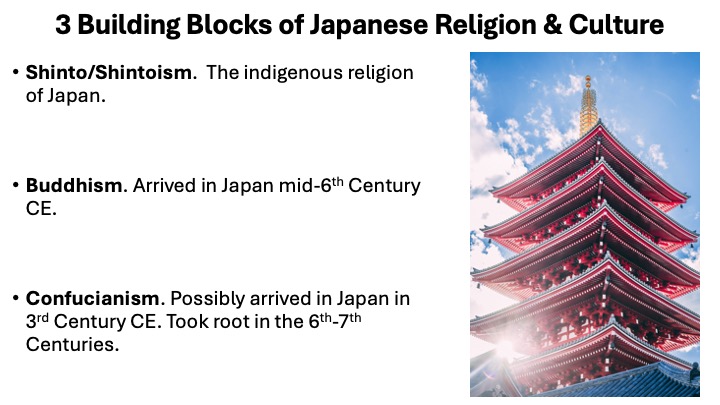
LVI. 3 Building Blocks of Japanese Religion & Culture
LVII. Shinto/Shintoism. The indigenous religion of Japan.
LVIII. Buddhism. Arrived in Japan mid-6th Century CE.
LIX. Confucianism. Possibly arrived in Japan in 3rd Century CE. Took root in the 6th-7th Centuries.
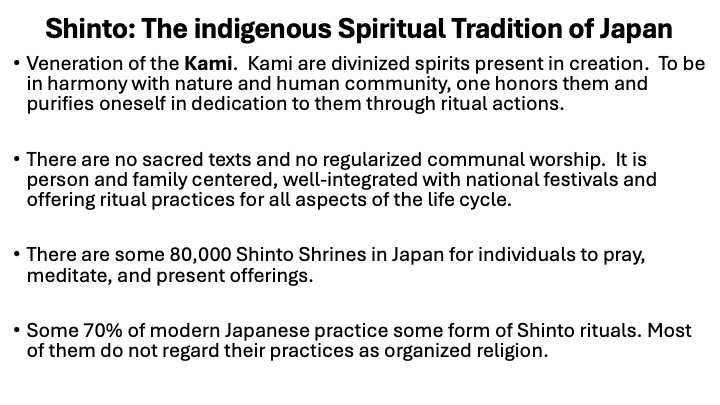
LX. Shinto: The indigenous Spiritual Tradition of Japan
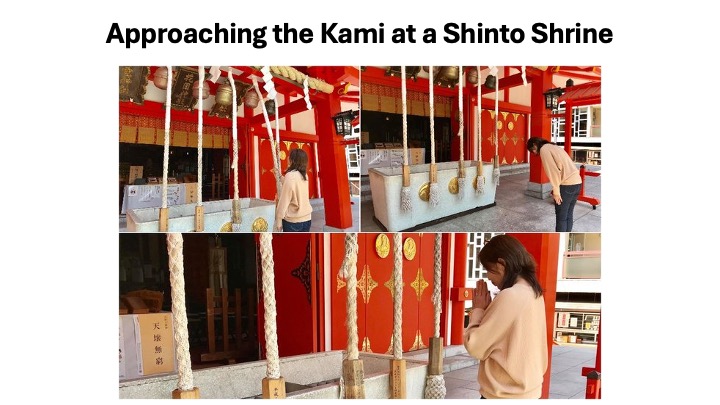
LXI. Veneration of the Kami. Kami are divinized spirits present in creation. To be in harmony with nature and human community, one honors them and purifies oneself in dedication to them through ritual actions.
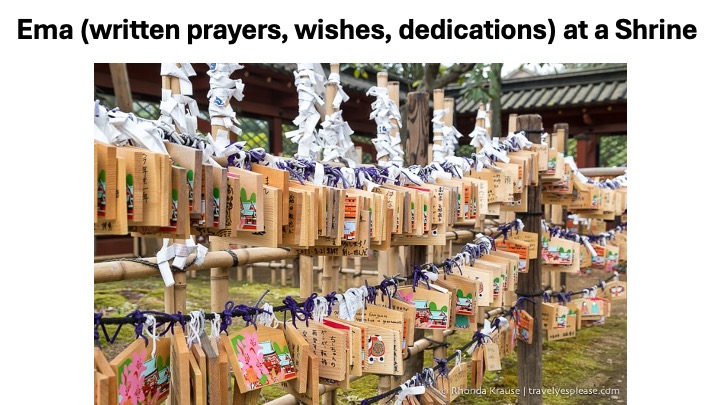
LXII. There are no sacred texts and no regularized communal worship. It is person and family centered, well-integrated with national festivals and offering ritual practices for all aspects of the life cycle.
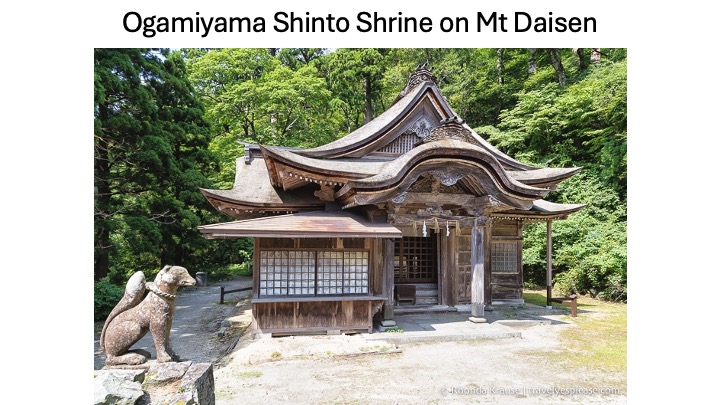
LXIII. There are some 80,000 Shinto Shrines in Japan for individuals to pray, meditate, and present offerings.
LXIV. Some 70% of modern Japanese practice some form of Shinto rituals. Most of them do not regard their practices as organized religion.
LXV. Japanese Buddhism
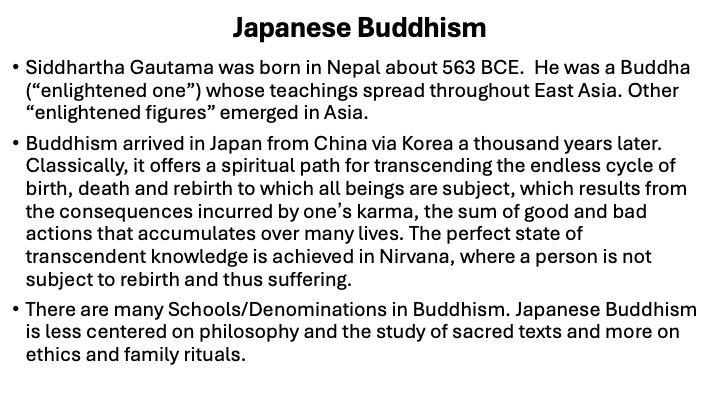
LXVI. Siddhartha Gautama was born in Nepal about 563 BCE. He was a Buddha (“enlightened one”) whose teachings spread throughout East Asia. Other “enlightened figures” emerged in Asia.
LXVII. Buddhism arrived in Japan from China via Korea a thousand years later. Classically, it offers a spiritual path for transcending the endless cycle of birth, death and rebirth to which all beings are subject, which results from the consequences incurred by oneʼs karma, the sum of good and bad actions that accumulates over many lives. The perfect state of transcendent knowledge is achieved in Nirvana, where a person is not subject to rebirth and thus suffering.
LXVIII. There are many Schools/Denominations in Buddhism. Japanese Buddhism is less centered on philosophy and the study of sacred texts and more on ethics and family rituals.
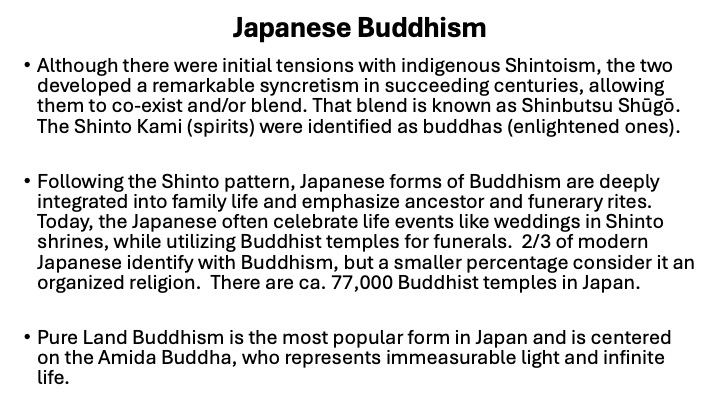
LXIX. Although there were initial tensions with indigenous Shintoism, the two developed a remarkable syncretism in succeeding centuries, allowing them to co-exist and/or blend. That blend is known as Shinbutsu Shūgō. The Shinto Kami (spirits) were identified as buddhas (enlightened ones).
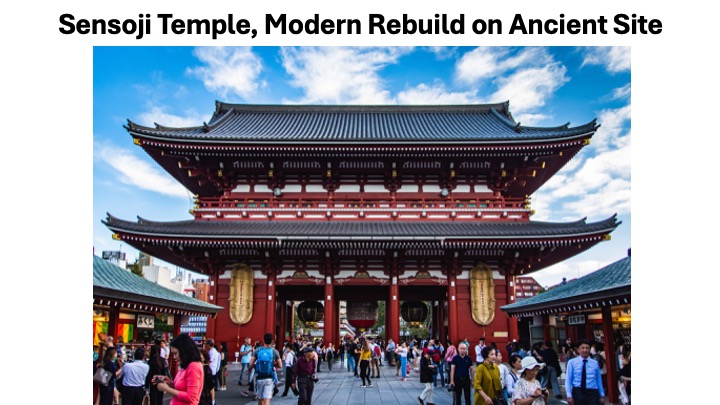
LXX. Following the Shinto pattern, Japanese forms of Buddhism are deeply integrated into family life and emphasize ancestor and funerary rites. Today, the Japanese often celebrate life events like weddings in Shinto shrines, while utilizing Buddhist temples for funerals. 2/3 of modern Japanese identify with Buddhism, but a smaller percentage consider it an organized religion. There are ca. 77,000 Buddhist temples in Japan.
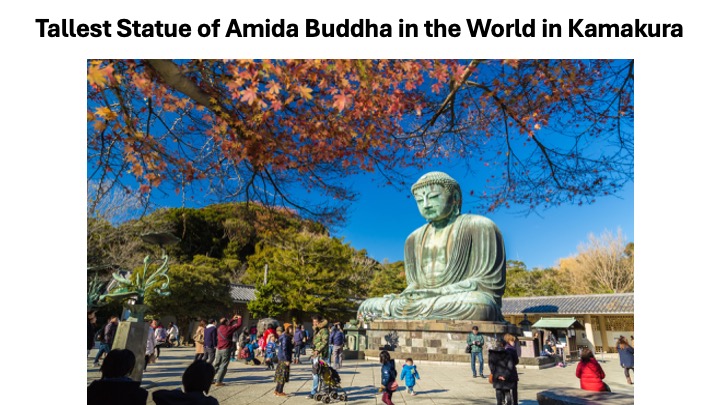
LXXI. Pure Land Buddhism is the most popular form in Japan and is centered on the Amida Buddha, who represents immeasurable light and infinite life.
LXXII. Japanese Confucianism
LXXIII. It took centuries for Confucianism to take root in Japan, but it came to have widespread influence on social life and ethics. Interpreters debate whether Confucianism is a religion or a social code. In Japan it is a way of life that values loyalty, obedience, and respect for parents/ancestors and those in authority.
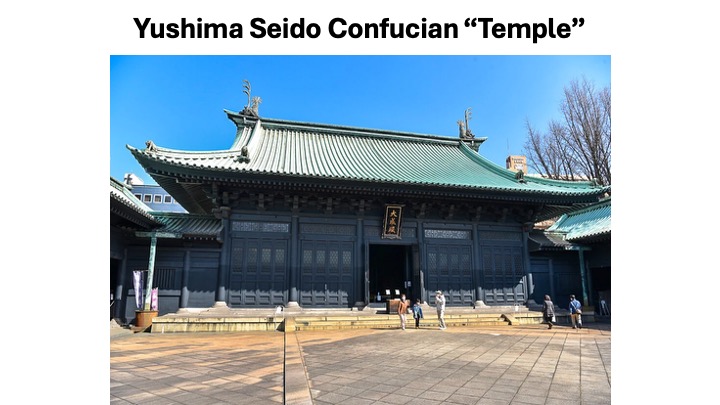
LXXIV. There are a few Confucian temples in Japan, but they function as centers of study and learning.
LXXV. Confucianism is plausibly the most influential “practical philosophy” in Japanese society.
LXXVI. Some Marks of Japanese Religion & Spiritual Practices
LXXVII.Shintoism is native to Japan and nowhere else. Its lack of creed and canonical texts fundamentally shapes Japanese approaches to religion.
LXXVIII. There is no communal worship in Shintoism, Buddhism or Confucianism. Historic religious practices are individual and family based. They are well integrated with such things as national festivals, holidays, and the family cycle of life events.
LXXIX. Over the centuries Japanese culture produced a remarkable mix of its native traditions (Shinto) with the East Asian movements of Buddhism and Confucianism mixed in. Historically, Japanese culture has been resistant to non-East Asian religious traditions.
LXXX. III. The expulsion and persecution of Christians
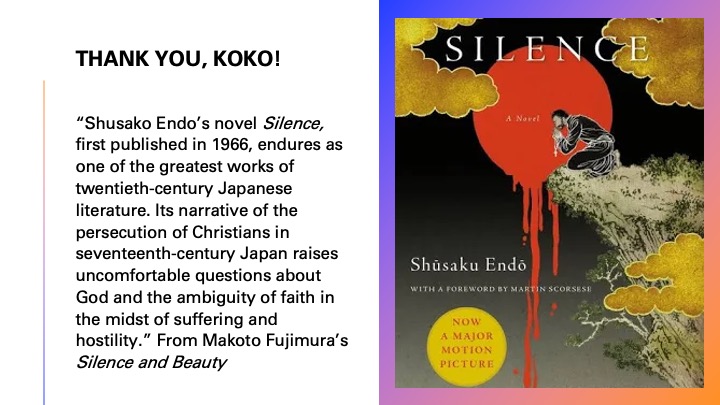
Thank you, Koko!
“Shusako Endo’s novel Silence, first published in 1966, endures as one of the greatest works of twentieth-century Japanese literature. Its narrative of the persecution of Christians in seventeenth-century Japan raises uncomfortable questions about God and the ambiguity of faith in the midst of suffering and hostility.” From Makoto Fujimura’s Silence and Beauty