Pastoral Epistles - 1st Timothy Rev Chris Knepp
Pastoral Epistles - 1st Timothy
Links
<< Home >> << Pastoral Epistles Menu >>
Pastoral Epistles - 1st Timothy - the Text
Pastoral Epistles 1st Timothy – the Text
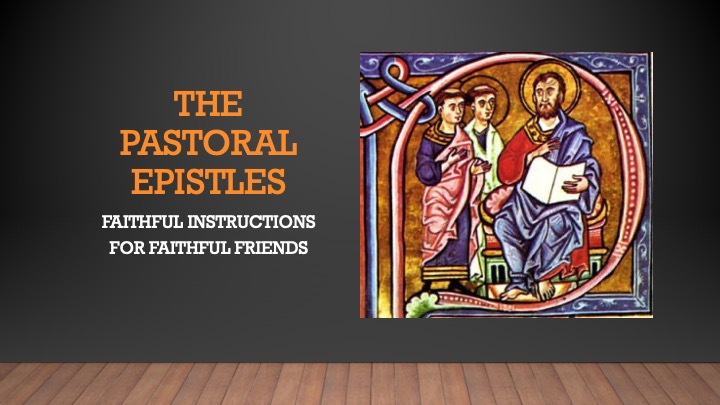
The Pastoral Epistles
Faithful instructions for faithful friends
The pastoral epistles
The collective witness of the New Testament to Paul includes a variety of images: Paul the prosecutor, Paul the convert, Paul the evangelist, Paul the pastor, Paul the defender of the gospel, Paul the letter-writer, and Paul the theologian. What we have in 1-2 Timothy and Titus is best described as Paul the mentor. Even though this trio of letters has, since the eighteenth century, gone under the collective title ‘The Pastoral Epistles’, which is appropriate in its way, they might more fittingly be named ‘The Mentoring Epistles’, or as Luke Timothy Johnson calls them, ‘Letters to Paul’s Delegates.’ N.T. Wright and Michael F. Bird, The New Testament In Its World
The pastoral epistles
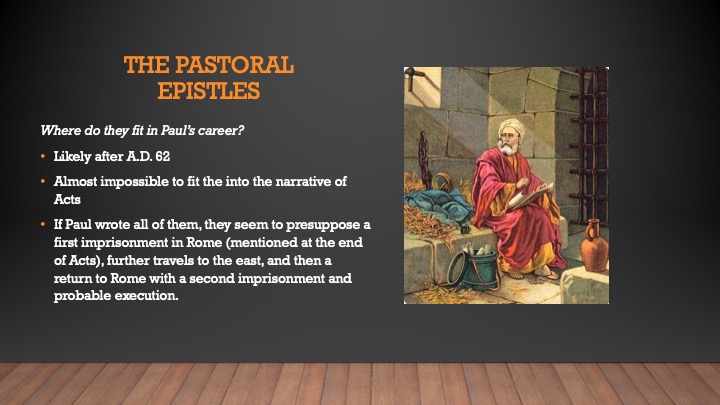
Where do they fit in Paul’s career?
• Likely after A.D. 62
• Almost impossible to fit the into the narrative of Acts
• If Paul wrote all of them, they seem to presuppose a first imprisonment in Rome (mentioned at the end of Acts), further travels to the east, and then a return to Rome with a second imprisonment and probable execution.
The pastoral epistles: author
1 Timothy 1:1 – “Paul, an apostle of Christ Jesus by command of God our Savior and Christ Jesus our hope.”
2 Timothy 1:1 – “Paul, an apostle of Christ Jesus by the will of God according to the promise of the life that is in Christ Jesus.”
Titus 1:1 – “Paul, a servant of God and an apostle of Jesus Christ, for the sake of the faith of God’s elect and their knowledge of the truth, which accords with godliness, in hope of eternal life, which God, who never lies, promised before the ages began and at the proper time manifested in his word through the preaching with which I have been entrusted by the command of God our Savior.”
The pastoral epistles: author?
• That Paul was the author of the pastorals was universally affirmed until the 19th century. Many today consider them pseudepigraphical, differing from Paul’s other letters in style, vocabulary, theology, and church order.
• But early church excluded from the canon any works they thought to be pseudonymous. Though this practice was common in ancient world, it was less common in personal letters and was rejected by early church.
1 timothy: recipient
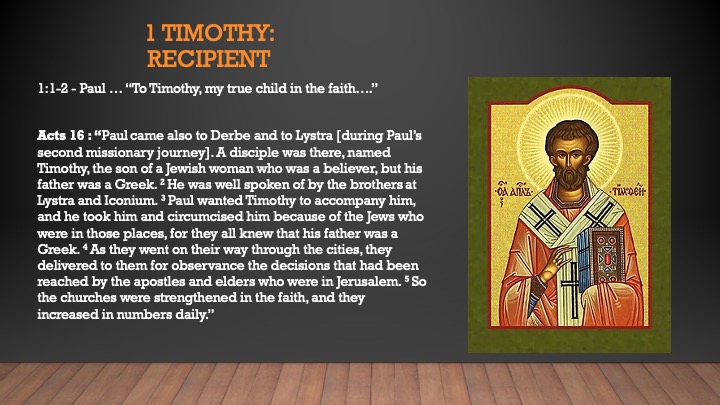
1:1-2 - Paul … “To Timothy, my true child in the faith….”
Acts 16 : “Paul came also to Derbe and to Lystra [during Paul’s second missionary journey]. A disciple was there, named Timothy, the son of a Jewish woman who was a believer, but his father was a Greek. 2 He was well spoken of by the brothers at Lystra and Iconium. 3 Paul wanted Timothy to accompany him, and he took him and circumcised him because of the Jews who were in those places, for they all knew that his father was a Greek. 4 As they went on their way through the cities, they delivered to them for observance the decisions that had been reached by the apostles and elders who were in Jerusalem. 5 So the churches were strengthened in the faith, and they increased in numbers daily.”
1 timothy: recipient
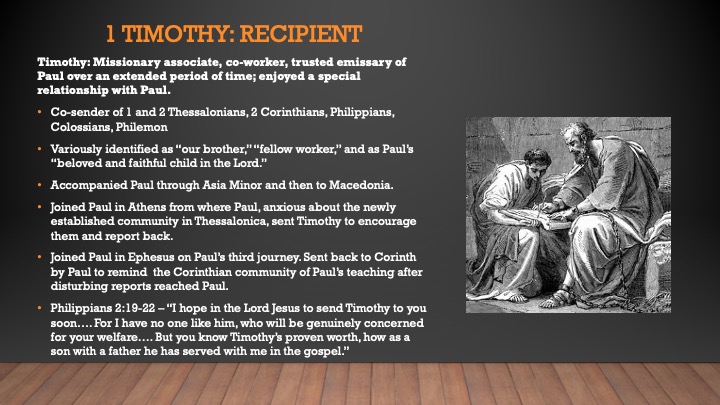
Timothy: Missionary associate, co-worker, trusted emissary of Paul over an extended period of time; enjoyed a special relationship with Paul.
• Co-sender of 1 and 2 Thessalonians, 2 Corinthians, Philippians, Colossians, Philemon
• Variously identified as “our brother,” “fellow worker,” and as Paul’s “beloved and faithful child in the Lord.”
• Accompanied Paul through Asia Minor and then to Macedonia.
• Joined Paul in Athens from where Paul, anxious about the newly established community in Thessalonica, sent Timothy to encourage them and report back.
• Joined Paul in Ephesus on Paul’s third journey. Sent back to Corinth by Paul to remind the Corinthian community of Paul’s teaching after disturbing reports reached Paul.
• Philippians 2:19-22 – “I hope in the Lord Jesus to send Timothy to you soon…. For I have no one like him, who will be genuinely concerned for your welfare…. But you know Timothy’s proven worth, how as a son with a father he has served with me in the gospel.”
1 timothy: date
Likely between Paul’s two Roman imprisonments. “If Paul’s arrival in Rome, as narrated in Acts, is dated about A.D. 59-61, then, allowing a couple of years for the imprisonment, he would have been released in about 62. If Paul was executed under Nero (died A.D. 68), 1 Timothy would have been written somewhere in the mid-60’s….” ESV Study Bible
1 timothy: purpose and occasion
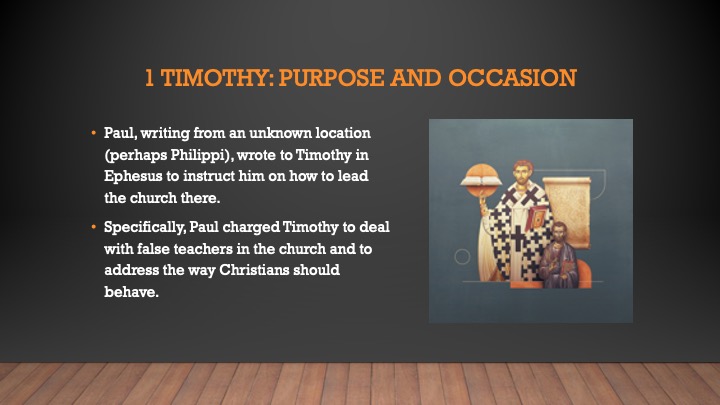
• Paul, writing from an unknown location (perhaps Philippi), wrote to Timothy in Ephesus to instruct him on how to lead the church there.
• Specifically, Paul charged Timothy to deal with false teachers in the church and to address the way Christians should behave.
1 timothy: structure
I. Confronting the false teaching (1:3-20)
II. Descriptions of gospel-shaped living (2:1-3:13)
III. Behavior in the church (3:14-16)
IV. Identifying the false teaching (4:1-5)
V. How Timothy should be shaped by the gospel (4:6-16)
VI. How specific groups in the church should be shaped by the gospel (5:1-6:2a)
VII. Confronting the false teaching again (6:2b-21)
1 timothy 1:3-20: confronting
the false teaching
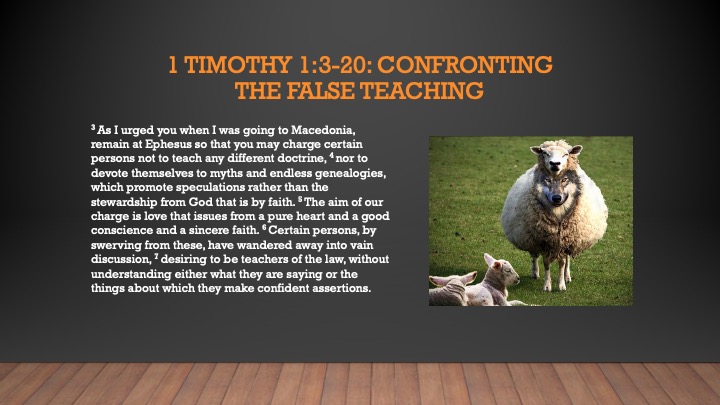
3 As I urged you when I was going to Macedonia, remain at Ephesus so that you may charge certain persons not to teach any different doctrine, 4 nor to devote themselves to myths and endless genealogies, which promote speculations rather than the stewardship from God that is by faith. 5 The aim of our charge is love that issues from a pure heart and a good conscience and a sincere faith. 6 Certain persons, by swerving from these, have wandered away into vain discussion, 7 desiring to be teachers of the law, without understanding either what they are saying or the things about which they make confident assertions.
1 timothy 1:3-20: what was
the false teaching?
• Do not know exactly what it was, though original readers might well have
• Imprecision may be intentional: “if the shoe fits….”
• Concern is not with identity of false teachers but their effect – “speculations” and “vain discussion” (but see the next slide!)
• Myths: fanciful, untrue, deceptive beliefs often used to excuse immoral behavior
• Genealogies: speculative use of OT accounts of biblical characters or family trees
1 timothy 1:3-20: a couple of
false teachers
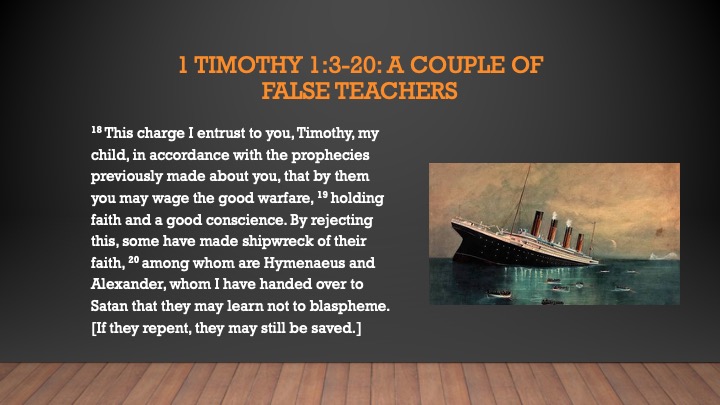
18 This charge I entrust to you, Timothy, my child, in accordance with the prophecies previously made about you, that by them you may wage the good warfare, 19 holding faith and a good conscience. By rejecting this, some have made shipwreck of their faith, 20 among whom are Hymenaeus and Alexander, whom I have handed over to Satan that they may learn not to blaspheme. [If they repent, they may still be saved.]
1 timothy 1:3-20: paul as an example of the true gospel
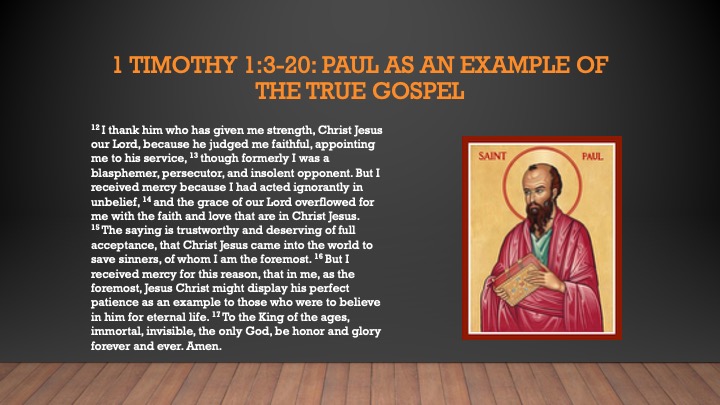
12 I thank him who has given me strength, Christ Jesus our Lord, because he judged me faithful, appointing me to his service, 13 though formerly I was a blasphemer, persecutor, and insolent opponent. But I received mercy because I had acted ignorantly in unbelief, 14 and the grace of our Lord overflowed for me with the faith and love that are in Christ Jesus. 15 The saying is trustworthy and deserving of full acceptance, that Christ Jesus came into the world to save sinners, of whom I am the foremost. 16 But I received mercy for this reason, that in me, as the foremost, Jesus Christ might display his perfect patience as an example to those who were to believe in him for eternal life. 17 To the King of the ages, immortal, invisible, the only God, be honor and glory forever and ever. Amen.
1 timothy 2:1-3:13: descriptions of
gospel-shaped living – prayer
2 First of all, then, I urge that supplications, prayers, intercessions, and thanksgivings be made for all people, 2 for kings and all who are in high positions, that we may lead a peaceful and quiet life, godly and dignified in every way. 3 This is good, and it is pleasing in the sight of God our Savior, 4 who desires all people to be saved and to come to the knowledge of the truth. 5 For there is one God, and there is one mediator between God and men, the man Christ Jesus, 6 who gave himself as a ransom for all, which is the testimony given at the proper time.
1 timothy 2:1-3:13: descriptions of
gospel-shaped living – qualifications for overseers (elders)
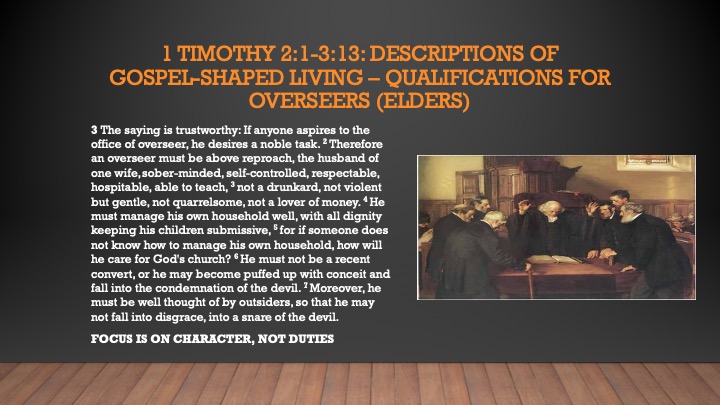
3 The saying is trustworthy: If anyone aspires to the office of overseer, he desires a noble task. 2 Therefore an overseer must be above reproach, the husband of one wife, sober-minded, self-controlled, respectable, hospitable, able to teach, 3 not a drunkard, not violent but gentle, not quarrelsome, not a lover of money. 4 He must manage his own household well, with all dignity keeping his children submissive, 5 for if someone does not know how to manage his own household, how will he care for God's church? 6 He must not be a recent convert, or he may become puffed up with conceit and fall into the condemnation of the devil. 7 Moreover, he must be well thought of by outsiders, so that he may not fall into disgrace, into a snare of the devil.
FOCUS IS ON CHARACTER, NOT DUTIES
1 timothy 2:1-3:13: descriptions of
gospel-shaped living – qualifications for overseers (deacons)
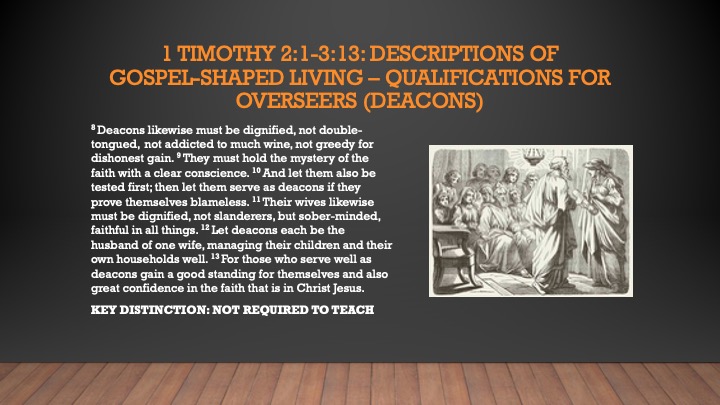
8 Deacons likewise must be dignified, not double-tongued, not addicted to much wine, not greedy for dishonest gain. 9 They must hold the mystery of the faith with a clear conscience. 10 And let them also be tested first; then let them serve as deacons if they prove themselves blameless. 11 Their wives likewise must be dignified, not slanderers, but sober-minded, faithful in all things. 12 Let deacons each be the husband of one wife, managing their children and their own households well. 13 For those who serve well as deacons gain a good standing for themselves and also great confidence in the faith that is in Christ Jesus.
KEY DISTINCTION: NOT REQUIRED TO TEACH
1 timothy 3:14-16: behavior in the church
THE PURPOSE OF THE LETTER!
14 I hope to come to you soon, but I am writing these things to you so that, 15 if I delay, you may know how one ought to behave in the household of God, which is the church of the living God, a pillar and buttress of the truth. 16 Great indeed, we confess, is the mystery of godliness:
He was
manifested in the flesh,
vindicated
by the Spirit,
seen
by angels,
proclaimed among the nations,
believed
on in the world,
taken
up in glory.
1 timothy 4:1-5: identifying
the false teaching
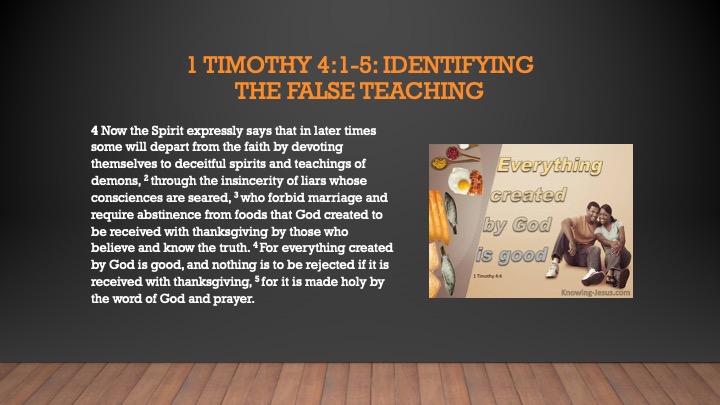
4 Now the Spirit expressly says that in later times some will depart from the faith by devoting themselves to deceitful spirits and teachings of demons, 2 through the insincerity of liars whose consciences are seared, 3 who forbid marriage and require abstinence from foods that God created to be received with thanksgiving by those who believe and know the truth. 4 For everything created by God is good, and nothing is to be rejected if it is received with thanksgiving, 5 for it is made holy by the word of God and prayer.
1 timothy 4:6-16: how timothy should be shaped by the gospel
6 If you put these things before the brothers, you will be a good servant of Christ Jesus, being trained in the words of the faith and of the good doctrine that you have followed….
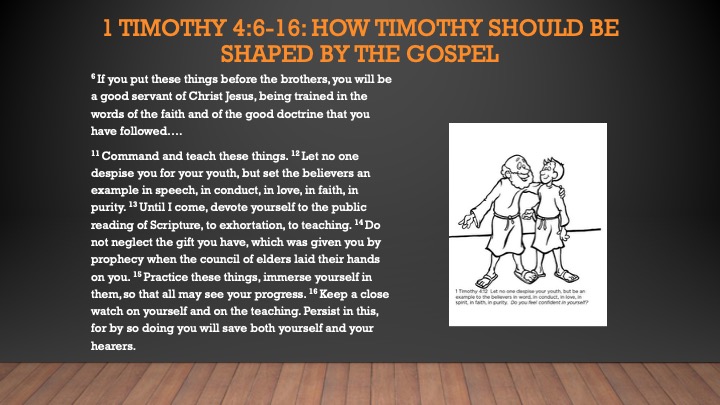
11 Command and teach these things. 12 Let no one despise you for your youth, but set the believers an example in speech, in conduct, in love, in faith, in purity. 13 Until I come, devote yourself to the public reading of Scripture, to exhortation, to teaching. 14 Do not neglect the gift you have, which was given you by prophecy when the council of elders laid their hands on you. 15 Practice these things, immerse yourself in them, so that all may see your progress. 16 Keep a close watch on yourself and on the teaching. Persist in this, for by so doing you will save both yourself and your hearers.
1 timothy 5:1-6:2a: how specific groups in the church
should be shaped
by the gospel
5 Do not rebuke an older man but encourage him as you would a father, younger men as brothers, 2 older women as mothers, younger women as sisters, in all purity.
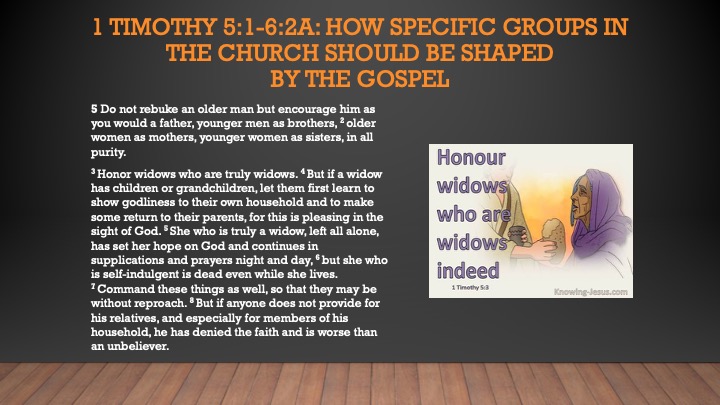
3 Honor widows who are truly widows. 4 But if a widow has children or grandchildren, let them first learn to show godliness to their own household and to make some return to their parents, for this is pleasing in the sight of God. 5 She who is truly a widow, left all alone, has set her hope on God and continues in supplications and prayers night and day, 6 but she who is self-indulgent is dead even while she lives. 7 Command these things as well, so that they may be without reproach. 8 But if anyone does not provide for his relatives, and especially for members of his household, he has denied the faith and is worse than an unbeliever.
1 timothy 5:1-6:2a: how specific groups in the church
should be shaped
by the gospel
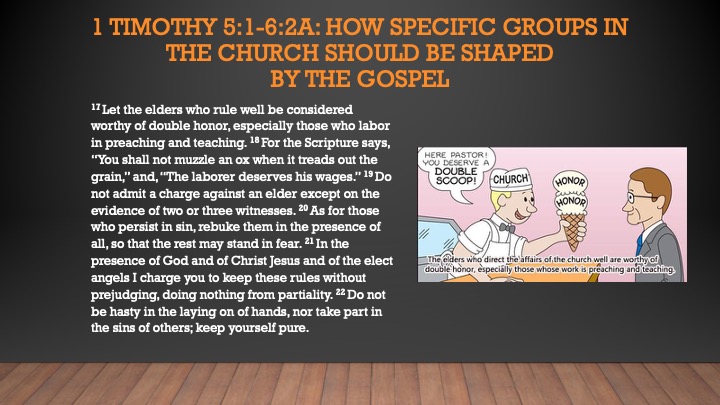
17 Let the elders who rule well be considered worthy of double honor, especially those who labor in preaching and teaching. 18 For the Scripture says, “You shall not muzzle an ox when it treads out the grain,” and, “The laborer deserves his wages.” 19 Do not admit a charge against an elder except on the evidence of two or three witnesses. 20 As for those who persist in sin, rebuke them in the presence of all, so that the rest may stand in fear. 21 In the presence of God and of Christ Jesus and of the elect angels I charge you to keep these rules without prejudging, doing nothing from partiality. 22 Do not be hasty in the laying on of hands, nor take part in the sins of others; keep yourself pure.
1 timothy 6:2b-21: confronting the false teaching again
3 If anyone teaches a different doctrine and does not agree with the sound words of our Lord Jesus Christ and the teaching that accords with godliness, 4 he is puffed up with conceit and understands nothing. He has an unhealthy craving for controversy and for quarrels about words, which produce envy, dissension, slander, evil suspicions, 5 and constant friction among people who are depraved in mind and deprived of the truth, imagining that godliness is a means of gain. 6 But godliness with contentment is great gain, 7 for we brought nothing into the world, and we cannot take anything out of the world. 8 But if we have food and clothing, with these we will be content. 9 But those who desire to be rich fall into temptation, into a snare, into many senseless and harmful desires that plunge people into ruin and destruction. 10 For the love of money is a root of all kinds of evils. It is through this craving that some have wandered away from the faith and pierced themselves with many pangs.
1 timothy 6:2b-21: confronting the false teaching again
11 But as for you, O man of God, flee these things. Pursue righteousness, godliness, faith, love, steadfastness, gentleness. 12 Fight the good fight of the faith. Take hold of the eternal life to which you were called and about which you made the good confession in the presence of many witnesses. 13 I charge you in the presence of God, who gives life to all things, and of Christ Jesus, who in his testimony before Pontius Pilate made the good confession, 14 to keep the commandment unstained and free from reproach until the appearing of our Lord Jesus Christ, 15 which he will display at the proper time—he who is the blessed and only Sovereign, the King of kings and Lord of lords, 16 who alone has immortality, who dwells in unapproachable light, whom no one has ever seen or can see. To him be honor and eternal dominion. Amen.