Appointment with Destiny 2
Chris Knepp & Al Krummenacher
Appointment with Destiny 2
Links
<< Home >> << Appointment with Destiny Menu >>
Appointment with Destiny 2 - The Text
APPOINTMENT WITH DESTINY. 2 – the Text
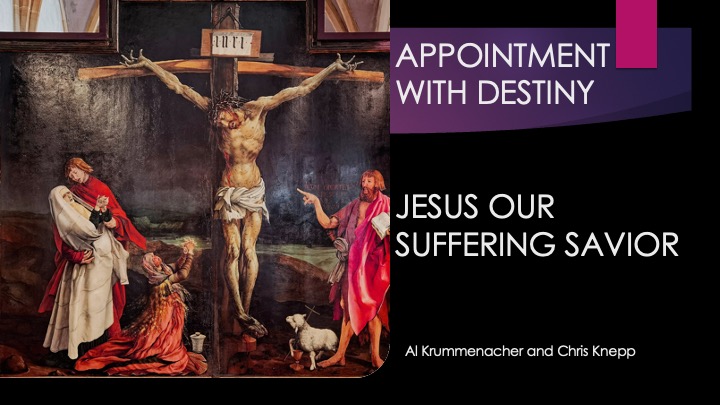
JESUS OUR SUFFERING SAVIOR
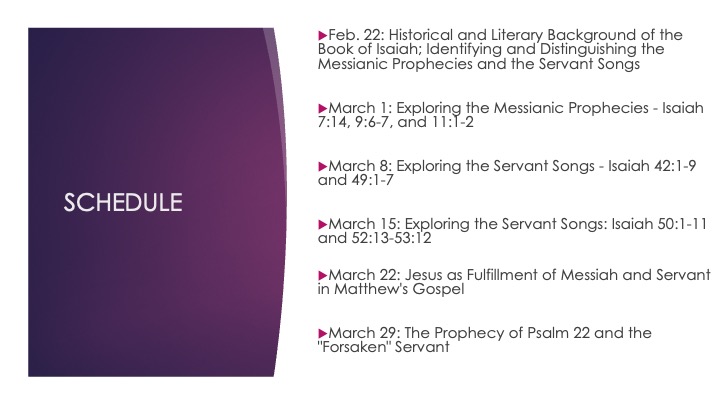
The Schedule
u Feb. 22: Historical and Literary Background of the Book of Isaiah; Identifying and Distinguishing the Messianic Prophecies and the Servant Songs
u March 1: Exploring the Messianic Prophecies - Isaiah 7:14, 9:6-7, and 11:1-2
u March 8: Exploring the Servant Songs - Isaiah 42:1-9 and 49:1-7
u March 15: Exploring the Servant Songs: Isaiah 50:1-11 and 52:13-53:12
u March 22: Jesus as Fulfillment of Messiah and Servant in Matthew's Gospel
u March 29: The Prophecy of Psalm 22 and the "Forsaken" Servant
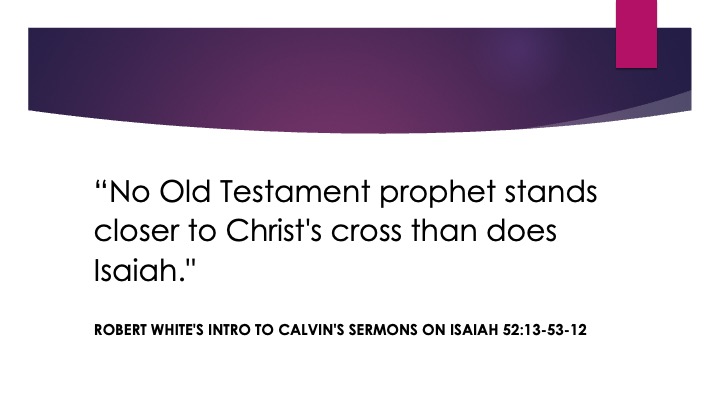
“No Old Testament prophet stands closer to Christ's cross than does Isaiah."
Robert White's intro to Calvin's sermons on Isaiah 52:13-53-12
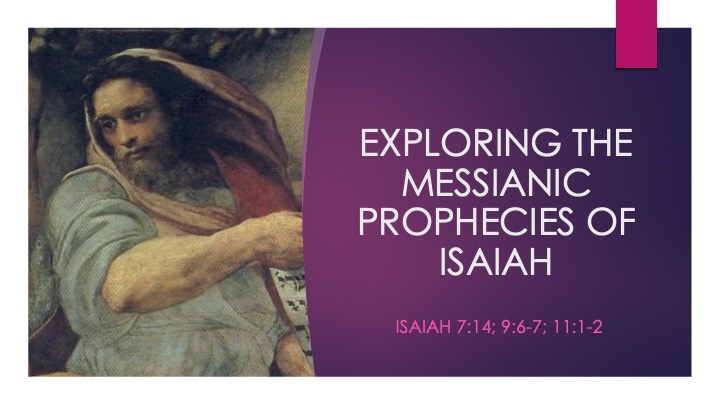
EXPLORING THE MESSIANIC PROPHECIES OF ISAIAH
ISAIAH 7:14; 9:6-7; 11:1-2
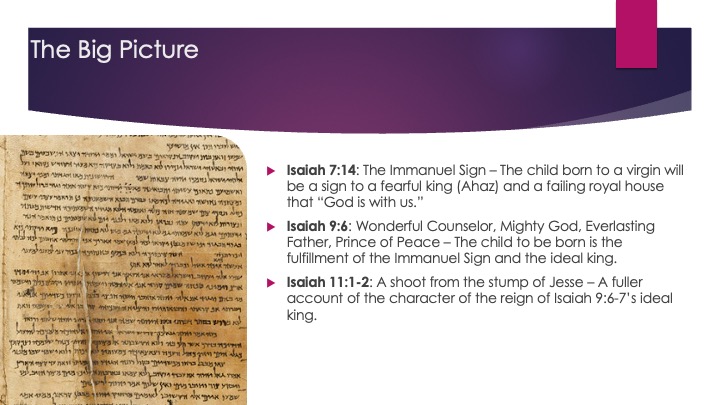
The Big Picture
u Isaiah 7:14: The Immanuel Sign – The child born to a virgin will be a sign to a fearful king (Ahaz) and a failing royal house that “God is with us.”
u Isaiah 9:6: Wonderful Counselor, Mighty God, Everlasting Father, Prince of Peace – The child to be born is the fulfillment of the Immanuel Sign and the ideal king.
u Isaiah 11:1-2: A shoot from the stump of Jesse – A fuller account of the character of the reign of Isaiah 9:6-7’s ideal king.
Context of the Immanuel
Sign
(Isaiah 7:14)
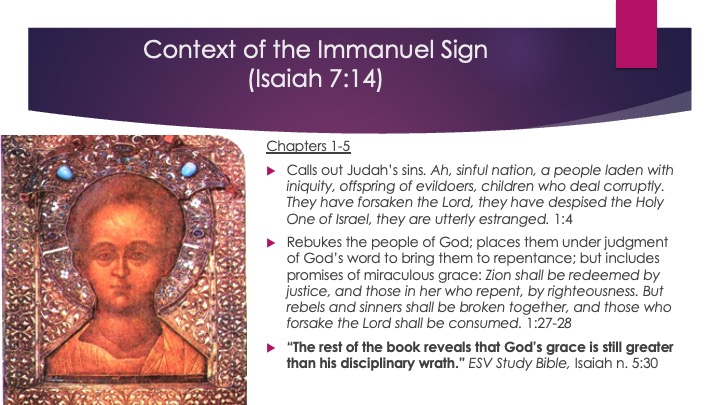
Chapters 1-5
u Calls out Judah’s sins. Ah, sinful nation, a people laden with iniquity, offspring of evildoers, children who deal corruptly. They have forsaken the Lord, they have despised the Holy One of Israel, they are utterly estranged. 1:4
u Rebukes the people of God; places them under judgment of God’s word to bring them to repentance; but includes promises of miraculous grace: Zion shall be redeemed by justice, and those in her who repent, by righteousness. But rebels and sinners shall be broken together, and those who forsake the Lord shall be consumed. 1:27-28
u “The rest of the book reveals that God’s grace is still greater than his disciplinary wrath.” ESV Study Bible, Isaiah n. 5:30
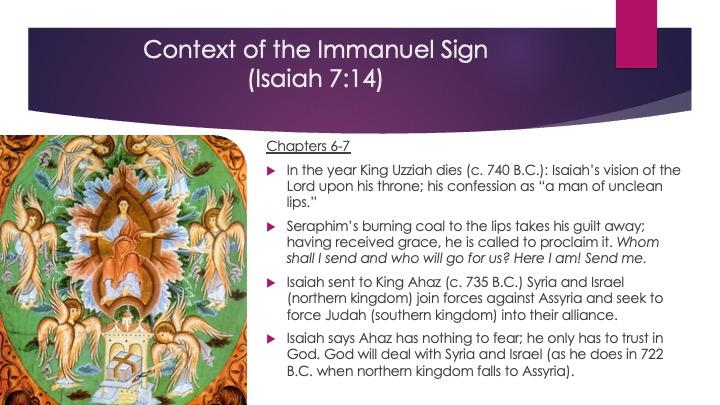
Chapters 6-7
u In the year King Uzziah dies (c. 740 B.C.): Isaiah’s vision of the Lord upon his throne; his confession as “a man of unclean lips.”
u Seraphim’s burning coal to the lips takes his guilt away; having received grace, he is called to proclaim it. Whom shall I send and who will go for us? Here I am! Send me.
u Isaiah sent to King Ahaz (c. 735 B.C.) Syria and Israel (northern kingdom) join forces against Assyria and seek to force Judah (southern kingdom) into their alliance.
u Isaiah says Ahaz has nothing to fear; he only has to trust in God. God will deal with Syria and Israel (as he does in 722 B.C. when northern kingdom falls to Assyria).
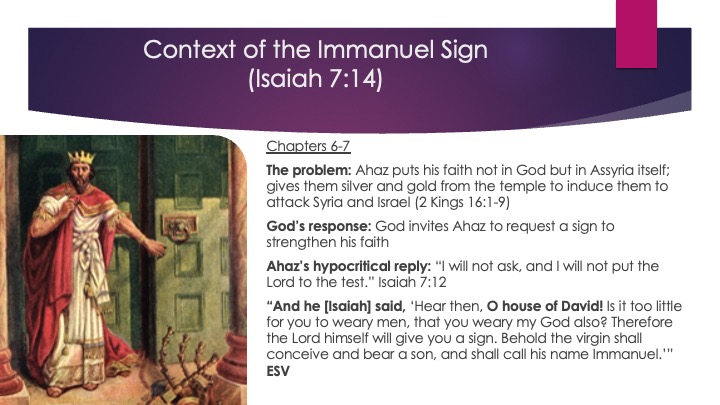
u Chapters 6-7
u The problem: Ahaz puts his faith not in God but in Assyria itself; gives them silver and gold from the temple to induce them to attack Syria and Israel (2 Kings 16:1-9)
u God’s response: God invites Ahaz to request a sign to strengthen his faith
u Ahaz’s hypocritical reply: “I will not ask, and I will not put the Lord to the test.” Isaiah 7:12
u “And he [Isaiah] said, ‘Hear then, O house of David! Is it too little for you to weary men, that you weary my God also? Therefore the Lord himself will give you a sign. Behold the virgin shall conceive and bear a son, and shall call his name Immanuel.’” ESV
The Immanuel Sign (Isaiah
7:14)
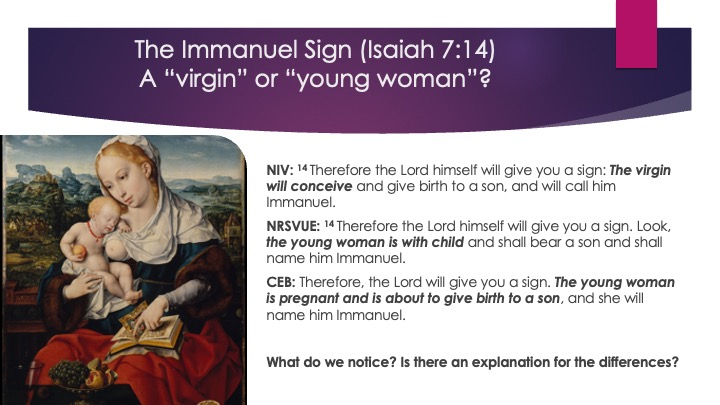
A “virgin” or “young woman”?
NIV: 14 Therefore the Lord himself will give you a sign: The virgin will conceive and give birth to a son, and will call him Immanuel.
NRSVUE: 14 Therefore the Lord himself will give you a sign. Look, the young woman is with child and shall bear a son and shall name him Immanuel.
CEB: Therefore, the Lord will give you a sign. The young woman is pregnant and is about to give birth to a son, and she will name him Immanuel.
What do we notice? Is there an explanation for the differences?
The Immanuel Sign (Isaiah
7:10-14)
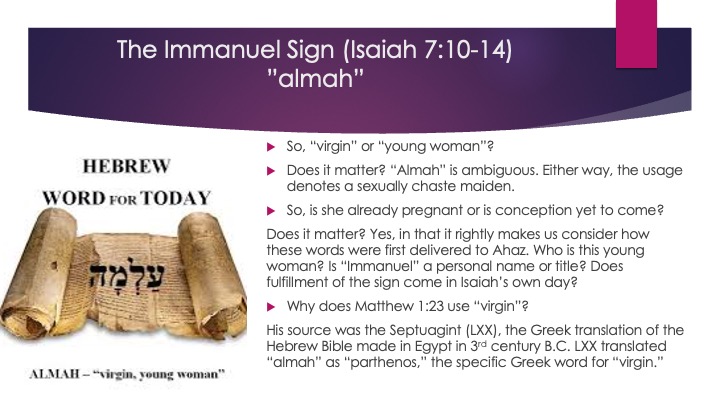
”almah”
u So, “virgin” or “young woman”?
u Does it matter? “Almah” is ambiguous. Either way, the usage denotes a sexually chaste maiden.
u So, is she already pregnant or is conception yet to come?
Does it matter? Yes, in that it rightly makes us consider how these words were first delivered to Ahaz. Who is this young woman? Is “Immanuel” a personal name or title? Does fulfillment of the sign come in Isaiah’s own day?
u Why does Matthew 1:23 use “virgin”?
His source was the Septuagint (LXX), the Greek translation of the Hebrew Bible made in Egypt in 3rd century B.C. LXX translated “almah” as “parthenos,” the specific Greek word for “virgin.”
The Immanuel Sign (Isaiah
7:14)
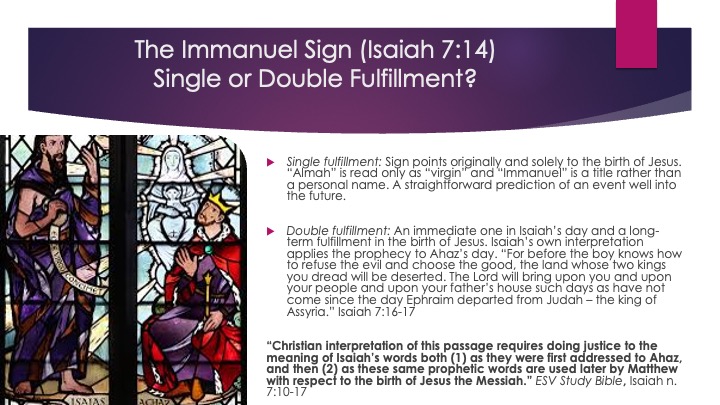
Single or Double Fulfillment?
u Single fulfillment: Sign points originally and solely to the birth of Jesus. “Almah” is read only as “virgin” and “Immanuel” is a title rather than a personal name. A straightforward prediction of an event well into the future.
u Double fulfillment: An immediate one in Isaiah’s day and a long-term fulfillment in the birth of Jesus. Isaiah’s own interpretation applies the prophecy to Ahaz’s day. “For before the boy knows how to refuse the evil and choose the good, the land whose two kings you dread will be deserted. The Lord will bring upon you and upon your people and upon your father’s house such days as have not come since the day Ephraim departed from Judah – the king of Assyria.” Isaiah 7:16-17
“Christian interpretation of this passage requires doing justice to the meaning of Isaiah’s words both (1) as they were first addressed to Ahaz, and then (2) as these same prophetic words are used later by Matthew with respect to the birth of Jesus the Messiah.” ESV Study Bible, Isaiah n.
The Immanuel Sign (Isaiah
7:14)
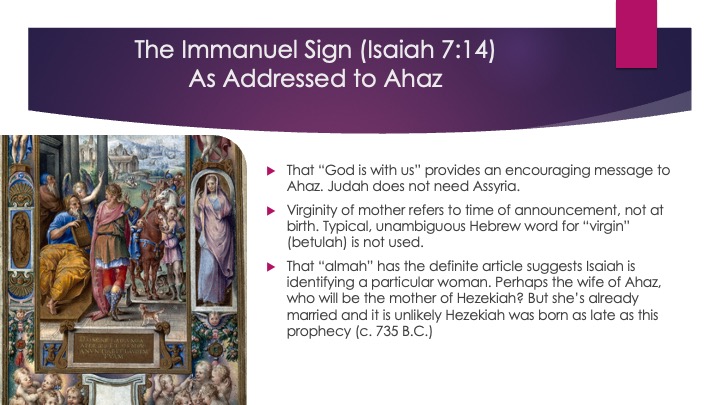
As Addressed to Ahaz
Ahaz an abbreviation of Jehoahaz II, "Yahweh has held" was the twelfth king of Judah, and the son and successor of Jotham. Ahaz was 20 when he became king of Judah and reigned for 16 years. Ahaz is portrayed as an evil king in the Second Book of Kings. In Edwin R. Thiele's opinion, Ahaz was co-regent with Jotham from 736/735 BC, and his sole reign began in 732/731 and ended in 716/715 BC. However, William F. Albright has dated his reign to 744–728 BC. The Gospel of Matthew lists Ahaz of Judah in the genealogy of Jesus.
u That “God is with us” provides an encouraging message to Ahaz. Judah does not need Assyria.
u Virginity of mother refers to time of announcement, not at birth. Typical, unambiguous Hebrew word for “virgin” (betulah) is not used.
u That “almah” has the definite article suggests Isaiah is identifying a particular woman. Perhaps the wife of Ahaz, who will be the mother of Hezekiah? But she’s already married and it is unlikely Hezekiah was born as late as this prophecy (c. 735 B.C.)
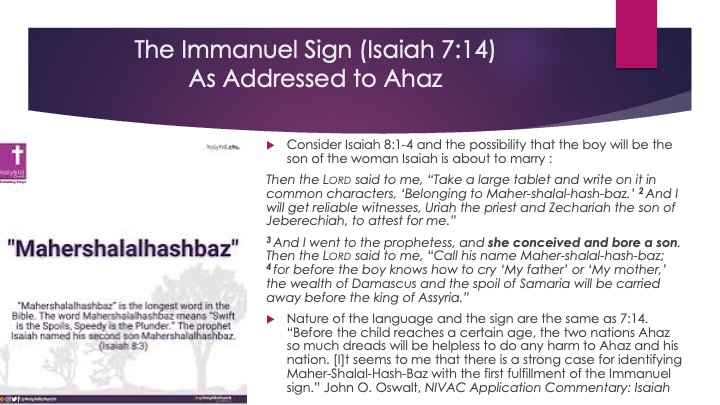
u Consider Isaiah 8:1-4 and the possibility that the boy will be the son of the woman Isaiah is about to marry :
Then the Lord said to me, “Take a large tablet and write on it in common characters, ‘Belonging to Maher-shalal-hash-baz.’ 2 And I will get reliable witnesses, Uriah the priest and Zechariah the son of Jeberechiah, to attest for me.”
3 And I went to the prophetess, and she conceived and bore a son. Then the Lord said to me, “Call his name Maher-shalal-hash-baz; 4 for before the boy knows how to cry ‘My father’ or ‘My mother,’ the wealth of Damascus and the spoil of Samaria will be carried away before the king of Assyria.”
u Nature of the language and the sign are the same as 7:14. “Before the child reaches a certain age, the two nations Ahaz so much dreads will be helpless to do any harm to Ahaz and his nation. [I]t seems to me that there is a strong case for identifying Maher-Shalal-Hash-Baz with the first fulfillment of the Immanuel sign.” John O. Oswalt, NIVAC Application Commentary: Isaiah
u One more possibility:
“Zion has already been pictured as a woman (literally, ‘daughter Zion’) in 1:8. Now, in the crisis of invasion and imminent siege, she is depicted as a sexually mature woman (literally, ‘young woman’, ‘alma’) who has already conceived and is even now in the pains of childbirth. The central statement of verse 14 is literally: ‘The young woman has conceived and is giving birth to a son…’ If the ‘young woman’ is Zion, then her son is the faithful remnant who will emerge from her sufferings. That is why he is given the name Immanuel, ‘God with us’. God will be with the faithful remnant who gather round Isaiah…, not with the unbelieving Ahaz and the rebellious nation as a whole.” Barry G. Webb, The Bible Speaks Today: The Message of Isaiah
The Immanuel Sign (Isaiah
7:14)
Other virgin births?
u Bart Ehrman, New Testament scholar and historian who transitioned from evangelical Christianity to agnostic atheism
Since, oh, I don’t know, the 19th century I guess, there have been people who have claimed that virgin births were common in the ancient world. You find that claim widely today still among those who call themselves “mythicists” — those who think Jesus didn’t exist but was just a myth. One of the most common claims of the mythicists is that there were numerous other divine men in Jesus’ day who were very similar – in fact, in almost every respect – to Jesus….
Historians of antiquity as a rule have trouble believing that anyone takes these kinds of claims seriously. It takes very little research in the ancient texts themselves to see how odd they are. The authors provide no evidence for them: they don’t even cite any sources from the ancient world that can be checked. And so it is not that they have provided an alternative interpretation of the available evidence. They have not even cited the available evidence. And for good reason. No such evidence exists. The Bart Ehrman Blog
The Fulfillment of the
Immanuel Sign
(Isaiah 9:6-7)
u Whereas 7:14 addressed the reigning king of David’s line (Ahaz), 9:6-7 promises a future king who will reign on David’s throne forever (keeping the Davidic Covenant of 2 Samuel 7:12-13)
u Between the Immanuel sign and 9:6-7, the Lord reveals to Isaiah the coming Assyrian invasion. “And they will be thrust into thick darkness.” 8:22
u But for the faithful remnant, “there will be no gloom for her who was in anguish.” 9:1
u “The people who walked in darkness have seen a great light….” 9:2
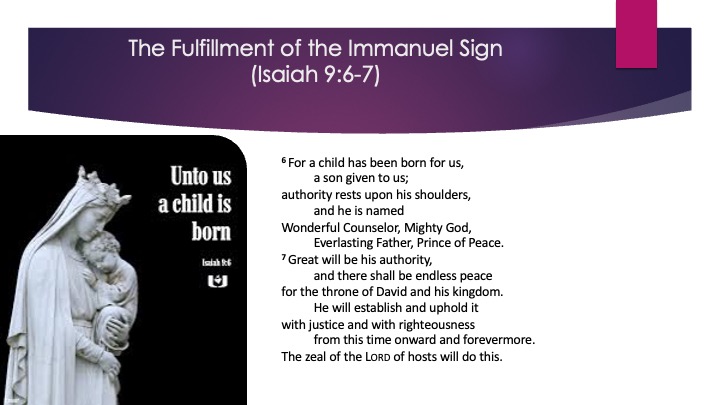
u And God will do this through the birth of a child: “Unto us a child is born.” 9:6
u
6 For a child has been
born for us,
a son given to us;
authority rests upon his shoulders,
and he is named
Wonderful Counselor, Mighty God,
Everlasting Father, Prince of Peace.
7 Great will be his authority,
and there shall be endless peace
for the throne of David and his kingdom.
He will establish and uphold it
with justice and with righteousness
from this time onward and forevermore.
The zeal of the Lord of hosts will do this.
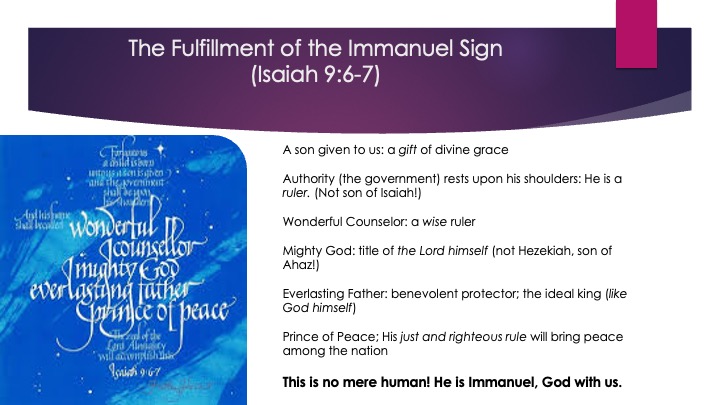
u A son given to us: a gift of divine grace
u Authority (the government) rests upon his shoulders: He is a ruler. (Not son of Isaiah!)
u Wonderful Counselor: a wise ruler
u Mighty God: title of the Lord himself (not Hezekiah, son of Ahaz!)
u Everlasting Father: benevolent protector; the ideal king (like God himself)
u Prince of Peace; His just and righteous rule will bring peace among the nation
u This is no mere human! He is Immanuel, God with us.
The Reign of the Ideal King
(Isaiah 11:1-9)
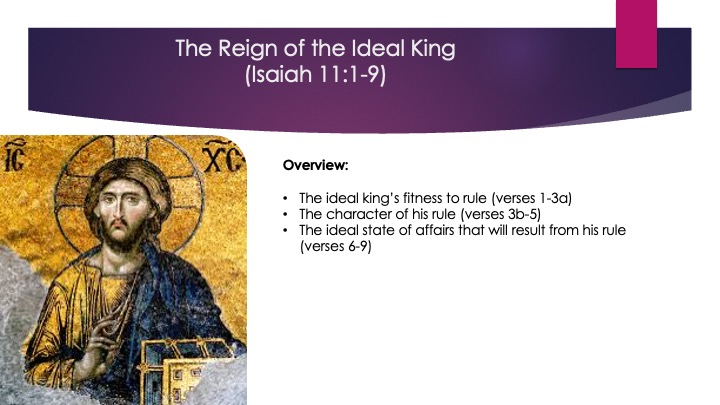
Overview:
• The ideal king’s fitness to rule (verses 1-3a)
• The character of his rule (verses 3b-5)
• The ideal state of affairs that will result from his rule (verses 6-9)
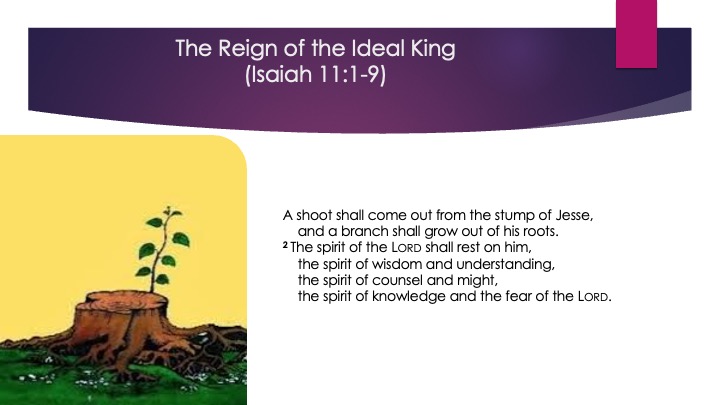
A shoot shall come out from
the stump of Jesse,
and a branch shall grow out of his roots.
2 The spirit of the Lord shall rest on him,
the spirit of wisdom and understanding,
the spirit of counsel and might,
the spirit of knowledge and the fear of the Lord.
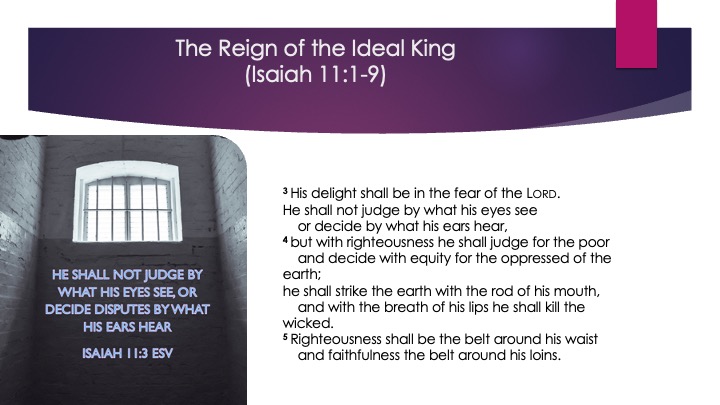
3 His delight shall be in the fear of the Lord.
He shall not judge by what
his eyes see
or decide by what his ears hear,
4 but with righteousness he shall judge for the poor
and decide with equity for the oppressed of the earth;
he shall strike the earth with the rod of his mouth,
and with the breath of his lips he shall kill the
wicked.
5 Righteousness shall be the belt around his waist
and faithfulness the belt around his loins.
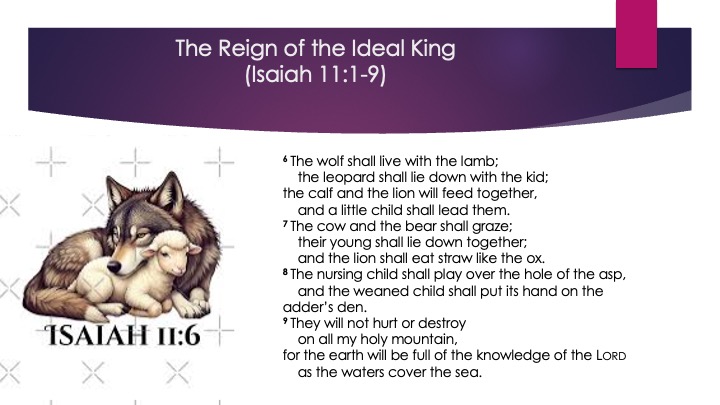
6 The wolf
shall live with the lamb;
the leopard shall lie down with the kid;
the calf and the lion will feed together,
and a little child shall lead them.
7 The cow and the bear shall graze;
their young shall lie down together;
and the lion shall eat straw like the ox.
8 The nursing child shall play over the hole of the asp,
and the weaned child shall put its hand on the adder’s
den.
9 They will not hurt or destroy
on all my holy mountain,
for the earth will be full of the knowledge of the Lord
as the waters cover the sea.
Why speak of Jesse (father of David) and not the House of David?
• The stump is the fallen Davidic house. Reference to Jesse underlines discontinuity with present representative of House of David. Also indicates humble origins, as opposed to ostentation of Davidic house as it had developed.
• A greater David is prophesied. Unlike kings before him, especially King Ahaz, this son of Jesse will bear fruit.
• This descendant of Jesse will rule with a different, richer spirit: wisdom and understanding; counsel and might; knowledge and fear of the Lord. Verses 3-5 show contrast with human kings who came before.
• The earth will be full of the knowledge of the Lord. (v.9) Once predatory powers will learn to be peaceable; the earth will be transformed.
• And this root of Jesse “shall stand as a signal for all people.” (v.10)
• In conclusion: “As with Isa 9:1-7, what originated as the promise of a new king in ancient Jerusalem came to be understood as the prophecy of a messiah, fulfilled by the coming of Jesus. So the Christian reader must struggle to hear and understand both the ancient Israelite hope for a new descendant of King David who will be a just and faithful king, establishing justice and righteousness in governing a particular human society, and the faith of the church, which has seen that hope both fulfilled and transformed in Jesus of Nazareth.” Gene M. Tucker, The Book of Isaiah 1-39, New Interpreter’s Bible