Appointment with Destiny 4
Chris Knepp & Al Krummenacher
Appointment with Destiny 4
Links
<< Home >> << Appoint with Destiny Menu >>
Appointment with Destiny 4 - the Text
Appointment with Destiny 4 – the Text
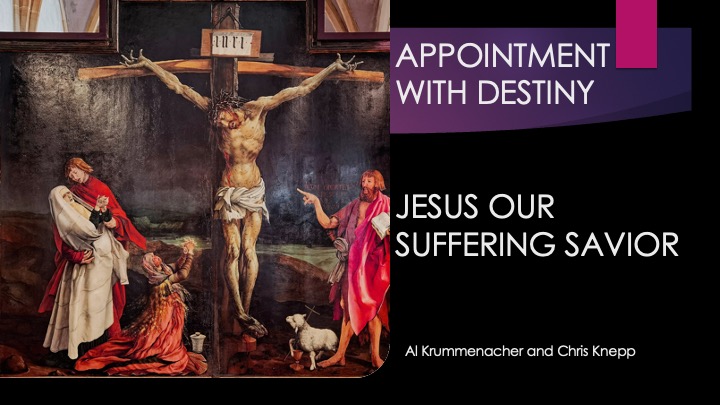
APPOINTMENT WITH DESTINY - JESUS OUR SUFFERING SAVIOR
Al Krummenacher and Chris Knepp
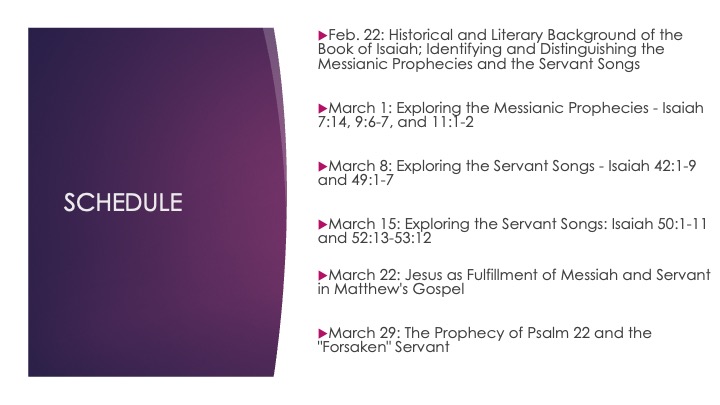
SCHEDULE
Feb. 22: Historical and Literary Background of the Book of Isaiah; Identifying and Distinguishing the Messianic Prophecies and the Servant Songs
March 1: Exploring the Messianic Prophecies - Isaiah 7:14, 9:6-7, and 11:1-2
March 8: Exploring the Servant Songs - Isaiah 42:1-9 and 49:1-7
March 15: Exploring the Servant Songs: Isaiah 50:1-11 and 52:13-53:12
March 22: Jesus as Fulfillment of Messiah and Servant in Matthew's Gospel
March 29: The Prophecy of Psalm 22 and the "Forsaken" Servant
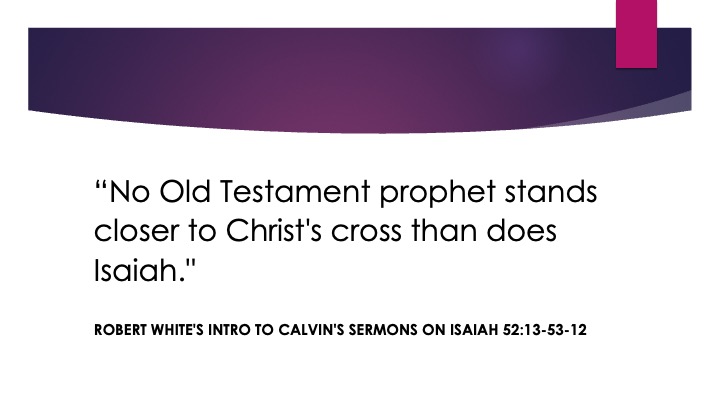
“No Old Testament prophet stands closer to Christ's cross than does Isaiah."
Robert White's intro to Calvin's sermons on Isaiah
52:13-53-12
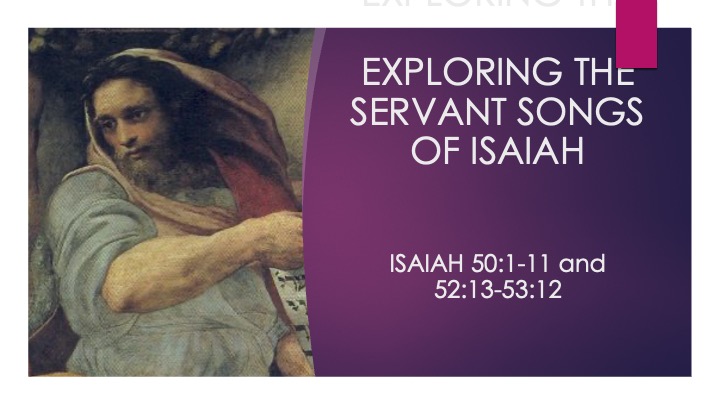
EXPLORING THE SERVANT SONGS OF ISAIAH
ISAIAH 50:1-11 and
52:13-53:12
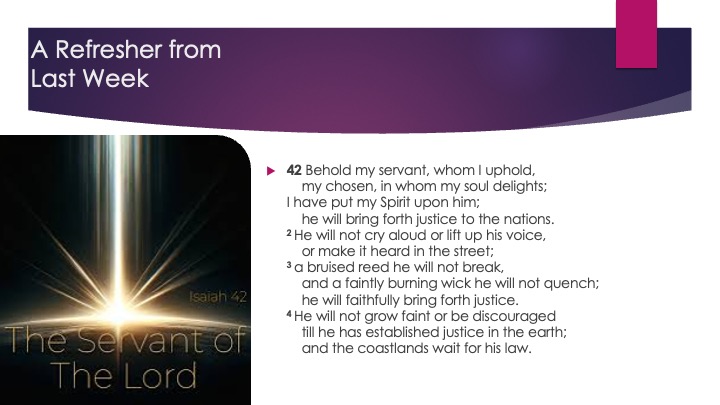
A Refresher from Last Week
42 Behold my
servant, whom I uphold,
my chosen, in whom my soul delights;
I have put my Spirit upon him;
he will bring forth justice to the nations.
2 He will not cry aloud or lift up his voice,
or make it heard in the street;
3 a bruised reed he will not break,
and a faintly burning wick he will not quench;
he will faithfully bring forth justice.
4 He will not grow faint or be discouraged
till he has established justice in the earth;
and the coastlands wait for his law.
The Big Picture
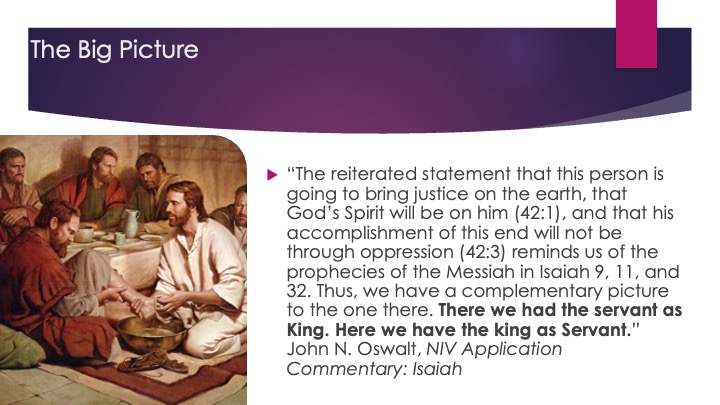
“The reiterated statement that this person is going to bring justice on the earth, that God’s Spirit will be on him (42:1), and that his accomplishment of this end will not be through oppression (42:3) reminds us of the prophecies of the Messiah in Isaiah 9, 11, and 32. Thus, we have a complementary picture to the one there. There we had the servant as King. Here we have the king as Servant.” John N. Oswalt, NIV Application Commentary: Isaiah
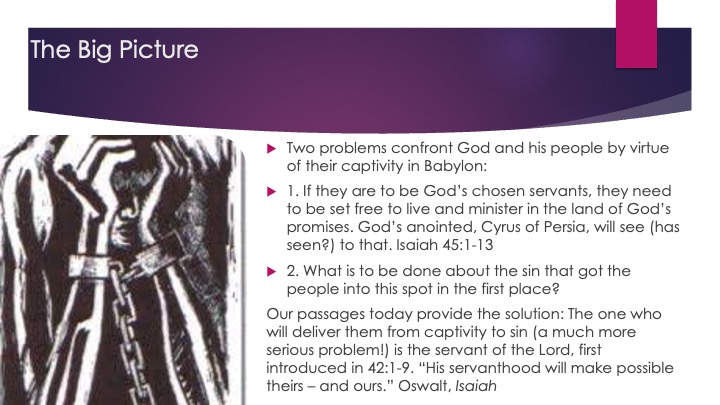
Two problems confront God and his people by virtue of their captivity in Babylon:
1. If they are to be God’s chosen servants, they need to be set free to live and minister in the land of God’s promises. God’s anointed, Cyrus of Persia, will see to that. Isaiah 45:1-13
2. What is to be done about the sin that got the people into this spot in the first place?
Our passages today provide the solution: The one who will deliver them from captivity to sin (a much more serious problem!) is the servant of the Lord, first introduced in 42:1-9. “His servanthood will make possible theirs – and ours.” Oswalt, Isaiah
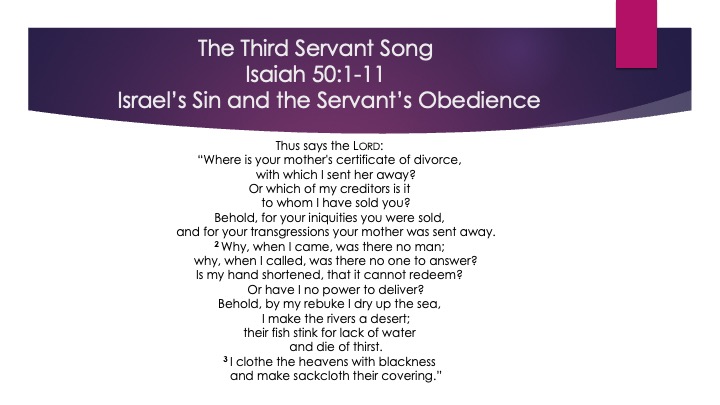
The Third Servant Song
Isaiah 50:1-11
Israel’s Sin and the Servant’s
Obedience
Thus says the Lord:
“Where is your mother's certificate of divorce,
with which I sent her away?
Or which of my creditors is it
to whom I have sold you?
Behold, for your iniquities you were sold,
and for your transgressions your mother was sent away.
2 Why, when I came, was there no man;
why, when I called, was there no one to answer?
Is my hand shortened, that it cannot redeem?
Or have I no power to deliver?
Behold, by my rebuke I dry up the sea,
I make the rivers a desert;
their fish stink for lack of water
and die of thirst.
3 I clothe the heavens with blackness
and make sackcloth their covering.”
4 The Lord God has
given me
the tongue of those who are taught,
that I may know how to sustain with a word
him who is weary.
Morning by morning he awakens;
he awakens my ear
to hear as those who are taught.
5 The Lord God has opened my ear,
and I was not rebellious;
I turned not backward.
6 I gave my back to those who strike,
and my cheeks to those who pull out the beard;
I hid not my face
from disgrace and spitting.
7 But the Lord God helps
me;
therefore I have not been disgraced;
therefore I have set my face like a flint,
and I know that I shall not be put to shame.
8 He who vindicates me is near.
Who will contend with me?
Let us stand up together.
Who is my adversary?
Let him come near to me.
9 Behold, the Lord God helps me;
who will declare me guilty?
Behold, all of them will wear out like a garment;
the moth will eat them up.
10 Who among you fears the Lord
and obeys the voice of his servant?
Let him who walks in darkness
and has no light
trust in the name of the Lord
and rely on his God.
11 Behold, all you who kindle a fire,
who equip yourselves with burning torches!
Walk by the light of your fire,
and by the torches that you have kindled!
This you have from my hand:
you shall lie down in torment.
Verses 1-3:
God challenges the despondency of his people. They feel abandoned, but “for your iniquities you were sold.”
Verses 4-9:
Servant of the Lord suffers to sustain others. “I gave my back to those who strike, and my cheeks to those who pull out my beard.”
Servant did not suffer because he was guilty but because others were guilty. For his innocence, God vindicates him.
Verses 10-11: Two possible responses to the Servant.
(1) Fear the Lord and obey the voice of the Servant.
(2) Walk by the light of their own wisdom and lie down in torment.
Some other observations:
Servant speaks in the first person in verses 4-9.
Servant is not the nation of Israel – they did not suffer because of their obedience but because of their rebellion.
Servant will reveal God through speech. His ears have been opened (v.5), and his tongue has been taught “how to sustain with a word him who is weary.” (v.4)
Declaring the message will bring on abuse (v.6), but servant will bear it because God will vindicate him in the end. (vv. 7-9)
Servant is not simply to be admired or wondered at, but to be obeyed. (vv. 10-11)
The Fourth
Servant Song Isaiah
52:13 – 53:12
He Was
Pierced for Our Transgressions
Frequently quoted in NT (e.g., Acts 8:26-40; 1 Peter 2:22-25)
Describes the servant in physical terms
Explains how the Holy One can bless sinful people – the suffering servant removes their guilt before God by his sacrifice.
Pay attention to the pronouns:
“I” = the Lord
“He” = the servant
“We/Us” = witnesses; believing remnant of Israel (Again, servant cannot be Israel.)
“This fourth Song is the most elaborate and poignant of them all. It is the jewel in the crown of Isaiah’s theology, the focal point of his vision.” Barry G. Webb, The Message of Isaiah
Five stanzas:
(1) 52:13-15: God’s wisdom revealed
(2) 53:1-3: Despised and rejected
(3) 53:4-6: Healed by his wounds
(4) 53:7-9: The sinless, silent sufferer
(5) 53: 10-12: Crowned with glory and honor
The Fourth Servant Song
First Stanza: God’s Wisdom Revealed
13 Behold, my servant shall act
wisely;
he shall be high and lifted up,
and shall be exalted.
14 As many were astonished at you—
his appearance was so marred, beyond human semblance,
and his form beyond that of the children of mankind—
15 so shall he sprinkle many nations.
Kings shall shut their mouths because of him,
for that which has not been told them they see,
and that which they have not heard they understand.
Servant appears repulsive but will be exalted.
“What is signified here is that, although our Lord performed miracles which bore witness to his divine powers, he was nevertheless marred, so that unbelievers could make no sense of it all.” John Calvin, Behold My Servant: Sermons on Isaiah 52:13-53:12
Servant will “sprinkle” many nations to make them clean, as Moses was to sprinkle blood on Aaron and his sons and their garments to purify them. Exodus 29:21
Kings (representing the nations) will be awed by his humiliation and glory.
The Fourth Servant Song
Second Stanza: Despised and Rejected
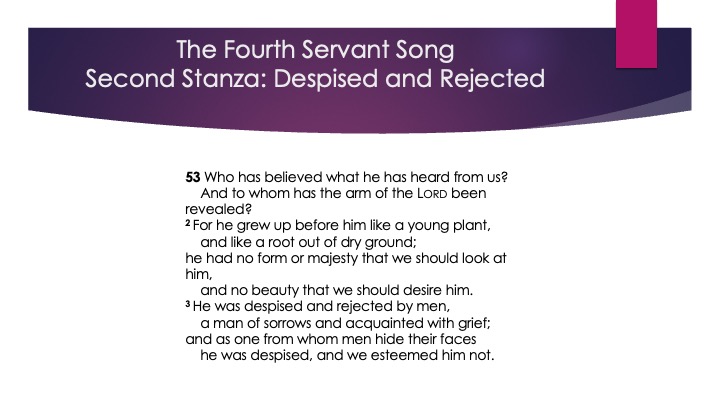
53 Who has believed what he has heard from us?
And to whom has the arm of the Lord been
revealed?
2 For he grew up before him like a young plant,
and like a root out of dry ground;
he had no form or majesty that we should look at him,
and no beauty that we should desire him.
3 He was despised and rejected by men,
a man of sorrows and acquainted with grief;
and as one from whom men hide their faces
he was despised, and we esteemed him not.
Servant lives in rejection. Unbelief is natural because he is an obscure, outwardly unimpressive person.
Witnesses believe he had shown promise at first, like a dead plant come to life. But the more he grew, the less impressive he became.
Even the witnesses – the believing remnant of Israel – turned their faces away.
The Fourth Servant Song
Third Stanza: Healed by His Wounds
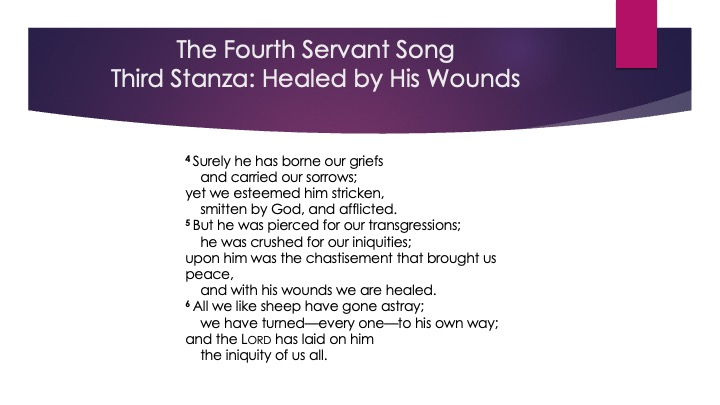
4 Surely he has borne our griefs
and carried our sorrows;
yet we esteemed him stricken,
smitten by God, and afflicted.
5 But he was pierced for our transgressions;
he was crushed for our iniquities;
upon him was the chastisement that brought us peace,
and with his wounds we are healed.
6 All we like sheep have gone astray;
we have turned—every one—to his own way;
and the Lord has laid on him
the iniquity of us all.
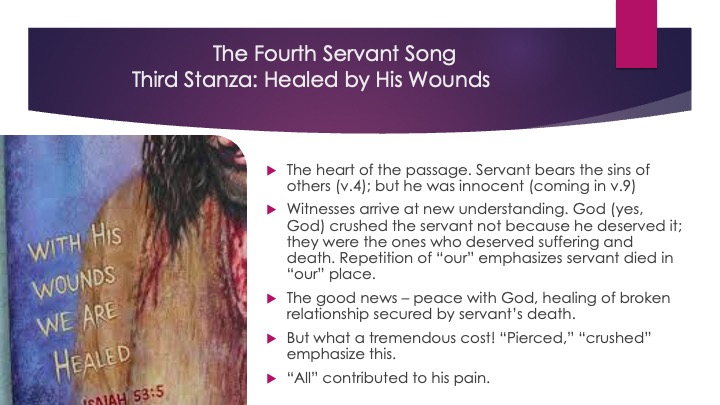
The heart of the passage. Servant bears the sins of others (v.4); but he was innocent (coming in v.9)
Witnesses arrive at new understanding. God (yes, God) crushed the servant not because he deserved it; they were the ones who deserved suffering and death. Repetition of “our” emphasizes servant died in “our” place.
The good news – peace with God, healing of broken relationship secured by servant’s death.
But what a tremendous cost! “Pierced,” “crushed” emphasize this.
“All” contributed to his pain.
The Fourth Servant Song
Fourth Stanza: The Sinless, Silent Sufferer
7 He was oppressed, and he was
afflicted,
yet he opened not his mouth;
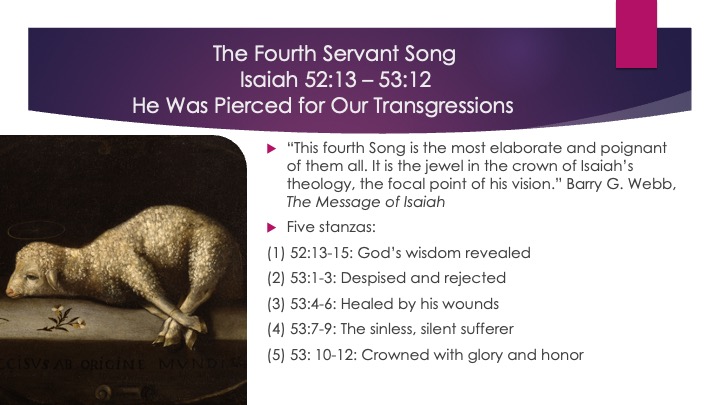
like a lamb that is led to the slaughter,
and like a sheep that before its shearers is silent,
so he opened not his mouth.
8 By oppression and judgment he was taken away;
and as for his generation, who considered
that he was cut off out of the land of the living,
stricken for the transgression of my people?
9 And they made his grave with the wicked
and with a rich man in his death,
although he had done no violence,
and there was no deceit in his mouth.
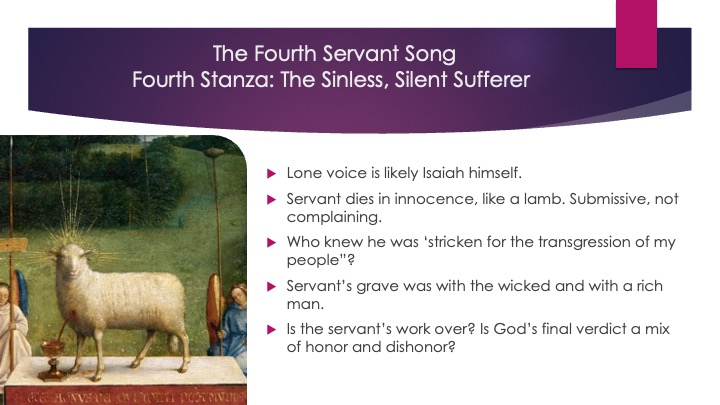
Lone voice is likely Isaiah himself.
Servant dies in innocence, like a lamb. Submissive, not complaining.
Who knew he was ‘stricken for the transgression of my people”?
Servant’s grave was with the wicked and with a rich man.
Is the servant’s work over? Is God’s final verdict a mix of honor and dishonor?
The Fourth Servant Song
Fifth Stanza: Crowned with Glory and Honor
10 Yet it was the will of
the Lord to crush him;
he has put him to grief;
when his soul makes an offering for guilt,
he shall see his offspring; he shall prolong his days;
the will of the Lord shall prosper in his hand.
11 Out of the anguish of his soul he shall see and
be satisfied;
by his knowledge shall the righteous one, my servant,
make many to be accounted righteous,
and he shall bear their iniquities.
12 Therefore I will divide him a portion with the many,
and he shall divide the spoil with the strong,
because he poured out his soul to death
and was numbered with the transgressors;
yet he bore the sin of many,
and makes intercession for the transgressors.
Servant was crushed, but victorious – both by the will of God. Suffered in body and soul (“an offering for guilt”).
Servant’s death was not the end of his career (“he shall see his offspring”).
“Therefore” (v.12): Servant’s sacrificial death explains his subsequent glory and eternal blessings of those who believe in him.
The one who was despised takes the place of a conqueror (“he shall divide the spoil”)
The Last Word
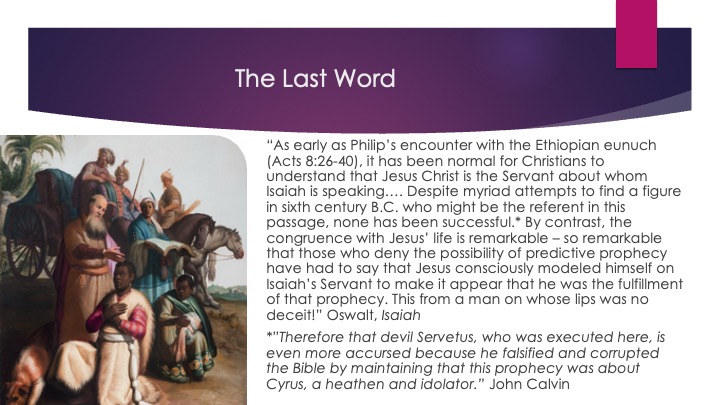
“As early as Philip’s encounter with the Ethiopian eunuch (Acts 8:26-40), it has been normal for Christians to understand that Jesus Christ is the Servant about whom Isaiah is speaking…. Despite myriad attempts to find a figure in sixth century B.C. who might be the referent in this passage, none has been successful. By contrast, the congruence with Jesus’ life is remarkable – so remarkable that those who deny the possibility of predictive prophecy have had to say that Jesus consciously modeled himself on Isaiah’s Servant to make it appear that he was the fulfillment of that prophecy. This from a man on whose lips was no deceit!” Oswalt, Isaiah
*”Therefore that devil Servetus, who was executed here, is even more accursed because he falsified and corrupted the Bible by maintaining that this prophecy was about Cyrus, a heathen and idolator.” John Calvin