Appointment with Destiny 6
Chris Knepp & Al Krummenacher
Appointment with Destiny 6
Links
<< Home >> << Appointment with Destiny Menu >>
Appointment with Destiny 6 - the Text
Appointment with Destiny 6 – The Text
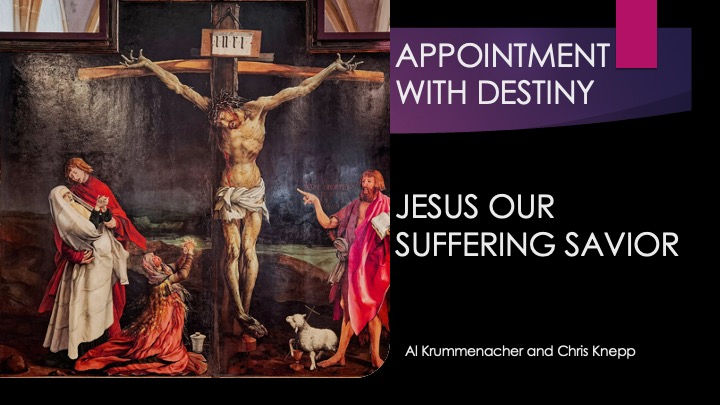
APPOINTMENT WITH DESTINY
JESUS OUR SUFFERING SAVIOR
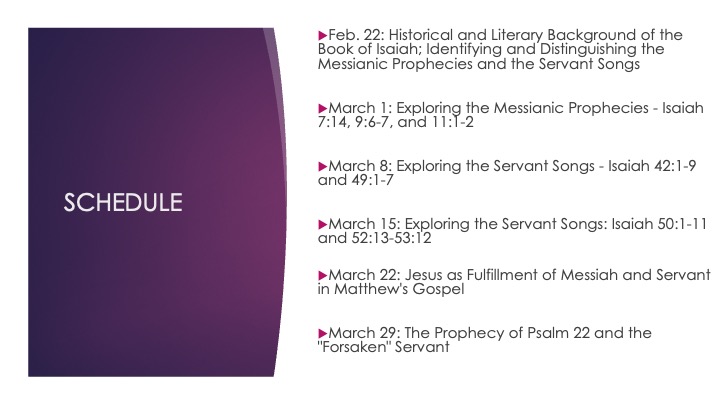
SCHEDULE
Feb. 22: Historical and Literary Background of the Book of Isaiah; Identifying and Distinguishing the Messianic Prophecies and the Servant Songs
March 1: Exploring the Messianic Prophecies - Isaiah 7:14, 9:6-7, and 11:1-2
March 8: Exploring the Servant Songs - Isaiah 42:1-9 and 49:1-7
March 15: Exploring the Servant Songs: Isaiah 50:1-11 and 52:13-53:12
March 22: Jesus as Fulfillment of Messiah and Servant in Matthew's Gospel
March 29: The Prophecy of Psalm 22 and the "Forsaken" Servant
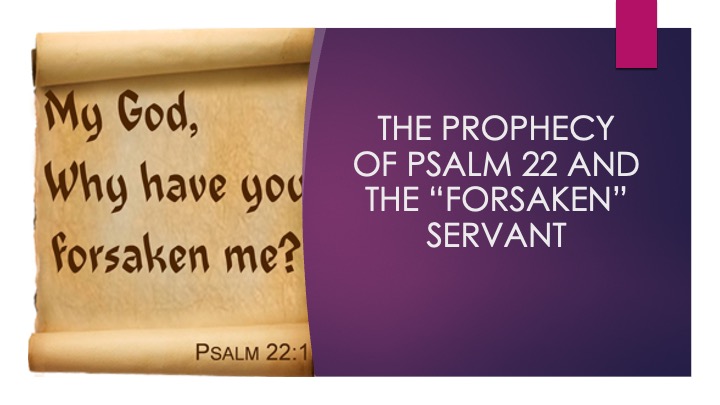
THE PROPHECY OF PSALM 22 AND THE “FORSAKEN” SERVANT
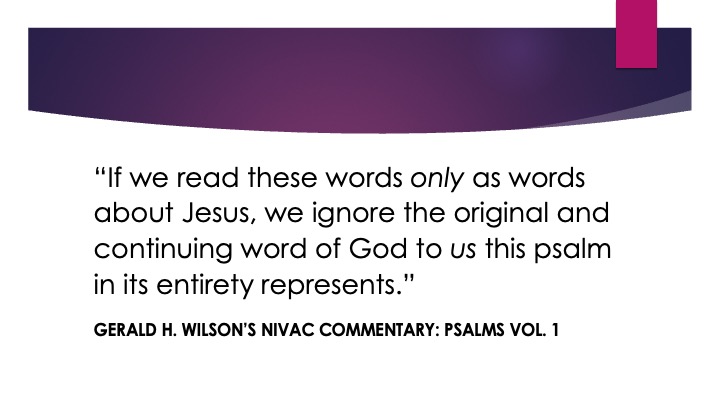
“If we read these words only as words about Jesus, we ignore the original and continuing word of God to us this psalm in its entirety represents.”
Gerald h. Wilson’s NIVAC commentary: Psalms vol. 1
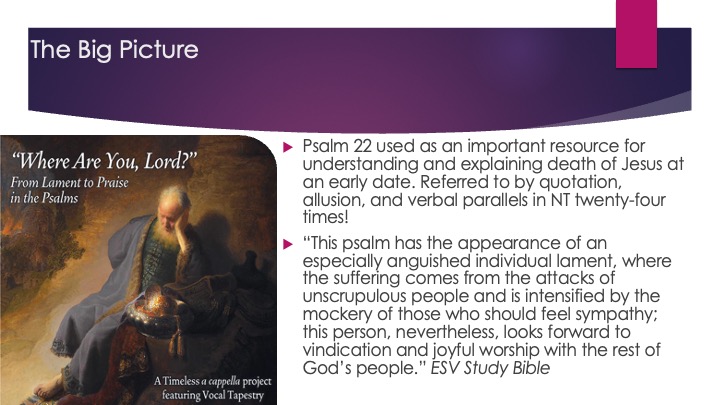
The Big Picture
Psalm 22 used as an important resource for understanding and explaining death of Jesus at an early date. Referred to by quotation, allusion, and verbal parallels in NT twenty-four times!
“This psalm has the appearance of an especially anguished individual lament, where the suffering comes from the attacks of unscrupulous people and is intensified by the mockery of those who should feel sympathy; this person, nevertheless, looks forward to vindication and joyful worship with the rest of God’s people.” ESV Study Bible
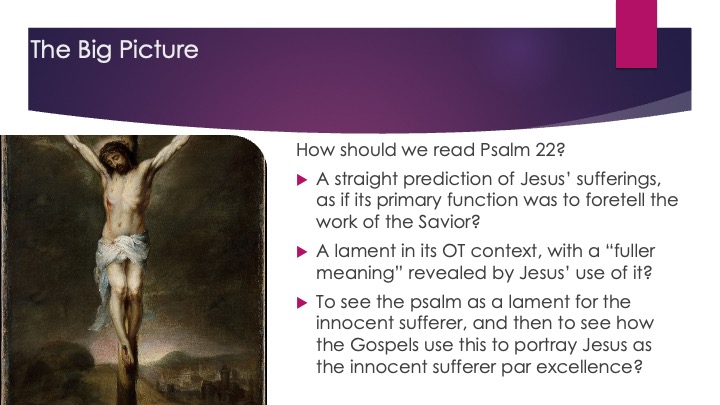
How should we read Psalm 22?
A straight prediction of Jesus’ sufferings, as if its primary function was to foretell the work of the Savior?
A lament in its OT context, with a “fuller meaning” revealed by Jesus’ use of it?
To see the psalm as a lament for the innocent sufferer, and then to see how the Gospels use this to portray Jesus as the innocent sufferer par excellence?
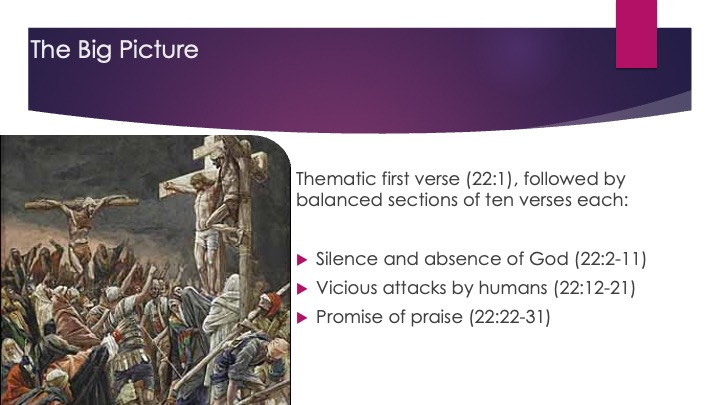
Thematic first verse (22:1), followed by balanced sections of ten verses each:
Silence and absence of God (22:2-11)
Vicious attacks by humans (22:12-21)
Promise of praise (22:22-31)
Psalm
22:1
Thematic Introduction
Psalm 22
To the leader: according to The Deer of the Dawn. A Psalm of David.
1 My God, my God, why have you forsaken
me?
Why are you so far from helping me, from the words of
my groaning?
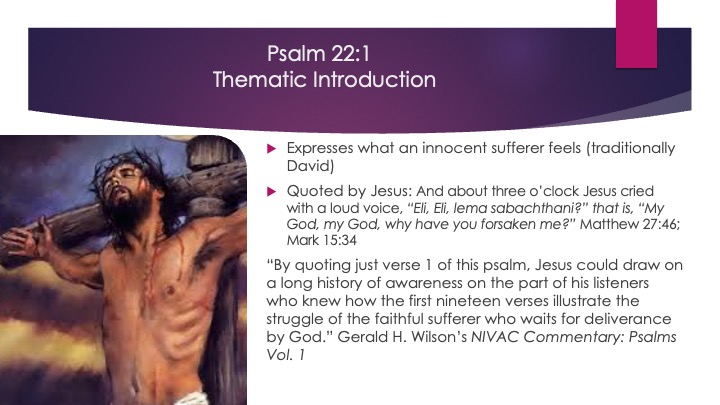
Expresses what an innocent sufferer feels (traditionally David)
Quoted by Jesus: And about three o’clock Jesus cried with a loud voice, “Eli, Eli, lema sabachthani?” that is, “My God, my God, why have you forsaken me?” Matthew 27:46; Mark 15:34
“By quoting just verse 1 of this psalm, Jesus could draw on a long history of awareness on the part of his listeners who knew how the first nineteen verses illustrate the struggle of the faithful sufferer who waits for deliverance by God.” Gerald H. Wilson’s NIVAC Commentary: Psalms Vol. 1
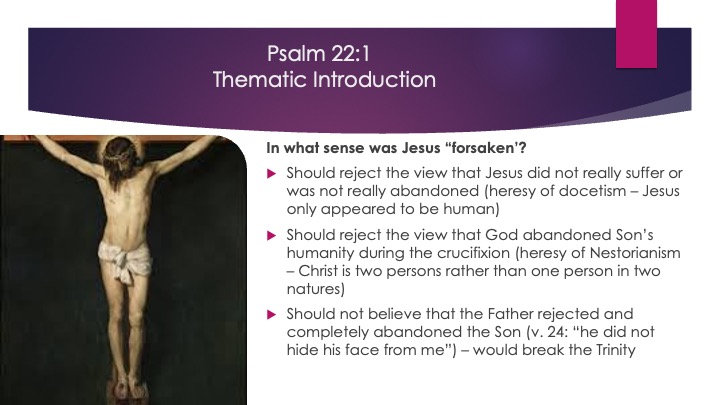
In what sense was Jesus “forsaken’?
Should reject the view that Jesus did not really suffer or was not really abandoned (heresy of docetism – Jesus only appeared to be human)
Should reject the view that God abandoned Son’s humanity during the crucifixion (heresy of Nestorianism – Christ is two persons rather than one person in two natures)
Should not believe that the Father rejected and completely abandoned the Son (v. 24: “he did not hide his face from me”) – would break the Trinity
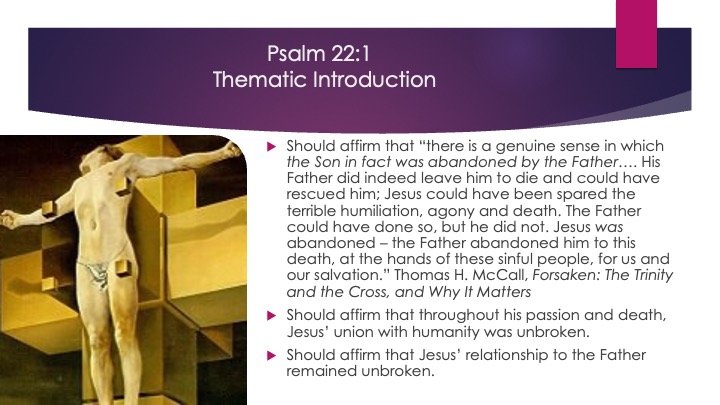
Should affirm that “there is a genuine sense in which the Son in fact was abandoned by the Father…. His Father did indeed leave him to die and could have rescued him; Jesus could have been spared the terrible humiliation, agony and death. The Father could have done so, but he did not. Jesus was abandoned – the Father abandoned him to this death, at the hands of these sinful people, for us and our salvation.” Thomas H. McCall, Forsaken: The Trinity and the Cross, and Why It Matters
Should affirm that throughout his passion and death, Jesus’ union with humanity was unbroken.
Should affirm that Jesus’ relationship to the Father remained unbroken.
Psalm
22:2-11
Silence and Absence of God
2 O my God, I cry by day, but you do not
answer;
and by night but find no rest.
3 Yet you are holy,
enthroned on the praises of Israel.
4 In you our ancestors trusted;
they trusted, and you delivered them.
5 To you they cried and were saved;
in you they trusted and were not put to shame.
6 But I am a worm and not human,
scorned by others and despised by the people.
7 All who see me mock me;
they sneer at me; they shake their heads;
8 “Commit your cause to the Lord; let him deliver—
let him rescue the one in whom he delights!”
9 Yet it was you who took me from the
womb;
you kept me safe on my mother’s breast.
10 On you I was cast from my birth,
and since my mother bore me you have been my God.
11 Do not be far from me,
for trouble is near,
and there is no one to help.
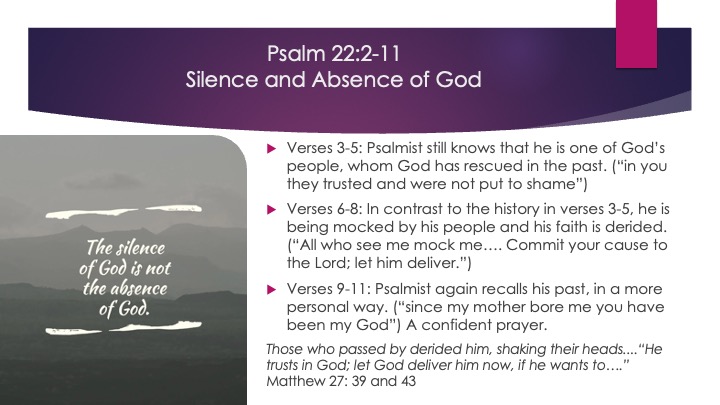
Verses 3-5: Psalmist still knows that he is one of God’s people, whom God has rescued in the past. (“in you they trusted and were not put to shame”)
Verses 6-8: In contrast to the history in verses 3-5, he is being mocked by his people and his faith is derided. (“All who see me mock me…. Commit your cause to the Lord; let him deliver.”)
Verses 9-11: Psalmist again recalls his past, in a more personal way. (“since my mother bore me you have been my God”) A confident prayer.
Those who passed by derided him, shaking their heads....“He trusts in God; let God deliver him now, if he wants to….” Matthew 27: 39 and 43
Psalm
22:12-21
Vicious Attacks by Humans
12 Many bulls encircle me;
strong bulls of Bashan surround me;
13 they open wide their mouths at me,
like a ravening and roaring lion.
14 I am poured out like water,
and all my bones are out of joint;
my heart is like wax;
it is melted within my breast;
15 my mouth is dried up like a potsherd,
and my tongue sticks to my jaws;
you lay me in the dust of death.
16 For dogs are all around me;
a company of evildoers encircles me;
they bound my hands and feet.
17 I can count all my bones.
They stare and gloat over me;
18 they divide my clothes among themselves,
and for my clothing they cast lots.
19 But you, O Lord, do not be far
away!
O my help, come quickly to my aid!
20 Deliver my soul from the sword,
my life from the power of the dog!
21 Save me from the mouth of the lion!
From the horns of the wild oxen you have rescued me.
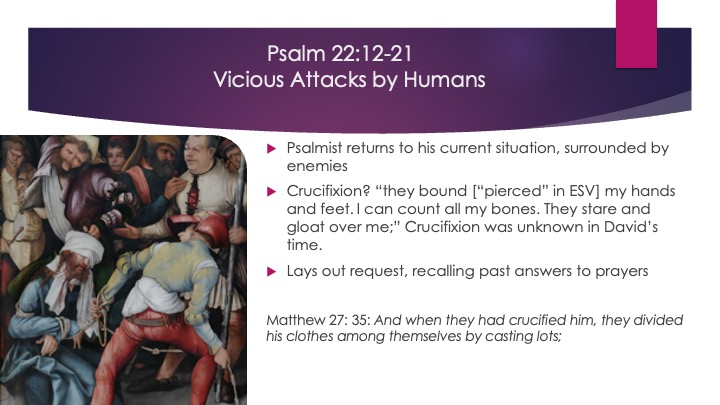
Psalmist returns to his current situation, surrounded by enemies
Crucifixion? “they bound [“pierced” in ESV] my hands and feet. I can count all my bones. They stare and gloat over me;” Crucifixion was unknown in David’s time.
Lays out request, recalling past answers to prayers
Matthew 27: 35: And when they had crucified him, they divided his clothes among themselves by casting lots;
Psalm
22:22-31
Promise of Praise
22 I will tell of your name to my brothers
and sisters;
in the midst of the congregation I will praise you:
23 You who fear the Lord, praise him!
All you offspring of Jacob, glorify him;
stand in awe of him, all you offspring of Israel!
24 For he did not despise or abhor
the affliction of the afflicted;
he did not hide his face from me
but heard when cried to him.
25 From you comes my praise in the great
congregation;
my vows I will pay before those who fear him.
26 The poor shall eat and be satisfied;
those who seek him shall praise the Lord.
May your hearts live forever!
27 All the ends of the earth shall remember
and turn to the Lord,
and all the families of the nations
shall worship before him.
28 For dominion belongs to the Lord,
and he rules over the nations.
29 To him, indeed, shall all who sleep
in the earth bow down;
before him shall bow all who go down to the dust,
and I shall live for him.
30 Posterity will serve him;
future generations will be told about the Lord
31 and proclaim his deliverance to a people yet unborn,
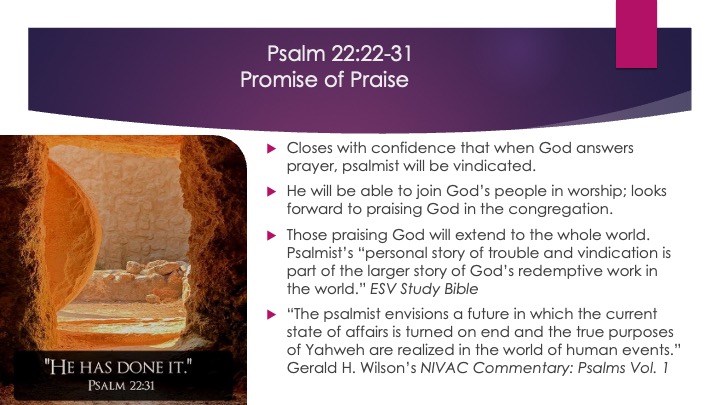
saying that he has done it.
Closes with confidence that when God answers prayer, psalmist will be vindicated.
He will be able to join God’s people in worship; looks forward to praising God in the congregation.
u Those praising God will extend to the whole world. Psalmist’s “personal story of trouble and vindication is part of the larger story of God’s redemptive work in the world.” ESV Study Bible
“The psalmist envisions a future in which the current state of affairs is turned on end and the true purposes of Yahweh are realized in the world of human events.” Gerald H. Wilson’s NIVAC Commentary: Psalms Vol. 1
The Last Word (from an OT scholar)
From Gerald H. Wilson’s NIVAC Commentary: Psalms
Vol. 1:
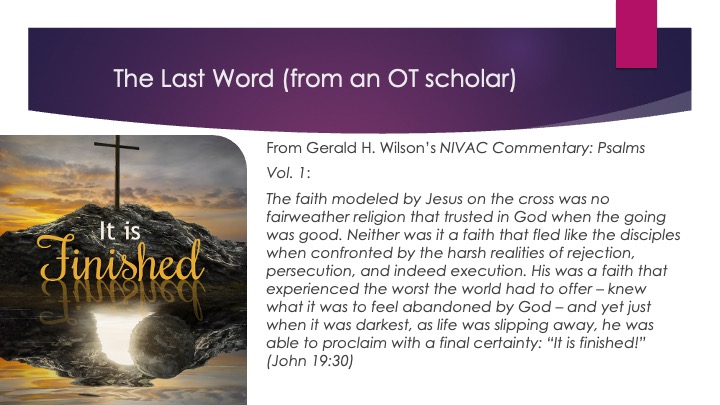
The faith modeled by Jesus on the cross was no fairweather religion that trusted in God when the going was good. Neither was it a faith that fled like the disciples when confronted by the harsh realities of rejection, persecution, and indeed execution. His was a faith that experienced the worst the world had to offer – knew what it was to feel abandoned by God – and yet just when it was darkest, as life was slipping away, he was able to proclaim with a final certainty: “It is finished!” (John 19:30)
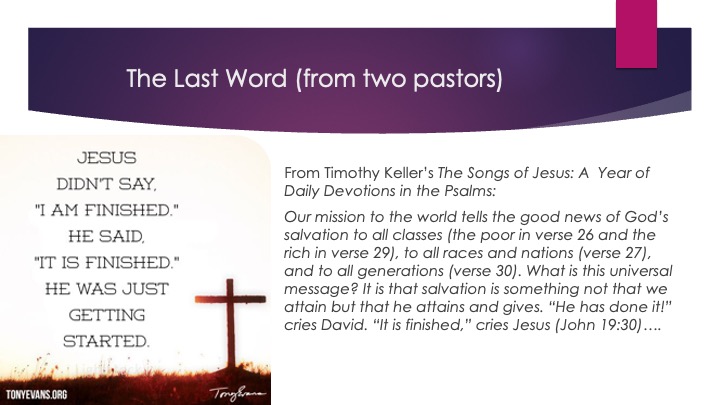
The Last Word (from two pastors)
From Timothy Keller’s The Songs of Jesus: A Year of Daily Devotions in the Psalms:
Our mission to the world tells the good news of God’s salvation to all classes (the poor in verse 26 and the rich in verse 29), to all races and nations (verse 27), and to all generations (verse 30). What is this universal message? It is that salvation is something not that we attain but that he attains and gives. “He has done it!” cries David. “It is finished,” cries Jesus (John 19:30)….
==================================================
(Tony Evans )
Jesus did not say “I am finished” He said “It is finished”
He was just getting started!